Showing posts with label Legal. Show all posts

Tuesday, June 23, 2020

The ACTUAL number of guns in public hands in the U.S.


The numbers often reported for how many guns were in civilian hands in the U.S. ... variously between 240 million and 400 million, depending on who reported on it when etc... are entirely and completely fictitious.

They're based on some polling data from the 80s, updated again in the mid 90s, and then extrapolated out.

They may have updated it again in the mid 2000s, I haven't been able to confirm either way... but even if they did, it's still a complete fiction.

This is also true of the estimates of the number of gun owners, and households with guns by they way... Which are also complete fiction (and I know they DID update those numbers in the last 5 years... for equally... or likely far MORE fictitious numbers).

Why do I say that? Simple... the numbers in question, are entirely based on self reporting, from a small sample size of self selected respondents... and they arent even broken out or controlled for by state, by rural or urban residence, political opinions or affiliations etc...

They called a few hundred people up on the phone, and asked if there were guns in their household, and how many. From there they made some statistical assumptions, and then multiplied out.

So... If you're a gun owner, and someone from a gun control lobby, or the government, or some random polling agency... who may be a criminal trying to scope out targets for all you know... called you up and started asking questions... Exactly how likely would you be to tell them you owned guns at all, never mind exactly how many guns you owned?

For that matter... How accurate have polls been about politically sensitive topics the last... forever really, but particularly the last oh... 23 years? The last 15? The last 8?

Mostly, they have been reporting something like 300 to 350 million... and they have been reporting something close to that as the number since the late 80s... Except in that time period, we've actually made and sold more firearms than that just domestically, never mind the tens of millions we have imported.

The real numbers are impossible to accurately determine, but at least as far as the total number of firearms, it is almost certainly at least 3 or 4 times the highest estimates I've seen reported.

We manufactured 14 million guns in this country for the civilian market last year, and imported 4 million more... as well as manufacuturing about half a million for civilian market export.

That's 18 million guns added to the marketplace in a single year.

We also manufactured between .5 and .7 million small arms for our own military and government, and another 1.7-2.4 million for military/government export (it's unclear as to exact numbers, because such contracts are spread out over multiple years) to friendly foreign powers.

There hasn't been a year since 1968 (when detailed statistics started being kept) that we haven't manufactured at least 5 million firearms, or imported less than 2 million... adding at least 7 million firearms to the market.

... over the almost 5 years in question, that would account for the total of reported estimates, all by itself... But actually, the numbers are FAR higher.

There hasn't been a year since 1994 that we haven't added at least 9 million guns to the market.

There hasn't been a year since 2001, that we haven't added at least 12 million.

Since 2009, it's been at least 14 million a year.
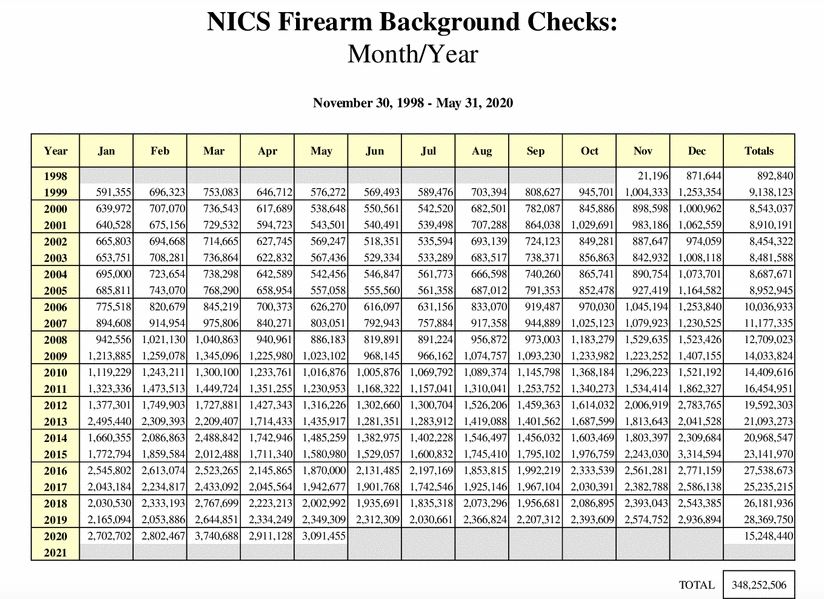
June 2020 update: The FBI reports there have been appx. 350 million NICS checks since the end of 1999, and every year since 2013 has been 20 million or more, every year since 2015 is 25 million or more. NICS checks numbers only capture approximately 40% of total sales... they don't include personal transfers in most states, they don't account for multi-firearm transactions (approximately 15% of all NICS transactions are multi-gun transactions), nor for transactions that don't require a NICS check (many states don't require NICS checks for people who already have concealed weapons permits, or for active law enforcement officers etc... 
And of course, that doesn't include the hundreds of millions that were manufactured between 1899 and 1968 (under most circumstances, the federal government doesn't consider guns made from the beginning of time, through December 31st 1898 to be firearms... though firearms capable of firing modern ammunition have been made since the 1870s...

Some states may vary, and there are special rules for machine guns, short barreled rifles and shotguns, guns that don't look like guns and the like, as regulated under title II of the national firearms act of 1934).

It also doesn't include the tens of millions of former military firearms that the government decommissioned and sold to the civilian market (m1911 .45acp pistols, 1903 Springfield and m1 garand rifles in .30-06, and m1 carbines in .30 carbine mostly).

Guns don't "go bad" with age, or generally wear out in ways that aren't easily fixed, so long as they are properly stored and maintained.

I personally own guns that old... 1891 that is, so 125 years old... that work just fine thanks.

... Clearly, we've added more than 350 million new guns to the public marketplace, in just the last 20 or so years, never mind all the firearms made and sold in the 100 years before that. 

So, like I said... the real number? At least 800 million on the conservative side, and I'm inclined to believe it's closer to 1 billion... maybe as much as 1.2 or 1.4 billion.

Wednesday, October 09, 2013

Bye Bye 4th and 5th amendment; Obamacare info may be used for Law Enforcement and Audit activities

Well... we knew that the 4th and 5th amendment meant nothing to them... never mind HIPAA... but really?

  Obamacare Marketplace: Personal Data Can Be Used For ‘Law Enforcement and Audit Activities'
Maryland's Health Connection, the state's Obamacare marketplace, has been plagued by delays in the first days of open enrollment. If users are able to endure long page-loading delays, they are presented with the website's privacy policy, a ubiquitous fine-print feature on websites that often go unread. Nevertheless, users are asked to check off a box that they agree to the terms. The policy contains many standard statements about information automatically collected regarding Internet browsers and IP addresses, temporary "cookies" used by the site, and website accessibility. However, at least two conditions may give some users pause before proceeding. The first is regarding personal information submitted with an application for those users who follow through on the sign up process all the way to the end. The policy states that all information to help in applying for coverage and even for making a payment will be kept strictly confidential and only be used to carry out the function of the marketplace. There is, however, an exception: "[W]e may share information provided in your application with the appropriate authorities for law enforcement and audit activities." Here is the entire paragraph from the policy the includes the exception [emphasis added]:
Should you decide to apply for health coverage through Maryland Health Connection, the information you supply in your application will be used to determine whether you are eligible for health and dental coverage offered through Maryland Health Connection and for insurance affordability programs. It also may be used to assist you in making a payment for the insurance plan you select, and for related automated reminders or other activities permitted by law. We will preserve the privacy of personal records and protect confidential or privileged information in full accordance with federal and State law. We will not sell your information to others. Any information that you provide to us in your application will be used only to carry out the functions of Maryland Health Connection. The only exception to this policy is that we may share information provided in your application with the appropriate authorities for law enforcement and audit activities.
The site does not specify if "appropriate authorities" refers only to state authorities or if it could include the federal government, as well. Neither is there any detail on what type of law enforcement and/or audit activities would justify the release of the personal information, or who exactly is authorized to make such a determination. An email to the Maryland Health Connection's media contact seeking clarification has not yet been answered The second privacy term that may prompt caution by users relates to email communications. The policy reads:
If you send us an e-mail, we use the information you send us to respond to your inquiry. E-mail correspondence may become a public record. As a public record, your correspondence could be disclosed to other parties upon their request in accordance with Maryland’s Public Information Act.
Since emails to the marketplace could conceivably involve private matters regarding finances, health history, and other sensitive issues, the fact that such information could be made part of the "public record" could prevent users from being as free with their information than they might otherwise be. However, as noted, any requests for such emails would still be subject to Maryland's Public Information Act which contains certain exceptions to the disclosure rules.
Read the fine print eh?

 These are such clear 4th and 5th amendment violations I can't believe anyone didn't immediately say "uh guys... we cant actually do this"...

... but as I said, we know that our elected and selected "lords and masters" don't give a damn about the 4th or 5th amendments (or really any of the others ones any time they become inconvenient).

So while I'm sure they were told they couldn't do it, I'm sure they said "ahh well the disclaimer and release is enough, we'll be fine".

 Yeah no.

 And as far as HIPAA goes... In reality these terms of use are not anywhere near an adequate HIPAA disclosure release, so using any of this data in any manner other than for healthcare purposes would be a federal offense.


Tuesday, September 24, 2013

Not Proven

There's an interesting practice in Scottish law, which isn't a part of either English or Northern Irish law... or for that matter, to my knowledge, any other code of laws in the world.

It comes from a particular concept of Presbyterianism (and Calvinism as a whole), in that one must not utter a false statement in Gods name (to do so is bearing false witness).

This has a particular effect on court proceedings, as the Presbyterian Kirk of Scotland, is the official (but not established) church of Scotland. Courts and juries are (or at least were... not sure if it's still done) sworn to deliver their verdicts in Gods name, and trials are conducted under and by the grace of God.

Because of this, in Scotland, as in no other nation on earth, there are in fact three possibly final verdicts for a completed case:

Not Guilty - The accused did not commit the crime, and is not legally responsible for it.

Guilty - The accused committed the crime and is legally responsible for it.

Not Proven - The accused likely committed the crime, but there is insufficient evidence to prove this beyond reasonable doubt.
Note: In fact, although Calvinism as a whole is Swiss in origin, the Presbyterian movement and church (technically churches, as they are individual and separate churches in each nation, under the auspices of the general assembly of the Presbyterian Polity), was founded in Scotland. I can't find if "not proven" was ever an element of Swiss law, but I know that it is not now.
The verdict of "not proven" is still an acquittal... it's just an honest one "We think you did it, but we can't prove it, so we're not sending you to jail... but we still think you did it".

The only reason this third verdict exists, is because of this precept that finding someone not guilty, when you know them to be guilty but cannot prove it, is an offense against God. It's uttering a false statement in Gods name.

I really think it's a useful concept though, even without the idea of God being involved.

Oh and the right of juries to bring in a "not guilty" verdict for a charge which is proven beyond a reasonable doubt, but for which the jury believes the accused holds no guilt, or that there was no true crime (malum prohibitum vs. malum in se; or crimes where mens rea and negligence were absent); is an explicit, and sacred, assumption of Scottish Law.

Again, because if you truly believe no crime was committed, then it would be an offense against God to declare a man guilty of one.

...And again... I think this is a very useful concept.

Here we call it Jury Nullification, and it's generally frowned upon. In Scotland, it's just "the way it is and should be".

Unfortunately, the parliamentary commission reviewing Scottish law and practices is trying to get rid of these; to bring Scotland in line with law around the U.K. and the EU.

Actually, they've more or less officially got rid of the latter... but Scottish juries still regularly return "not guilty" verdicts, for charges that are fully proven, but which they believe are not crimes, or for which there is no "guilt".

After all, you can't be guilty of something that wasn't wrong in the first place can you.

Something I think our own courts might be better off taking into account...


Sunday, December 02, 2012

Jesse James and Danny Trejo, commit multiple felonies, with machine guns, on film

A few years ago, I wrote a piece (which is still among my most viewed posts) about how Mark Wahlberg was technically not a felon, and therefore the actual shooting training he has done to support his action movie career, was in a legal gray area.

For those who don't know (hello google searchers), it is illegal in the entire United States (under federal law, as well as state laws in every state) for a felon of any sort to buy, own, receive, possess, operate, or handle a firearm or ammunition.

It is also a felony for any person to transfer, provide, or allow access to any firearm; to any person whom they know, or should reasonably know, is a felon, or otherwise a prohibited person (domestic violence conviction, restraining order, drug addict, fugitive from justice, illegal alien etc.. All are lawfully considered "prohibited persons" who cannot possess firearms).

There are actually a hell of a lot of felons (usually drugs, occasionally white collar crime) in the film industry; including a fair number of stuntmen, and actors in B grade action movies (and even a few big name stars, though usually they manage to avoid felony charges).

Sometimes, they fire guns, on film.

Isn't that illegal?

Well, yes, it is...

But it's Hollywood...

Hollywood gets around the illegality of this under the rather tissue thin veil of "prop" guns used in theatrical performances. Many of those props are in fact legally fully functioning firearms; but since you can't easily tell the difference on film, and because Hollywood can make a big stink (and they donate a lot of money), the FedGov doesn't make an issue out of it.

Note: The ATF actually DOES hassle the prop houses that build and maintain these film weapons... In fact, they've hounded many of the smaller suppliers out of business; and occaisonally even go after the big guys (one of the largest prop suppliers went through massive difficulties a few years ago). 

Anyway, that's Hollywood movies, where there is that whole tissue of protection.

Jesse James, the motorcycle and custom car fabricator and reality TV star, is also a very avid firearms collector. In fact, hes even a collector of fully automatic weapons; the most highly regulated weapons in the country.

Jesse himself has had some trouble with the law, spending a few months in jail (or juvenile detention) while he was a teenager, and having caught a few minor assault charges in his teens and twenties; but he has never been convicted of a felony or offense that would prohibit him from owning firearms. He has also had his juvenile record expunged (required to become a licensed and bonded security guard in states that license them, which Jesse was for several years before founding his fabrication company).

It's actually very difficult to own a machine gun in the United States. It requires an extensive federal background check conducted by the FBI and ATF, which can take more than six months; as well as the sign-off of your local chief law enforcement officer (usually your county sheriff), in order to buy or receive one.

I'm actually surprised that, given his history, he hasn't had problems in getting his class III items (industry term for specially regulated guns like machine guns) transferred; but since his only serious offenses were juvenile  and have been expunged, legally it's as if they never happened (though people who've had their records expunged often still have problems with transferring firearms).

Jesse also has a concealed carry license in Texas; which again, requires a very stringent background investigation, and a training class.

Anyway, Jesse has been into guns for a long time, has taken a number of firearms training courses, collects highly regulated weapons, and he's well known for shooting and playing with lots of cool guns on his TV shows.

He's not a novice. He should, in theory, know what he's doing

Even if they didn't know from any other source,  anyone who has ever bought a gun from a licensed dealer knows that it is illegal for a prohibited person (including felons as I said above) to buy, own, or posses a firearm... it's right on the form you fill out for your federal background check (required for all purchases from a licensed dealer).

Further, Jesse's ex-wife (porn star Janine Lindemuller) is a convicted felon, and as part of their divorce, James needed to deal with guns and his wife (it can be illegal to even have guns in the same house as a felon, if the felon can gain access to the guns).

There are no circumstances under which Jesse could claim that he didn't know it was illegal for a felon to touch a gun; or for someone to give a felon a gun, even temporarily, even just to shoot under your own supervision.

On an episode of his new reality TV show "Jesse James Outlaw Garage" aired a few weeks ago, Jesse had action movie star Danny Trejo over to his ranch in Austin, to go shooting.

During this meetup, Trejo fired numerous firearms (owned by James) on film, including several fully automatic weapons (machine guns), and suppressed weapons (the industry term for what most people know as silencers). James was shown handing Trejo firearms (including automatic weapons) on film.

There's a major problem with that...

Danny Trejo is a multiply convicted felon, who served 11 years in prison for drug possession,  robbery, assault, and attempted murder (which he committed at age 17).

Trejo has been friends with James for something like 20 years, having met in the late 80s or early 90s while Trejo was taking occasional security and bouncer jobs in between minor roles in action movies and B movies; and Jesse was working those same jobs before opening his own shop.

Trejo is very open about his history; talking frequently about his problems with drugs, alcohol, and gangs that led him to prison; and the 12 step program of recovery and turning to god, that saved his life in prison, and motivated him to become successful since.

Trejo is, by all reports, a genuinely good guy. He has a large family which he spends a lot of time with (he's 68 years old, and has several grandchildren from his three sons and two daughters). He does a lot of charity work, and is an advocate for rehabilitation; often speaking to church groups, homeless groups, gang outreach programs etc... He has certainly turned his life around, and is not a danger to society.

If there is any formerly violent felon who deserves to have his rights restored, it's Danny Trejo. There is really no reason why he shouldn't be allowed to shoot and own guns.

Unfortunately, it's still a felony for him to do so; and a felony for anyone to give him the guns to do it with.

It is possible under some circumstances for a felon to have their firearms rights restored; by having their records expunged, or by receiving a pardon and going through a rights restoration process with the FBI and ATF (they generally refuse to conduct this process without direct intervention of a congressman, claiming that they are not funded to do so, but they also refuse any offer to pay for the process... but that's a separate issue). TV and movie star Tim Allen went through this process a few years ago, so he could own guns and hunt again (he spent two and a half years in prison in the early 80s, for selling cocaine).

Unfortunately, Trejo has not had his record expunged, nor has be been pardoned, and his rights have not been restored.

Also, I'm certain there was no genuine criminal intent here, which SHOULD be an element of any crime; nor was any injury or any danger to any person or to society created, which should be a pre-requisite for any felony.

Unfortunately, that is not how our government chooses to interpret and enforce the law.

So, Jesse James and Danny Trejo just committed multiple state and federal felonies, which could result in prison sentences of up to 25 years, and fines running into the hundreds of thousands of dollars; on film, and broadcast to an entire nation.

... and this time, there isn't that thin tissue of "props" used in a "theatrical performance" to protect them.

Usually, Hollywood  gets a pass on this sort of thing; but I think there's a pretty good shot that Jesse James is going to see some legal repercussions here. The ATF LOVES to get press attention, and some folks online are already making noises about "special treatment for celebrities etc...

On  the one hand, I don't believe that someone like Trejo should be prevented from owning or shooting firearms...

On the other hand, my belief is irrelevant, and the law is what it is. If I did something like that, and was stupid enough to film it and put it up on say, youtube... I'd be going to jail. Special treatment for the wealthy or famous.. or really any kind of selective enforcement... is the worst kind of perversion of the justice system, effectively creating a special class of citizen.

Hell... maybe James and Trejo can be the test case for reformed felons having their rights restored.

Wednesday, April 04, 2012

How far we have fallen...

Crossposted from The Liberty Papers, where I am a contributor:

Reading these point/counterpoint posts on the question of how the supreme court would decide on Obamacares constitutionality, was quite disturbing to me in several ways.

On the one hand I was heartened, because clearly both Brad and Doug are sane and rational folks with a reasonably solid background in both law and politics, and a foundational understanding of the constitution…

Of course, that only highlights how many people in this country are not.

Any reading of the constitution… of the very intent of the founding of this nation… makes it clear that our federal government is meant to be one of of limited and enumerated powers. If the government can mandate this, they can mandate anything. This is the fundamental argument about the necessity for a limiting principle to any government act.

And anyone who doesn’t want unlimited, unconstrained government can see that. Sadly, it seems that the idea of unlimited, unconstrained government is quite popular in some quarters… even with some supreme court justices.

The basic liberal/progressive/leftist argument for socialized medicine is “we should do this even if it IS illegal and unconstitutional, because it’s the right thing to do so the supreme court should uphold it”.

I.E. “It’s good because we want it, and therefore it should be legal because it is good; and we need to get rid of this whole “limited government” thing, because it gets in the way of us doing what is right and good.”

What I also find heartening is that both Brad and Doug both seem to have a good sense of all of this…

But that is also disturbing…

Because both of them seem to share the same actual opinion:

Both believe that Obamacare is ACTUALLY unconstitutional, and should be struck down…

…It’s just that Brad is cynical enough about the supreme court and the political aspects of the decision that he thinks enough justices will be able to argue themselves into ignoring the constitution and doing what they want to do, rather than what is right.

… and Doug believes that there’s a good possibility of that as well; he just has a bit more hope that they won’t.

… and if you look around the commentariat, that’s pretty much the split of positions that every other knowledgable observer has as well.

And if that isn’t disturbing to you, then you really have no idea what is going on, do you?

Tuesday, January 25, 2011

The implication of this number...

My good friend over Traction Control posted up the 2010 NICS check numbers here:

http://tractioncontrol.well-regulatedmilitia.org/?p=9540

Just a quick check of the relevant numbers leaves a rather significant implication in ones mind...

There were approximately 14 million approved NICS checks in the U.S. last year (There were about 14 million checks, over 99% of which were proceeds or proceed after delay. less than 1% of NICS checks are denied... actually in most years it's less than .1 percent).

There are approximately 280 million non-prohibited persons over the age of 18 in the United States.

In most states, CCW holders are not required to go through a NICS check. There are at least 2 million of those in the U.S.

Each NICS check can include multiple firearms. There are no good numbers as to the average number of guns sold per transaction, various sources place it somewhere between 1.05 and 1.1... but obviously, it is a number greater than 1(discounting the very small number of checks that involve no firearm being sold, or people claiming their guns from pawn etc...)

That means the absolute minimum number of firearms sold in the U.S. last year is a little more than 14 million; or approximately one out of every 20 people over 18.

Oh and that's almost exactly the same number of guns sold in the U.S. in 2009; again, one for every 20 people over 18.

In fact, in the entire history of the NICS system there have never been less than 8 million approved transactions in a full year.


We can't really estimate how many of those are used guns, vs. new guns; because the firearms industry doesn't report on new gross unit sales, so it doesn't necessarily mean that there are 14 million NEW guns (and of course, no-one knows anything about private sales... But I'd guess it's somewhere around half and half new and used).

...and guns dont expire, go bad, or in general wear out.

Oh and there were 14 billion rounds of ammunition sold in the U.S. last year, to go with those 14 million guns.

Those gun owners who admit to pollsters that they own guns, average 4.4 guns per.

Lets assume that there is a useful life for a gun of 50 years... It's certainly much more than that, but let's set that arbitrary limit.

Somehow, I think the often bandied about number of 240 million guns for 80 million gun owners, is a bit low... I think it's an absolute minimum of about 400 million, and 100 million.

Thursday, September 30, 2010

Going Back to Court on October 28th

To get the full custody petition and motion to set aside the order heard.

Ought to be interesting.

Thursday, September 09, 2010

The Only Difference That I See

Is pretty much, well, everything.

The last time the kids were taken from me was December 4th, 2004.  I had just turned 24 and I was in complete shock, stranded in a foreign city with close to no money, no support, completely alone.  My only support network was my immediate family, who proceeded to freak out more than I did, and the guy I was seeing at the time who REALLY did not get it.  I had no money for a lawyer, barely had money for lodging and food, and had no idea what I was doing.

I still managed to get the kids back.

This time is a bit different.

This time, I have Chris whose role as my rock should never be understated.  I have a network of friends behind me, including many that I have met through this blog.  I have income.  I have a lawyer who, while he cannot take this on right now due to his schedule is busting his ass to find me counsel just as good as he is.  I have money to pay for a lawyer and a means to continue the fight.  My family still freaks out, but I can handle it better now.

I am far more confident, and competent, at 29 than I was at 24.  I owe this in large part to the gun rights community who pulled me out of my shell, good friends I can lean on, and a husband that keeps me sane.

Everything is different, including me.

I kicked ass before.  Only imagine what I can do with so many people behind me.

Never give up, never surrender.

Mel

Saturday, September 04, 2010

We've TEMPORARILY Lost Our Children

Copied from the Guncounter thread, mostly because I just don't have the heart to rehash it this morning.

Never let your case be argued before a judge at 3:30pm the Friday before a long weekend.

Mel went to court today to stop enforcement of a fraudulently obtained order from 2006 issued by a Canadian court, to surrender the children to their biological father.

This order was obtained by their father by alleging custodial kidnapping. He deliberately did not serve notice of the hearing for the order to Mel, and the order was obtained ex parte. Further, there had been no judgement of custody at the time, and the residential agreement in place had not been violated, so there was no valid cause for the original order to be issued.

We went to U.S. federal court and won on this very issue. The 9th circuit declared that there had been no parental misconduct, no custodial violation had occurred, that there was no kidnapping, and that no valid custodial agreement was in place.

We went into court today with clear evidence this order was obtained fraudulently, including a federal court ruling from the 9th circuit that it was invalid; and that enforcing the order was not in the best interest of the children (which according to the UCCJEA, federal law, and Idaho state law is supposed to be the highest authority in all matters regarding children).

We also went in with evidence Mels ex committed perjury, which he admitted to on the stand. That he has effectively abandoned the children, that he has made no attempt at contacting them in over two years...

That doesn't help when the judge refuses to hear arguments or accept evidence.

The judge decided that she had to enforce this fraudulent order on its face, because she didn't have authority to do otherwise (which is not true), and literally would not hear any arguments or evidence to the contrary. She heard the opposing councils argument, and accepted his cites, and then not just ignored ours, but refused to enter them into evidence.

The judge acknowledge that what she was doing was not in the best interests of the children, but that she didn't believe she had the authority to do otherwise. She also refused to ensure access provisions for the children, as there is now no residential agreement, no custodial determination, and no access agreement in place. Again, she said she did not have the authority.

It was clear she wanted to get out of there as soon as possible. She even told opposing council "just write the order and I'll sign it".

We asked for an emergency stay so we could appeal, and she refused to hear the request, stating again she didn't believe she had the authority.

Shortly after I publish this post we will be taking the kids to the police station to surrender them to Mels ex husband.

Now the fight moves to Canada.

We turned over the kids at 5:30 yesterday.

I'm already attempting to move heaven and earth in order to get something filed in Canada NOW.

I already know what the bulk of the comments will be, so there's two things we need:

1. a place to stay along the I-5 corridor in northern Washington for the court appearances, preferably for both me and Chris as he can work anywhere there's an internet connection.


2. a place to stash my firearms in northern Washington before I cross the border.

Thanks,

Mel

Saturday, August 28, 2010

Back to Court

I'm heading back to court on Friday.  This will be the 7th court I've been to, for those of you who are counting.

The issue at hand is whether or not Idaho will enforce a 4 year old court order forcing me to take the kids back to Canada, an order than happened without my knowledge due to a hearing without my knowledge.  I don't have a lawyer this time, as the cash hasn't become available (we don't have a boat either, for those of you who will point that out, that deal is long gone).  The opposition has two lawyers appearing at this hearing.

We're tired, cash poor, and fighting someone who hasn't even bothered to contact the children for just shy of 2 years.  I don't have much faith in the legal system left.  Maybe I'll be proven wrong there.

Mel

Wednesday, June 30, 2010

Yes, the Second Amendment really means what it says... and that means you too Chicago

This past Monday, Samuel Alito, writing for the majority (with separate concurring opinions from Clarence Thomas and Antonin Scalia) in the case McDonald vs. City of Chicago and Village of Morton Grove; handed down what in 30 years will I believe, be held as one of (or perhaps half of a pair of, or the second in a series of) the most significant rulings in the courts history, not just for the right to keep and bear arms, but for the rights of all people in this nation.

I had meant to get this post out yesterday, but I had to take the time to read the entire opinion... all 214 pages of it... and think about it for a bit.

This judgment is notable, both for what it does, and for what it does not do; and I want to go into that in some depth... and I want to go into some of the background and issues surrounding the decision that aren't necessarily about the right to keep and bear arms

However, that is going to get long.... and if you aren't interested in constitutional law and the nature and exercise of the rights and powers of the states, it's going to be boring. There's only so much you can do to make enumeration and separation of powers issues over more than two hundred years, all that interesting.
Note: Also, for those of you who DO closely follow con law, this is going to be a gross simplification in some ways. I don't have time to write a book here, and a book is what it would take to cover this comprehensively (actually several... there are a few out there already, and Heller and its progeny are sure to generate more).

At any rate, I'm going to break it out into another posts, and I'll update this post with a link when I finish the other one.

... I should warn you, I'm already 5,000 words in, and I'm probably less than half done...


McDonald vs. Chicago is the first major gun rights case brought before the supreme court under the clarified Heller doctrine, to wit:
The right to keep and bear arms for all lawful purposes is an individual right, possessed by all citizens and lawful residents of this country (provided this right has not been statutorily stripped from them, with due process of law); and the core of that right, is the fundamental right to defense of self, and others.

Actually, McDonald is a bit more than just "first"... In fact, the case was prepared in advance, and filed immediately on the handing down of the Heller ruling; by the lead counsel on the Heller case, Alan Gura.

The issue at hand in Heller was to affirm and clarify the basic right; something which those on the left in general, and in the gun control lobby in particular, had been trying to deny for something like the last 40 years.
Note: The modern gun control movement as currently constituted really began in the late 60s; roughly coinciding with accelerating decay of civil order and rise in civil unrest, the rise of the drug and counterculture, and dramatically rising crime rates.

More than anything else, it was the assassination of Robert Kennedy, and Martin Luther King that kick-started the gun control movement as it exists today.

The gun control movement in the U.S. as a whole has its roots in racial discrimination against immigrants in the pre-civil war northern cites, and blacks in the post civil war south.

Up until the late 1950s, the left as a whole actually advocated gun ownership, as a bulwark against the state... a position generally ascribed these days to the "far right"; but as the left post 1932 increasingly BECAME the state, their position on civilian non-police gun ownership changed.

The issue at hand in McDonald is substantially identical to Heller, with a crucial difference we'll discuss in a moment; that of incorporation of the second amendment against state and local governments, as other rights enumerated in the bill of rights have been.

In Heller, the substance and nature of the right were affirmed. However, though the assertion of the right is very clear; it's application is potentially limited.

Because the Heller case pertained to a federal enclave (Washington D.C. is not a part of any state. It is a federal enclave. Precedent in DC cases applies federally, but not necessarily to issues in the several states), the ruling only explicitly applied to the federal government.

In principle the right could be asserted against the states, or it could not be... depending on judicial interpretation. Either way a judge decided, it would almost be certain to be appealed... as indeed it was (in at least four cases so far, all of which were delayed pending the McDonald ruling).

Also, Heller left various questions open to interpretation, such as the standard of review for laws pertaining to the right to keep and bear arms, and whether interest balancing tests could be made.. or for that matter just what types of laws would be acceptable short of outright bans on firearms in the home (which were explicitly forbidden).

In Mondays decision on McDonald, it was affirmed (quite strongly), that the rights protected by the second amendment are equal in stature to the rights protected by the first amendment, and all the others.

In both the majority opinion, and the concurrences, the court made it explicit that the protections afforded by the second amendment applied against the state. Further, they made it clear that a strict standard of review was to be applied to any law regarding the right to keep and bear arms (though they do not by any means disallow all regulation. In both Heller and McDonald, it is acknowledged that some regulation of any right can be acceptable, but must be strictly scrutinized).

There is still one set of questions to be resolved, what exact restrictions against keeping and bearing arms will be acceptable under this standard of review. Just as there are many limitations against speech permitted by current jurisprudence, including many which probably should not be allowed under the constitution (such as most of what is called "campaign finance reform"); there will likely still be substantial restrictions allowed by the court. In any case, it will be years... likely decades... before the whole issue is settled law, and in the mean time, there will be a lot of contradiction and chaos.

The fight is certainly not over... in fact it's really just getting started.

This is where we get into the theoretical discussion about the constitution, so I think I'm going to end here and pick it up in the next, much longer, post.

Monday, May 17, 2010

Modern Jurisprudence is PROFOUNDLY Broken

Two contrasting stories out of the Supreme Court today, that bring home the fact that jurisprudence in this country is profoundly... hopefully not irreparably... broken.

First, from the New York Times:

NO MORE LIFE SENTENCES FOR MINORS WHO HAVEN'T MURDERED.... In yet another 5-4 ruling, the Supreme Court said this morning that incarcerated minors can't receive life sentences if they haven't killed anyone.

By a 5-4 vote Monday, the court says the Constitution requires that young people serving life sentences must at least be considered for release.

The court ruled in the case of Terrance Graham, who was implicated in armed robberies when he was 16 and 17. Graham, now 22, is in prison in Florida, which holds more than 70 percent of juvenile defendants locked up for life for crimes other than homicide.

"The state has denied him any chance to later demonstrate that he is fit to rejoin society based solely on a nonhomicide crime that he committed while he was a child in the eyes of the law," Justice Anthony Kennedy wrote in his majority opinion. "This the Eighth Amendment does not permit."

The Eighth Amendment, of course, prohibits cruel and unusual punishments.

Justices Alito, Scalia, and Thomas dissented. Chief Justice John Roberts also sided with the minority, though he agreed with the majority on the specific case of Terrance Graham's fate.

In Justice Kennedy's majority ruling, he made note of the "global consensus" against life-sentences for youths who haven't committed murder. The sentence will likely enrage the far-right, which tends to throw a fit when justices take note of international developments.

In a concurrence, Stevens, joined by Ginsburg and Sotomayor, threw an elbow at one of their colleagues: "While Justice Thomas would apparently not rule out a death sentence for a $50 theft by a 7-year-old ... Court wisely rejects his static approach to the law. Standards of decency have evolved since 1980. They will never stop doing so."

and in a complete reversal of logic, this judgement:

AP: High Court: 'Sexually Dangerous' Can Be Kept in Prison

WASHINGTON (May 17) -- The Supreme Court ruled Monday that federal officials can indefinitely hold inmates considered "sexually dangerous" after their prison terms are complete.

The high court reversed a lower court decision that said Congress overstepped its authority in allowing indefinite detentions of considered "sexually dangerous."

"The statute is a 'necessary and proper' means of exercising the federal authority that permits Congress to create federal criminal laws, to punish their violation, to imprison violators, to provide appropriately for those imprisoned and to maintain the security of those who are not imprisoned by who may be affected by the federal imprisonment of others," said Justice Stephen Breyer, writing the majority opinion.

President George W. Bush in 2006 signed the Adam Walsh Child Protection and Safety Act, which authorized the civil commitment of sexually dangerous federal inmates.

The act, named after the son of "America's Most Wanted" television host John Walsh, was challenged by four men who served prison terms ranging from three to eight years for possession of child pornography or sexual abuse of a minor. Their confinement was supposed to end more than two years ago, but prison officials said there would be a risk of sexually violent conduct or child molestation if they were released.

A fifth man who also was part of the legal challenge was charged with child sex abuse, but declared incompetent to stand trial.

The 4th U.S. Circuit Court of Appeals in Richmond, Va., ruled last year that Congress overstepped its authority when it enacted a law allowing the government to hold indefinitely people who are considered "sexually dangerous."

But "we conclude that the Constitution grants Congress legislative power sufficient to enact" this law, Breyer said.

Justice Clarence Thomas dissented, saying Congress can only pass laws that deal with the federal powers listed in the Constitution.

Nothing in the Constitution "expressly delegates to Congress the power to enact a civil commitment regime for sexually dangerous persons, nor does any other provision in the Constitution vest Congress or the other branches of the federal government with such a power," Thomas said.

Thomas was joined in part on his dissent by Justice Antonin Scalia.

It seems clear to me, that both of these decisions are examples where justices are deciding a case based on what they want to do and finding a way to justify it, rather than a considered opinion of the law and the constitution.

In the first case, the majority came to what I believe is the right decision on constitutional ground, but for what appear to be the wrong reasons. The minority on the other hand are supporting an unconstitutional practice, based on pragmatic considerations.

In the second case, the majority supported a CLEARLY unconstitutional practice for pragmatic reasons; and the minority dissented based on the constitution.

Both cases however, highlight a major problem with our "justice system" today: We can't deal effectively with our criminals, our prisoners, or our prisons.

There are many reasons for this of course, but what it comes down to, is that there are too many crimes, too many criminals, and too little honesty in how we deal with either.

Both of these cases are about recidivism. The plain fact is, more than 40% of people who go to prison, go back. More than 60% who go to prison for violent crimes go back. More than 80% who go to prison for sex crimes go back.

There have been a number of attempts at dealing with these difficult facts; none of them effective, and most of them unconstitutional.

In the case of the criminals under 18 being imprisoned for life because of sentence enhancements... The problem here isn't that it's a 17 year old in prison for life for something other than rape or murder... Its that "sentence enhancements" even exist at all.

Firstly, I think the whole "global consensus" thing is not only irrelevant, but dangerous and unconstitutional (interpretation of American law should ONLY be based on the Constitution, and the constitutions of the several states)

Yes, the law evolves, and yes it is influenced by changing moral standards, which is influenced by world culture.

When we wrote our constitution, it was in large part based on principles inherent in English common law; as was the early constitutional scholarship and interpretation until we built up our own body of case law. The goes further back to the greeks, romans, even the Assyrians. Certain basic principles of law and justice are universal; or have filtered up through from the earliest formalized conceptions of both rights, and laws.

However, it is important that case law be consistent with the written constitution; and that any case law which is not be ignored in interpretation of future cases, and hopefully be reversed.

If the American people want to change their constitutions, they can. There is a mechanism for that. Until they do, there should be no other arbiter for American law than the constitution.

One of the fundamental principles of jurisprudence is that the law should be knowable, and predictable; not arbitrary and capricious. One should not need to follow "evolving moral standards" and case law in other countries, to know whether one is violating the law.

In a system where ignorance of the law is no defense, the law must be written and knowable. The fact that in todays world it is not; is not an indication that we have evolved morally, it is an indication that modern jurisprudence is profoundly broken.

All that said however I agree that the law in question should have been struck down, just for a different reason.

I believe that "sentence enhancement" conditions are themselves a bad thing. They are invalid and unconstitutional as far as I am concerned. A crime is a crime, and one should be punished the same way for the same crime, as everyone else.

Certainly, there can be special circumstances, but they shouldn't increase punishment; a maximum punishment should be set, and that's it. There should be discretion for judges to reduce sentences, but not to increase them. Three strikes laws, hate crime enhancements, all of them need to go.

The problem that three strikes laws are intended to solve (high recidivism rates), is more properly addressed by longer or more harsh initial sentences, combined with better rehabilitation and reintegration efforts, and a better running of our penal system.

In the second case, we again have an issue of inappropriate sentencing.

Genuine sexual predators (rapists, molestors etc..) need to be put away for life without parole, or they need to die (though I have grave reservations about the death penalty). Either way, they need to be permanently removed from society.

For some reason, we treat sex crimes as far less serious than major property crimes, or other violent crimes; as if rape were not every bit as serious as attempted murder (believe me, it is).

Some things require ultimate sanction, and serious sex crimes are among those things.

On the other hand though, we now classify the most piddling things as sex crimes. Right now, we have hundreds of 18 and 19 year old young men in prison around this country, for having consensual sex with their 17 year old girlfriends (somehow, we almost never imprison older young women for sex with teenage boys). We make people register as sex offenders for having consensual sex in the back of their cars in a parking lot...

Which just reinforces the point: We're broken both ways. We are far too harsh on one side, and far too lenient on the other; and just plain broken all the way around, because a sentence doesn't mean what it says it means.

The very idea that a state official can simply decide you are too dangerous to be let out of prison, EVEN THOUGH YOUR JUDICIAL SENTENCE IS OVER... It's disgusting. It's abhorrent to the very nature of our country, and our constitution.

Three strikes laws, sentence enhancements, sex crime laws... All are seriously broke; because they are attempting to deal with practical problems, in an impossible way. You can't achieve the goals they're trying to achieve, with the techniques and tools they are using.

We're broken. We need to fix it. We need to protect society from real criminals, real dangerous people, real evil people; and we need to provide a strong incentive for the "casual criminal" (and we are all "Casual Criminals" now). But we need to do it, without destroying what it means to be American.

In order to do this, we must first reduce our prison population, not by releasing the truly dangerous; but by DRAMATICALLY slashing the amount of people we imprison (both today, and in the future).

The first thing we need to acknowledge, is that the so called "war on drugs" has not only failed, but was wrongly conceived in the first place.

Imprisoning people for drug use simply does not achieve the goals it is intended to achieve. It doesn't reduce drug use at all. It doesn't reduce crime at all, in fact it increases it. It turns people who might otherwise be productive... or at least LESS of a drag on our society; into total dependents. It frequently makes them into "harder" criminals.

It just doesn't work.

Frankly, I think we should entirely decriminalize drug use and possession; even if we choose to maintain prohibition on importation, sales, and distribution.

Then there is the question of the proliferation of felonies... Damn near everything is a felony these days. Two students in Virgina were charged with felonies last year for THROWING SNOW BALLS. Schoolchildren have been charge with felonies for drawing pictures with guns in them...

Felonies are supposed to be reserved for "high crimes". Those things which must be punished by long term removal from society.

Does anyone really believe it is necessary to send someone to prison for two years, for serving hotdogs wrapped with bacon out of a cart (yes, that is a felony in several jurisdictions in this country).

The fact is, we classify far too many things as felonies, which simply should not be. We need to eliminate most of those felonies.

What it comes down to, is that we should reclassify most non-violent felonies as misdemeanors, and eliminate custodial sentences for them; substituting EXTREMELY HIGH fines, and supervised restricted release (ankle bracelets etc...).

Combined, that would reduce our prison population by more than three quarters immediately (the drug changes alone would cover 60%). This would allow us to deal with the remainder of that population more appropriately. More harshly for those who need it, and with a higher focus on rehabilitation for those who are willing to make the effort.

Importantly, it would allow us to eliminate early release for those who have not made serious and genuine rehabilitation efforts; allowing prison officials and judges to exercise discretion appropriately.

Perhaps when we no longer have to be so concerned about overcrowding, and inappropriate early releases, and imprisoning those who should not be; we can restore some sanity to the system as a whole.

But that's all related to the practical issue.. The pragamatic justice as it were..

The bigger issue here, is that under todays conception of jurisprudence, it is impossible to know or understand whether you are breaking the law or not. Whether your crime is a felony or not. Exactly what that crime might be, or what the punishment for it might be.

That isn't law, or justice; and it isn't what our country is supposed to be.
Sunday, December 20, 2009

Terms and Conditions

Whenever anyone has asked me, I've given them permission to reprint my original work for this blog under a Creative Commons license; but I never bothered to put up the license notice.

For one thing, I do prefer that people ask; if only so I know where I'm being reprinted, and what the reaction of that sites audience is.

However, I realized that not listing a license explicitly, makes it more difficult for those who want to repost/reprint legitimately to do so. Also, I'd like to further spread the message of the creative commons licenses.

So, as of today, my wife and I am officially licensing all content of this blog, and all other publicly accessible web content to which I retain copyright (including all materials published non-commercially on all other sites, and on all dates since the inception of any of our websites; and other materials we have published non-commercially online, that either of us still retain copyright to, and have not otherwise separately licensed); under the Creative Commons, Attribution-Noncommercial-No Derivative Works 3.0 United States License, unless explicitly noted otherwise.

Yeah, there's a bunch of legalistic stuff in there, because I can't grant you right I don't have to give; and some of my content is used under fair use, or by permission from other sites; and some I've already licensed differently, or published commercially (which is also licensed differently) etc... So I can't just blanket give you all everything.... Too bad as it'd be a lot simpler.

That said, the core if it is pretty simple. Almost everything is licensed CC-BY-NC-ND.

What that means, is that anyone is free to reprint or republish my original work from this site, so long as they credit me and this site, don't alter it (including deleting or adding), and don't use it for commercial purposes.

If you wish to use content from this site for commercial purposes, please contact me at the address listed in my personal profile.

Commentary, parody, criticism, and reasonable excerpting for citation, are of course all acceptable fair use, and need not be covered under license.

I'm putting up a notice in the blogs template, that will show on the sidebar and footer; along with the explanatory link, and Creative Commons button:

Creative Commons License

The AnarchAngel by Christopher J. Byrne IV
is licensed under a Creative Commons
Attribution-Noncommercial-No Derivative Works 3.0 United States License.

This button and link were created using the Creative Commons "License your work" tool, which formats the whole thing for you.

I don't think it's particularly necessary to do this right at this moment to protect myself, and I'm certainly not looking to protect a potential revenue source.

I just think that every blogger should understand copyright, and licenses, and how it effects them and their work; and should explicitly publish under a license (there are many others out there, not just Creative Commons).

Thursday, October 22, 2009

Risk and Compliance

For the first time today, TASER international has acknowledged that the use of their electro-compliance device has a higher risk to the health of the restrainee than they have advertised
Taser: Don't shoot stun gun at chest

First time company has suggested there is any risk from its stun guns

AP - updated 8:23 a.m. PT, Wed., Oct . 21, 2009

PHOENIX - Taser International is advising police agencies across the nation not to shoot its stun guns at a suspect's chest.

The Arizona-based company says such action poses a risk — albeit extremely low — of an "adverse cardiac event."

The advisory was issued in an Oct. 12 training bulletin. It marks the first time that Taser has suggested there is any risk of a cardiac arrest related to the use of its 50,000-volt stun guns, The Arizona Republic reported.
Story continues below ↓advertisement | your ad here

Taser officials said Tuesday the bulletin does not state that Tasers can cause cardiac arrest. They said the advisory means only that law-enforcement agencies can avoid controversy if their officers aim at areas other than the chest.

Critics called it a stunning reversal for the company.
We have all of course seen or heard of such incidents as the intransigent elderly woman who was TASED a few months ago in Texas (and many other similar incidents involving the elderly or emotionally disturbed); and most famously of course, of Rodney King, who continued resisting arrest after multiple TASER hits (which is why the officers began beating him. What started as an attempt to physically restrain a violent and intoxicated offender, turned into an emotional free for all).

Less frequently, we hear of someone experiencing cardiac or respiratory arrest, seizures, or nervous system damage from the use of the TASER.

Civil liberties activists have claimed that TASERs have directly caused the death of at least 350 people this decade; and that unjustified use of the TASER device is rampant, with thousands of effective cases of police brutality every year.

I take those claims with a hefty grain of salt.

Unfortunately, it IS clear that there have been a not insignificant number of deaths, either directly or indirectly caused by TASER usage; and that the risks of TASER usage are in fact much higher than law enforcement agencies and individual officers have been trained, or led to believe.

Because of these risks, those same civil liberties activists have called for the TASER device to be banned.

For years, TASER international has utterly denied the possibility of any elevated risk of death or serious injury involved in the use of the TASER.

Today, for the first time, the company acknowledged those risks; but in response suggested something I believe is ridiculous, counterproductive, and may even be harmful. In order to avoid liability, they are advising law enforcement agencies to train their officers to avoid shooting restrainees in the chest...

This is patently ridiculous.

First, the TASER is most effective when shot into the chest (resuming a forward facing subject. The mid back is even more effective). The TASER device works by disrupting neuromuscular co-ordination, and hits outside of center mass are far less effective at causing systemic disruption. Other areas simply do not have the concentrations of nerve and muscle junctions that allow for effective immobilization.

When targeting peripheral areas of the body, effective immobilization may be limited to the localized area of the hit, or to one side of the body. Even hits to the abdomen or pelvis (as Taser international is recommending) are far less effective in immobilization, (especially on larger restrainees) though they are exceptionally painful.

It is entirely possible (though very difficult) to fight through a TASER hit to a peripheral area, whereas it is nearly impossible to do so with a chest hit (unless you are physically huge, wearing heavy clothing that the darts can't get full penetration on, or are very high).

It is also standard tactical doctrine for all projectile weapons training to aim for center mass; and it's damn near impossible to hit a limb in a stressful situation. You don't want to train officers to shoot for other targets under stress, it will just cause more problems.

Even after the department training officers and lawyers dutifully pass on the message from TASER; officers will, RIGHTLY, ignore this warning.

If you're going to restrict TASER usage to targeting peripheral areas of the body, you might as well ban their use entirely.

I believe banning TASERs would be a huge mistake, as would changing the targeting area for the device; but clearly something needs to change.

The problem with TASERs isn't their risks; it's their doctrine for use.

I've been a law enforcement trainer myself, and I've been through various less-lethal force training courses, including TASERs. I've been TASED several times, and have had several other electro-compliance devices demonstrated on me (to great effect).

Officers are trained to view TASERs as, and to use them as, a less harmful compliance option than direct physical contact; with less risk to both the officer, and the restrainee. The TASER is viewed as a less risky, and less harmful option in the continuum of force.

While the less risk to the officer part is true, the risk of great harm to the restrainee is very high. Much higher than that of chemical compliance techniques, and as high as PROPERLY EXECUTED physical restraint and compliance techniques

Improperly executed physical restraint and compliance techniques, unfortunately present nearly as high a risk of fatality as a shooting; and with much greater risk to the officer. Without extensive training, continuing practice, and exceptional strength and physical fitness; it is very difficult for officers to maintain proper physical restraint and compliance techniques. Even with proper technique, the risk to the officer remains much higher than non-contact restraint and compliance techniques.

It is these issues, which in fact prompted much of the development of less-lethal force technologies; including chemical restraints, and electro-compliance devices like the TASER.

So where does this leave us? Where does this leave law enforcement officers; who are simply looking for a way to effectively restrain subjects, with less risk to the officer, and the subject.

This improper perception of risk has created an environment; especially in smaller law enforcement organizations, with lower training budgets and more permissive attitudes towards the continuum of force; where TASER use is not considered serious.

In general, many officers would prefer to use the TASER than other means of enforcing physical compliance; because it presents the least risk to them, and the most compliant restrainee.

Combined this false perception of low risk, with a more permissive attitude, and the undoubted advantages to the officer; and it is understandable why in many jurisdictions it seems that taser usage is out of control, and suspects are being TASEd almost casually.

The use of the TASER should be understood to be (and officers should be trained to this effect) 1/2 step below the use of a firearm in the continuum of force. Officers should be trained in a more realistic assessment of the risks and dangers of the TASER (and other electro-compliance devices).

Additionally, TASER use in the line of duty, should be reviewed with the same diligence as the discharge of a firearm.

I don't want to take the TASER away from officers, as it is a useful and excellent tool that in general DOES increase the safety of both the officer, and the restrainee.

What I want, is for officers, and agencies, to understand, and take the risks and impact of TASER usage more seriously.

HT: Unc

Wednesday, July 08, 2009

Civic Duty

So I've been really busy the last couple days, because tomorrow and possibly Friday (and possibly more but I hope not) I'll be out for jury duty.

Seriously, there is no lawyer on the planet that will want me on a jury... unless it's someone who defended themselves with a firearm; and then the prosecutors would get rid of me so fast my head would spin.

So I expect I wont be out past Friday.

Importantly though I will have no net access at all 'til after 5 tomorrow. No writing to be done over here.

Sunday, April 19, 2009

Legal Updates

Well, the 9th Circuit (no, I will not refer to it as the 9th Circus, particularly in this circumstance) has finally issued a FINAL ruling concerning the custody/jurisdiction/breaking of international treaty case. Based on the briefs, they have once again ruled in my favor.

Yay!

Also, it does not look likely that we'll be going before the Supreme Court with this issue so I may very well be done with federal courts as a whole.

Double Yay!

However, we have one legal irritation left.

My appeal to the Arizona Appeals Court.

Once again, I was informed the timeline was something between immediate and "2 years from now".

Our brief is due the Tuesday after Memorial Day.

Gah.

On top of that, the death of the truck and the necessity of buying a new vehicle took essentially all of our savings. Plus, I'm going to be out of work for a couple of weeks until I get re-upped for the next phase.

So we have currently outstanding legal bills (ugh) plus more forthcoming (double ugh). Plus, my lawyer's finances have taken a turn for the worst, as most of his clients are businesses, many of which are in trouble. He can't put off payment anymore.

From Chris: The "funny" part of that? Instead of my bonus going to pay down debt as had been planned, what was left after the taxmans bite went straight into buying the truck. That put us in an unhappy spot on the credit cards, as I was planning on paying a bunch of them off either completely, or at least 60% with the bonus money.

So we cut our spending to the bone, sold some stuff, took on some side work, and put off everything we could except the new carry gun; to clear up some cash from the day we bought the truck until this Friday.

In one month, we managed to pull $4,000 together to pay off about half the remaining outstanding credit card debt (we also owe about $4k on furniture. Thankfully it's on zero percent through the middle of next year).

A few minutes after the payments to the credit card companies went through, the lawyer called.

Ironically, it was the legal bills that caused us to run up the cards that high in the first place. We ended up short on cash at the same time as he needed $7,000, so we put everything but the rent on the cards for six weeks, and paid him.

I wouldn't normally have done something like that; but I did it because I had a zero percent balance transfer for life on my higher limit card, so I just transferred all the balances over onto that card. That way at least I wasn't paying interest on it. That's where most of that $4000 went.

Yes I know, that's a bad idea. Unfortunately, when the laywer needs money, he needs money right then.


Now we've been pondering a solution for this problem, and working on said solution, for about 4 months now. We're not going to do what we did last time, which was ask for ideas and end up with a bunch of donations instead (thank you though, because that really did save our collective asses).

This time we have something else in mind entirely, a side business whose proceeds will be going straight to the legal bills as well.

Stay tuned.

Mel

Thursday, January 22, 2009

Updates, Both Legal and Personal

Some of you may have been wondering how it is that Chris and I could get married, yet no legal update had been posted.

It's quite simple; only half of our legal issues (or really, 1/4) are resolved at this moment. The judge decided something very odd, and so we've been grappling with what to do ever since.

We expected the judge to rule on jurisdiction in one of two ways, either by ruling that AZ had jurisdiction, or ruling that BC had jurisdiction.

He did neither. He ruled that although he could take jurisdiction over the divorce (which he did, yay!) he did not think AZ could have jurisdiction over the children. He did not decline jurisdiction, nor hand it to BC, he just essentially said, "I don't think AZ can take jurisdiction."

We essentially ended up with a non-ruling ruling. Since then, after recovering from the "huh?" reaction Chris, my lawyer, and I had, we've been pursuing legal avenues to get the case looked at again. We've filed a Motion for New Trial and Additional Findings of Fact which, when translated to plain English means, "hey judge, we think you overlooked something and if you didn't, we'd like to know what you're referring to in your ruling."

My lawyer filed the final paperwork on Tuesday, and now it goes before the judge. Within the next 60 days we'll have one of three things; an "oops, I was wrong and here's the new ruling," a new trial, or an actual basis for an appeal.

Obviously life for us continues to be expensive while we wait for the judge. No matter what, our legal expenses keep coming. We have a plan for catching up (other than me finding a job that doesn't require the additional cost of day care) that will be revealed shortly. And no, this will not be another appeal for help, we've come up with an actual way to raise money that we think will be well received.

Unfortunately this means we will not be doing the big wedding in May. Legal costs are still in the "oh my god" range and we can't afford to do the wedding at this point in time. We've decided to wait the 2 1/2 years until my Catholic annulment comes through and have the big wedding when we have our religious wedding. However we will still be at the 2nd Amendment Blog Bash, since there's nothing like attending a nation-wide blogger meetup 20 minutes from your own house.

Despite the wedding plans falling through, we hope to see you all at the annual meeting in May.

Mel

Wednesday, November 26, 2008

Lawyers and Money

No guns, and no hitting of fans with excrement, though my jaw and the floor got uncomfortably familiar.

The hopefully final legal bill of the year just came in... MY GOD.

The donations from our readers took us up through the summer, but were exhausted in August.

Since August, we've accrued another $24,000 in legal bills, of which we've paid $7000. We didn't know what that final number was until today though.

$17,000...

We had expected about $10,000 but they dragged the pretrial stuff out a bit, and then had to file post hearing paperwork and responses and all this other crap...

Christ, that's a lot of money all at once.

Oh and of course when they finally lose, they're going to file another pointless appeal, which we're going to have to respond to, probably another $10,000.

Before anyone does anything, no we are NOT asking for donations at this time. This is a very different situation than we were in at the beginning of the year. As of right now, there is no danger we'll lose the kids without additional legal services; and our lawyer will be understanding in allowing us some time to pay him. I don't know if he'll be understanding enough to stretch it out to a year though, which is what I'm going to need; but we'll get by.

Now if the judge would just issue the damn ruling. Apparently he has 60 days from October 24th to do so, but we're still checking with the court every day.

Tuesday, April 01, 2008

Happy Happy Joy Joy (NOT an April Fool's Joke)

Just did my daily scan of Court's website, checking my case number for any new developments. The court mail is horrendously slow; by checking the site I find any new filings a WEEK before they arrive in my lawyer's PO Box.

Most of the time, nothing changes.

Most of the time.

Our next trial date is set. We're going to court again, and I couldn't be happier about it.

Why? Because we're not going there to argue over jurisdiction. Arizona accepted jurisdiction, as evidence by the fact that the trial date is set. We're going to court to argue over custody of the kids.

Yes, the fact that custody is going to be decided by the judge sucks; however, since it can't be any other way, I'm more than happy to argue in my home court. Plus, this my light at the end of the tunnel. This is the assurance that soon all of this will be over, and we'll have a custody determination.

Finally. After almost 4 years of legal struggle.

For the kids' privacy reasons I'm not announcing the exact date of the trial although I will say it's in September. Ironically enough, it's the 8th anniversary of the marriage in question. I am highly amused by that coincidence.

Plus now I don't have to worry about this trial being like the 9th Circuit case and surprising me two weeks beforehand. We have plenty of time to prepare for this particular showdown.

And I could not be happier.

Mel

Saturday, March 08, 2008

Confessions

I have a confession to make.

I aided and abetted the abuse visited upon me, and at points failed in my duties as a mother.

I let myself be abused for 3 1/2 years, then let myself be taken advantage of and legally screwed.

Before this happened, I never understood that there were types of abuse besides physical abuse. I never understood manipulation, emotional abuse, mental abuse, neglect.. I never understood what was happening to me before I got away.

And even then, I blamed myself.

For those of you who wonder why a woman (or a man) would willingly stay in an abusive relationship, it's quite simple. Abuse quite often begins small; criticism delivered the wrong way, insults, invaded privacy of all kinds. By the time full-blown abuse comes around, the victim is fully convinced that they DESERVE what is happening to them.

And so I was fully convinced, for almost 7 years. I convinced myself that if I'd been better, done something different, done something right, I wouldn't have been abused. Even when the kids were snatched from me, kidnapped from me, I thought it was my fault and I deserved it. At that moment I emotionally shut down, entered a continual panic attack, and completely turned my focus to just surviving.

I just recently pulled myself out of survival mode.

It is because I blamed myself, even though I knew what was happening was wrong, that I allowed the children to stay with their father while we fought the first case. The man who, in concert with his family, abused me and destroyed my dignity and will to live.

I honestly thought that even though they'd abused me, since I'd obviously deserved the abuse and the kids didn't, that the kids would be all right.

I will never forgive myself for being so stupid and blind. I've realized how utterly naive and willfully ignorant I was to leave the kids in his care. I should never have let him near the children again, and I realize that now. I don't know what happened to the kids in his care, but I know some things went wrong. I have no proof for most of them, but what I know is enough to give me enough regrets for a lifetime.

We're coming up against the end of the custody case, where all of the dirty laundry, real and manufactured, will be spread out for the judge to see. I've been advised by my lawyer that although he and I would rather not have to sling mud, he's never seen a family court case where taking the high road worked out. I need to be prepared for any allegations that could possibly be brought up against Chris and me, and prepare some mud myself. I'm committed to being honest and truthful, but being honest requires admitting to some very personal tragedy in court, and admitting to ALL of what has happened. Even the parts I'm ashamed of.

It's that preparation which has me thinking about the past as much as I am. Thinking about where I failed, and where I could have done better. Thinking about the kids and how much this entire business has hurt them.

If I had my way, I would not even be going through this. Everything would have been dealt with, negotiated, settled. It's the fact that I'm the only one willing the negotiate that has opened my eyes to the fact that if my ex were to gain custody of the kids, he would most likely abuse them as well. He thinks he's right in all of this, and that I'm the horrible person... it's the fact that he thinks he is blameless that scares me the most.

As much as I've made mistakes, I've never intentionally harmed another person. The fact that my ex has, and thinks it was RIGHT to do so, terrifies me.

So the case goes before a stranger in black robes, who decides the future of the children. The entire concept of a judge deciding the kids' fate is extremely wrong, but unavoidable. I'm praying the judge has the gift of seeing through bullshit.

In the meantime, I need to admit to myself, and everyone, my own portion of culpability in this sad affair. I fucked up in ways completely avoidable because I let someone convince me I was worthless and deserved what happened.

I will never make that mistake again.

Mel