The Random Mumblings of a Disgruntled Muscular Minarchist
Igitur qui desiderat pacem praeparet bellum
Saturday, September 26, 2020
Mirror Tribes
Monday, September 07, 2020
Do you want to know the secret knowledge?
A short lesson on how to lie, with parts of the truth
Sunday, August 09, 2020
A bit of Pi
This is a 1.5ghz quad core, 4 gig of ram, full on 2x USB3 and 2x 4k HDMI capable workstation or server. It cost $69 for the computer, or $99 including the case, power supply, connection cables, extra fan and heat sinks, and a preloaded OS on a memory card.
...And about ten minutes later, theres two of them, assembled and ready to configure.
A hell of a world we live in.
Haven't done an EDC post in... uhhh... I dunno, 7 years? Ten?
Since I haven't done an EDC post in approximately forever... this is what I just carried out to dinner with me, and represents my normal pants (and wrist and neck) Every Day Carry.
I also usually carry a small cross body bag with my medications, a 25000mah slimline USB battery bank, some chargers and cables,a USB/bluetooth DAC and headphone amp, some USB drives and little security tools, additional spare ammo, a multi tool and a multi screwdriver, a notebook, some pens, and my kindle.
I also usually go out with a collapsible but 600lb rated aluminum cane... which is a formidable piece of kit by itself (and it has another flashlight in the handle).
So, from top center, clockwise:
- Soon to be replaced Samsung Galaxy S8 plus, with Linsoul KZ-ZSX in earmonitors, on a waterproof APTX bt5 cord.
- Case Edifice ECB-900 solar smart chronograph (it syncs with phones and atomic clocks etc...
- Kershaw Ken Onion S30V Blur
- SureFire Stiletto Pro flashlight
- KenaKai RFID/NFC blocking wallet. The wallet itself has a metal mesh faraday cage as its lining, and is opaque to x-ray. Inside, in addition to normal wallet items, are a concealed set of lock picks, a concealed knife, and a concealed handcuff key
- Custom Springfield EMP (I did a full action, reliability, and trigger on it... it was a gift from my girlfriend), with a simple belt slide holster, and a spare mag... a total of 19 rds of Federal HST 9mm +p. I'm thinking of putting the green laser CT laser grips on it.
- A microfiber cloth... it's what I carry instead of a handkerchief
- CRKT Get-A-Way driver on a QD clip, to a QD web strap key chain, which attaches to a real 1600lb rated 80mm D-ring carabiner (I wear a rescue belt, which can be used with the carabiner to lift me or secure me to something if necessary).
The StilettoPro by the way is brand new today. Prior to that, and for the last almost 20 years, on my keychain I have carried this single AAA all titanium type 3 hard anodized 25 lumen LED light made by a local aircraft aluminum/titanium fabricator, called the ARC-P (the "premium" version of the ARC-AAA).
Arc went out of business 16 years ago, but the light itself is tiny, light, and indestructible. I will probably keep it clipped to the d ring in my daily carry bag.
Honestly... I cant think of much of anything I could do to improve this setup... I'm pretty happy with it... except I would like my 340pd back as a backup pocket carry gun.
Friday, July 10, 2020
Friction
A digital bubble floating on an analog ocean
Believe me... there is no-one more particular about the characteristics of their analog cabling, than a ham. We use it ... generally multishielded coax these days... for antenna feed lines. The strength of some of the signals we use it to receive, are measured in femotwatts, at frequencies in the multighz ranges. The higher the frequency, the higher the attenuation of the signal per foot of feedline, and the more subject to spurious interference... so low attenuation and spurious signal rejection are kinda important to us.
Whether you're transmitting radio frequency analog transmissions, or internet data, or high resolution high framerate high def video... it's all analog once it's on copper, because the real physical world is analog. It's all high and low voltage values in a sine wave (or at least you hope it's a sine wave), and is subject to all the vagaries of the analog world.
For example, HDMI... 1080p at 60hz SDR color (HDMI-1.1) is a two channel analog signal at about 165mhz, transmitted over 4 shielded twisted pair... 8 signal wires wide effectively, plus clock sync, control channel, power, and ground pins (including one ground pin for each shielded twisted pair), for a total of 19 pins. For 1080p@ 120hz it's about 340mhz, as is 4k@30hz. 4k@120hz HDR color is about 1.2ghz, however as transmitted over HDMI including audio, and various overheads, the actual maximum data rate ends up being appx. 1.485ghz... and 1.485gigabits per second per channel. Again, that's all over HDMI, which is a bonded multi channel serial digital interface (not actually a parallel interface, though the difference between the two is somewhat esoteric at this point)... the total aggregate data rate is between appx. 4gps for HDMI-1.0 (3.96gbps technically the same as DVI by the way), and appx. 48gbps for HDMI-2.1 (actually its 47.52gbps, effectively the same as 12x DVI channels, or 32x 1.485gbit serial data channels bonded together)
The higher the frequency of an analog signal, the higher the signal loss over distance, and the more subject to electromagnetic and radio frequency interference it is... which is why when we make digital interfaces out of analog wires, we tend to limit them to about 1.2-1.5ghz, and when we need more bandwidth, we aggregate or bond more 1.2-1.5ghz channels together.
...Which is why high bandwidth stuff like 4k video, is always transmitted as digital signals if it has to go long distances. It has extremely high signal attenuation, and sensitivity to interference, in analog form (about 6db per 100feet at 1000mhz, over conventional rg6 coax for example... the stuff your cable company uses to get signal to your cable box and cable modem. 30db signal attenuation is generally considered the maximum, so 500 feet would be the maximum at 1ghz. The actual data rate for a 1080p60hz signal as actually transmitted over coax as SDI [serial digital interface] is 1.485ghz x2 channels, for a maximum run of about 140 feet at 30db attenuation, though SDI interface boxes generally extend that out to between 200 and 300 feet through higher power, and some tricks with frequency modulation and error correction. As a purely analog signal, including audio and overhead, it's almost 3ghz if it's a single channel, which would attenuate out at about 90 feet on RG6, which is why we never do that). Breaking it up into high bandwidth IP data is much easier, with much lower losses and greater error tolerance and error correction.
In analog data transmission, using a waveform structure... as most electrical and optical data transmission and cabling standards, and most radio standards do... there's basically two factors which can be used to transmit information. Frequency, and amplitude. We can modulate the frequency at which we transmit... the number of times per second the wave hits a peak... and the amplitude... how strong the signal is, which translates into how high the peak gets.
...(note: theres actually a third, called "phase", and it IS used in many data transmission systems... most of them actually... but it's a much more difficult and complicated thing to decode with precision, or to explain without further background, so I'm MOSTLY ignoring it for most of this explanation)...
The most basic way of doing that is with binary amplitude modulation... off and on, dot and dash. That's the easiest thing to detect.... and consequently those were our earliest forms of optical and electrical communications... the heliograph and the telegraph... and our earliest form of radio communications as well, using spark gap transmitters and cat whisker coherer receivers. We then converted those "off" and "on" states into useful information with thing like Morse code or Baudot code (where we get the word "baud" from).
You'll find that for... ease of explanation let's call it... most examples and illustrations of most communication methods simplify it to this binary representation.
A binary amplitude modulation system, is limited by how fast you can turn the signal off and on... or really, how fast you can precisely and reliably detect it being turned off an on. It can only encode 1 bit of data per time division, because it is always on or off referenced to off.
However, even without frequency modulation, amplitude modulation can be more complicated... and cary more data... than just off and on. In fact, it's actually a lot easier to create more precise signals by NOT using a binary "off" and a binary "on", but instead to use a "high" value, where every signal above a certain "high" amplitude threshold is a 1 and everything below a "low" value is a 0... Every computer logic circuit on the planet does this, but we pretend that "high" and "low" are really "on" and "off" to simplify it for logical explanation purposes.
Further, because we are talking about waveform transitions between high and low states, we can actually have FOUR states represented with basic amplitude modulation... "high", "low", "rising", and "falling" (this is called Quad Amplitude Modulation or QAM, which itself can be detected either by precise time reference, or by phase shifting an amplitude modulated signal wave in reference to a baseline carrier wave... I said I would MOSTLY ignore phase, not entirely).
So, before we even get into frequency modulation, we have the ability to represent 4 states of data. In reference to itself, that can mean 2 or 3 bits (depending on how you encode and how you detect the state), or in reference to a precise clock or a known baseline state such as an unmodulated carrier wave, it can mean 4 bits of data.. a useful increment.
...An important note... 2 different states of data, only in reference to that state change itself... a binary 0 or 1...is only ONE bit of data. 2 different states in reference to something else, like a high or low state in reference to a neutral carrier, or a precise time clock, can be just one bit, OR it can be used to represent TWO bits of data with proper encoding. Four states in reference only to themselves can be 3 bits, but in reference to an outside value can be 4 bits etc... This is because some state must always be null or neutral, representing no data, while all other states can encode data in reference to null or neutral. One can even do this with purely binary data with bitwise time encoding or bytewise sequence encoding, across multiple bits or bytes... Each bit is in reference to a time, or sequence of previous bits, or sequence within a byte, and therefore 0 or 1 are both information states. Without bitwise or bytewise encoding, 0 is the null reference and 1 is the only state with data, with it both states contain or transmit data.... This logical structure is generally ignored when this subject is explained, because it hurts peoples heads.
Now... we have figured out that over most transmission media... be it copper wire, optical fiber, or radio frequency transmissions through a vacuum... we can transmit additional data through two other means.
The first, is by modulating the frequency of a signal wave slightly, compared to either a very precise time clock, or to a reference carrier wave. This again can give us four discernable states of information in any given time division for a wave... any given discrete small frequency band... a peak state, a trough state, a rising state, and a falling state.
The second, is by combining multiple signals in different frequency bands, over the same medium.... Of which there could potentially be infinite divisions in theory... though in practice its difficult to generate and detect a lot of different bands simultaneously with any precision.
However, even before we reach that point, you should be able to see that for any given time division, using a combination of both amplitude modulation, and frequency modulation, we can actually represent.. and transmit and receive... 4 discrete states per frequency, and as many frequency states per time division as we can detect, with 4 states for each as well... 16 total states per discrete division... 16 bits... using purely analog signaling.
In fact, for any given division of time and any given frequency banding, we can use frequency modulation (4 states), amplitude modulation (4 states), and in theory both frequency phase modulation (2, 3, or 4 states, but the 3rd and 4th state are hard to deal with, so really 2 states), and amplitude phase modulation (again theoretically 4 states but really 2) within each discrete frequency band, to represent 64 bits of data.... though using both amplitude phase modulation and frequency phase modulation, is extraordinarily difficult to do with precision, so up until recently generally only one or the other has been used. And of course, it is technically possible to detect and use all four phase states for both amplitude and modulation, meaning you could theoretically represent 256 discrete states, or bits, within one discrete frequency band, in one discrete time division (or you can do it on the rising and falling of a clock cycle.. but it's not practical to do both clock and phase at the same time, because one is detected in reference to the other).
Then, by modulating within a small discrete frequency band, we can multiply those states by the smallest divisions we can discern within that band, times the total number of divisions, or width of that band.
That's where the term bandwidth comes from by the way. It's a measure of the number of discrete bits of data we can discern within a single time division, in a single frequency band, or an aggregate of channelized bands.... and it applies whether were talking about copper hardline, fiber optics, or radio waves.
Right now our highest frequency, and highest bandwidth, commonly used wireless systems are using the 5ghz RF band, and modulating across 80mhz channels within the band. Our highest bandwidth commonly used hardline video systems (HDMI 2.1 or CoaXpress CXP-X standards) use 1.485ghz frequency (anything higher causes severe attenuation of signal over distance... the higher the frequency the higher the attenuation), with HDMI 2.1 using 4 different states per conductor, and 8 conductors, to get 32bits times 1.485ghz, or just under 48 gigabits per second.... a similar standard is also used for our fastest common data networking over copper wire (currently 40gig ethernet), achieving a similar data rate.
The fastest data transmission over copper wire commercially available for mainstream computing applications, is currently 100gigabit ethernet. It uses four pairs of conductors moving 25gigbit each pair, but the frequency is so high that the signal attenuated to un-usability within just a couple meters, so almost all 100gbe is over fiber optics.
When you combine that with heterodyning, or multiplexing of different frequency banded signals over the same media (or as noted near the top, in phase or out of phase signals... the last time I'll mention it in this piece), for channelization within the same larger band, it should be clear that analog data signaling can do a hell of a lot more than just off and on, one and zero.
The most basic means we have used these properties for... for well over a century now... are audio transmissions over the telephone, and audio transmission over the radio.
Audio inherently transmits both frequency and amplitude modulated signals, in 1hz and 1db increments, across about 20khz of frequency spectrum, and 120db of dynamic range... Or at least human audible audio does (ultrasound goes much higher of course). Though to simplify transmission, and to multiply the maximum number of transmissions over a single medium, we have often "narrowbanded" audio to as little as 3khz and as little as 30db dynamic range.
Taditional telephone signals for example, drop everything below 300-400hz or above 3300-3400hz (depending on the region and standards of the particular telephone system) and compand -compress and expand- dynamic range down to 42db or less (+- 18db). We can then take those limited bandwidth "narrowband" signals, and combine them over a single wire, by shifting their frequency up and down in discrete bands, and then shifting them back to their original frequency at the other end... even with basic analog equipment (this is called frequency shifting or tone shifting).
That's how some long distance phone calls and trunk line calls worked for decades, before we switched to digital telephony systems... a process which took decades (and if you still have a land line, your home phone may still be connected directly to the neighborhood switching node over a single analog channel, or even to a local central switching office, depending how overdue your local infrastructure upgrades are... But in the U.S. most landline service is now digital to the neighborhood node, or even digital to the home, and is only analog from that switching box to the analog handset)
It's also how radio stations work. FM stands for "frequency modulation" and AM stands for "amplitude modulation" but in reality both types of radio do both things, its just a question of how each creates and recreates the signal at either end of the transmission. An FM radio station can modulate frequency and amplitude across a small defined band, to transmit appx 15khz and 48db dynamic range worth of audio signal. An AM radio station can do the same but with only a 10khz and 30db range. Thus we can theoretically fit about 200 local FM and about 120 local AM radio stations into a given area, in the FM and AM broadcast bands... But to avoid interference and crosstalk, it's actually more like about 100 fm and 60 am stations.
When we first started sending digital transmissions over analog phone lines, we did it in the simplest way possible... Essentially back to the days of the telegraph, only a little bit faster... We eventually got to about 300 bits per second, before we had to switch from purely binary amplitude modulation, to add the rising and falling signal states, and the frequency banding and heterodyning or multiplexing of signals. Within the limited 3khz and 42db dynamic range allocated to each analog telephone line, we managed to go from pushing just 300 bits per second, up to about 56,000 bits per second.
Now, we're using wideband 5ghz band wireless with QAM, to get bandwidth exceeding a gigabit per second per channel, and bonding multiple channels to get multi gigabit wireless.
...But still... digital data, becomes an analog signal, the second it hits a wire or a radio, and is subject to the capabilities and limitations of its transmission medium. We may live in a digital bubble, but that digital bubble floats on an analog ocean, in an analog universe.
Monday, July 06, 2020
That's EASY... It's basically his Specialty
...Oh that's easy... He pretty much specialized in it...
- The Rock
- Gone in 60 Seconds
- Face Off
- Con Air
- National Treasure 1 and 2
- Lord of War
- Kick Ass
- Raising Arizona
- Wild At Heart
- Bringing Out the Dead
- Matchstick Men
- Ghost Rider
- Valley Girl
- Fast Time at Ridgemont High
- Red Rock West
- Bad Lieutenant Port of Call New Orleans
- Snake Eyes
- Drive Angry
- Vampires Kiss
- Peggy Sue Got Married
- Fire Birds
- Honeymoon in Vegas
- Guarding Tess
- Bangkok Dangerous
- The Sorcerers Apprentice
- Mandy
- Running with the Devil
Now, my friend specifically asked for delightfully trashy... that's the delightfully trashy part of his filmography... This includes both good and bad movies... Roughly the first 15 are actually GOOD movies, and the last 12 or so are not actually good, but they're all at least fun, or interesting, or entertaining, or amazing to watch because of the Cageness.
There's also just BAD trashy like the wicker man remake, which some consider so bad its good... I am not one of those people.
And there's the good, but depressing part of his filmography like "Leaving Las Vegas", or trashy but very much NOT delightful like "8mm"... Both categories of which I left off... And of course there's the great but not trashy bits of his filmography I also left off.
There's a surprising number of oscar winners involved in the movies in that list.
Honestly... Nobody has ever done "Delightfully Trashy" as well as Nic Cage... as an actor.
I just wish he had done something great with John Waters, who is the ultimate "Delightfully Trashy" director.
Friday, July 03, 2020
A very happy holiday weekend for me indeed
Saturday, June 27, 2020
Been one of those months...
...And I've been trying to avoid it, because I have had some great job prospects and I was hoping I'd be making some money by now... Hell I've even picked up a few hundred on the side here and there doing little things, and working with friends, and a few friends have just helped me out without even asking...
In fact I have a great job prospect working right now, and may have a new job next week...
...But even then it's going to be a month before I actually get paid... and I'm out of some of my meds, and close to running out on others... And unfortunately our household took a HUGE (as in about 80%) income cut because of Covid 19, and we haven't started getting unemployment yet (three weeks and counting... almost 4)... and frankly, I'm down to $17, and bills are due next week.
So... if you want to and can help, the best way is via PayPal at chris@chrisbyrne.com , but I can accept donations almost any way you can think of... Including this GoFundMe, ormessage me to make arrangements...
...And thank you all for your help and support... Its kept me alive and running for so long now... Copy HTML code
Wednesday, June 24, 2020
Some more interesting numbers about guns, and the military
The entire U.S. military is in the process of replacing their now mostly decades old Beretta made M9 pistols (in service since 1985), with the SIGArms manufactured M17 and M18 (full size and compact variants of the civilian P320)... A process going on since the beginning of 2017, and expected to be finished by the end of 2022... though most likely there will be some spillover into 2023.
Tuesday, June 23, 2020
The ACTUAL number of guns in public hands in the U.S.
The numbers often reported for how many guns were in civilian hands in the U.S. ... variously between 240 million and 400 million, depending on who reported on it when etc... are entirely and completely fictitious.
They're based on some polling data from the 80s, updated again in the mid 90s, and then extrapolated out.
They may have updated it again in the mid 2000s, I haven't been able to confirm either way... but even if they did, it's still a complete fiction.
This is also true of the estimates of the number of gun owners, and households with guns by they way... Which are also complete fiction (and I know they DID update those numbers in the last 5 years... for equally... or likely far MORE fictitious numbers).
Why do I say that? Simple... the numbers in question, are entirely based on self reporting, from a small sample size of self selected respondents... and they arent even broken out or controlled for by state, by rural or urban residence, political opinions or affiliations etc...
They called a few hundred people up on the phone, and asked if there were guns in their household, and how many. From there they made some statistical assumptions, and then multiplied out.
So... If you're a gun owner, and someone from a gun control lobby, or the government, or some random polling agency... who may be a criminal trying to scope out targets for all you know... called you up and started asking questions... Exactly how likely would you be to tell them you owned guns at all, never mind exactly how many guns you owned?
For that matter... How accurate have polls been about politically sensitive topics the last... forever really, but particularly the last oh... 23 years? The last 15? The last 8?
Mostly, they have been reporting something like 300 to 350 million... and they have been reporting something close to that as the number since the late 80s... Except in that time period, we've actually made and sold more firearms than that just domestically, never mind the tens of millions we have imported.
The real numbers are impossible to accurately determine, but at least as far as the total number of firearms, it is almost certainly at least 3 or 4 times the highest estimates I've seen reported.
We manufactured 14 million guns in this country for the civilian market last year, and imported 4 million more... as well as manufacuturing about half a million for civilian market export.
That's 18 million guns added to the marketplace in a single year.
We also manufactured between .5 and .7 million small arms for our own military and government, and another 1.7-2.4 million for military/government export (it's unclear as to exact numbers, because such contracts are spread out over multiple years) to friendly foreign powers.
There hasn't been a year since 1968 (when detailed statistics started being kept) that we haven't manufactured at least 5 million firearms, or imported less than 2 million... adding at least 7 million firearms to the market.
... over the almost 5 years in question, that would account for the total of reported estimates, all by itself... But actually, the numbers are FAR higher.
There hasn't been a year since 1994 that we haven't added at least 9 million guns to the market.
There hasn't been a year since 2001, that we haven't added at least 12 million.
Since 2009, it's been at least 14 million a year.
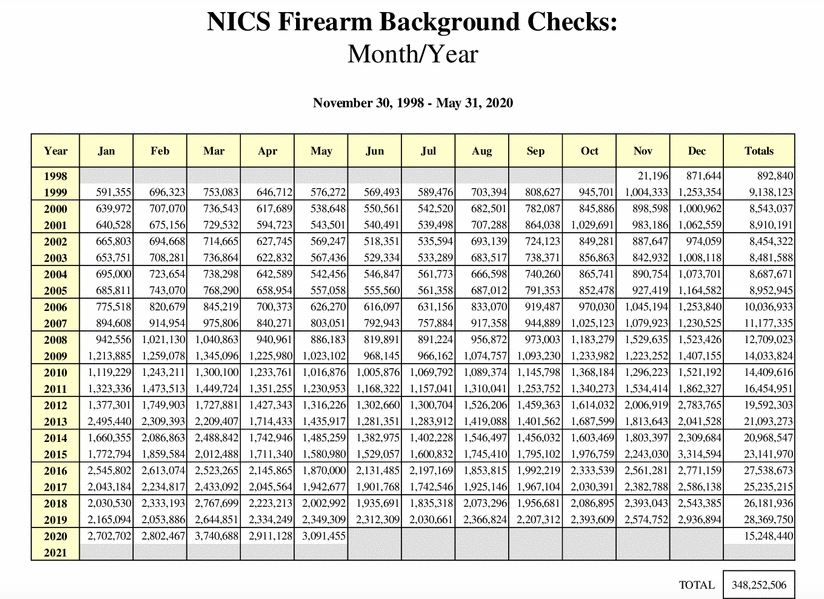
June 2020 update: The FBI reports there have been appx. 350 million NICS checks since the end of 1999, and every year since 2013 has been 20 million or more, every year since 2015 is 25 million or more. NICS checks numbers only capture approximately 40% of total sales... they don't include personal transfers in most states, they don't account for multi-firearm transactions (approximately 15% of all NICS transactions are multi-gun transactions), nor for transactions that don't require a NICS check (many states don't require NICS checks for people who already have concealed weapons permits, or for active law enforcement officers etc...And of course, that doesn't include the hundreds of millions that were manufactured between 1899 and 1968 (under most circumstances, the federal government doesn't consider guns made from the beginning of time, through December 31st 1898 to be firearms... though firearms capable of firing modern ammunition have been made since the 1870s...
Some states may vary, and there are special rules for machine guns, short barreled rifles and shotguns, guns that don't look like guns and the like, as regulated under title II of the national firearms act of 1934).
It also doesn't include the tens of millions of former military firearms that the government decommissioned and sold to the civilian market (m1911 .45acp pistols, 1903 Springfield and m1 garand rifles in .30-06, and m1 carbines in .30 carbine mostly).
Guns don't "go bad" with age, or generally wear out in ways that aren't easily fixed, so long as they are properly stored and maintained.
I personally own guns that old... 1891 that is, so 125 years old... that work just fine thanks.
... Clearly, we've added more than 350 million new guns to the public marketplace, in just the last 20 or so years, never mind all the firearms made and sold in the 100 years before that.
So, like I said... the real number? At least 800 million on the conservative side, and I'm inclined to believe it's closer to 1 billion... maybe as much as 1.2 or 1.4 billion.
Tuesday, June 16, 2020
Not That Kind of Flag
Thursday, June 11, 2020
Dantoniste et Girondiste
Understanding What You ACTUALLY Want...
1. Do you want to be "right"
Sometimes people want to be "right" (or be seen and acknowledged to be "right") regardless of consequences, even if it's ineffective or counteproductive, in achieving their goals and solving their problems.
2. Do you want to feel good/better/sad/angry/a specific way?
Sometimes people just want to say something they find emotionally satisfying... whether it is true or helps them achieve their goals or solve their problems.
Often people just want to feel angry or sad about something (stereotypically women, but men often want this too)... to more fully experience or work out their emotions... Sometimes in commiseration with others, or getting sympathy and emotional support from others... not achieve goals or solve problems. .
3. Do you want to actually achieve your goals or solve your problems?
If you're lucky, you can combine two of the above... usually 1 and 3... or very rarely, even all three... But sometimes... very often in fact... you have to accept you can't have 1 or 2, and still get 3.
So... which is it that you want?
...And if you could let me know if you're starting an argument with me, so I can decide if I want to participate in your desired type of interaction, and then act accordingly... that would be great.
Patriotism, Criticalism, and the Left
Thursday, June 04, 2020
Good People, Bad Situation, and BAD Gear
I hate that it has been necessary, but I love that this has been the response to the necessity. The more people understand that the police are not here to protect them, have no duty to do so, and in extreme circumstances will not do so, the better.
The more that understand they must be prepared to effectively and responsibly defend themselves and others, the better off we will be as a nation.
...HOWEVER...
There are three major problems I've been seeing over and over again:
- Plate carriers so low that they don't actually cover the areas they need to... some that might even make sitting difficult. You need to be able to do everything you normally do (and everything that you HAVE to do) without your gear, when your gear is on. For that to work, your gear has to fit properly, and be adjusted, worn, and used properly.
- SERPA... lots and lots of SERPA holster... just... no. Never SERPA ever. Friends don't let friends SERPA... Do you want to negligently or accidentaly shoot yourself, your car, your floor... or worst of all, someone else? No? Then don't use a SERPA EVER.
This link is an explanation of why never SERPA, and a list of dozens of SERPA related unintentional discharges and shootings, plus lists of ranges, schools and agencies that have banned SERPAs: https://www.activeresponsetraining.net/the-serpa-compendium
- LOTS of folks wearing drop leg holster rigs (including a lot of drop leg SERPAs)...
Which are often silly, but if you're wearing plate carriers and LBE can be justified (it can be hard to get a clean and secure draw from the waist when you've got a lot of gear on, even moreso if you're in a vehicle, or frequently getting in and out of vehicles)....
But they're being worn so low that they're not just ineffective, they're silly, to maybe dangerous. I've seen some worn low enough to put the muzzle of their pistol at or below knee level.. In that position they cannot be used effectively, and they could position your weapon such that it would be easily snagged on the environment, or worst case, difficult to retain in a struggle... or even accidentally shoot yourself or others (see SERPA above).
Drop leg holsters that you can't reach while standing aren't holsters... they're just insecure carrying cases.
I have ridiculous gorilla arms... literally four inches longer for my height than average...and I wouldn't be able to get a secure draw from a holster in that position on me without bending down. Never mind someone with average reach.
Good gear used improperly, is as bad or worse than bad gear (because it gives you a false sense of security).
REAL Charcoal, Humans First Fuel Technology
Humans have been making... and cooking with... charcoal for thousands of years.
It was literally our first processed fuel technology, making a much hotter, cleaner, and more manageable fire than wood, with MUCH lighter and easier to pack fuel.
...In fact, charcoal is STILL the most common cooking fuel in much of Africa and parts of Asia and south America even today.
We've come up with hundreds of ways of cooking, since we started cooking over charcoal... None of them taste any better, and very few nearly as good.
Sadly.. Lots of people think cooking with charcoal is a hassle and a mess. They prefer propane, or just using their ovens or broilers.. or maybe cast iron preheated in the oven, then used over really hot burner...
... all of which can produce good results of course, especially cast iron....
... and if they've only cooked with "charcoal briquettes"... which aren't anything like actual charcoal (more on that later)... I can certainly understand why they would (mistakenly) think charcoal was not that great, a mess, and a hassle...
...Because they've never ACTUALLY cooked with charcoal...
Cooking with natural lump charcoal, is one of the most efficient, quickest, easiest, and least messy means of cooking there is... And of course, one of the tastiest.
Wood, natural gas, and propane (and some types of mineral coal), all make for medium temperature, and very "wet" heat, with lots of, sometimes unpleasant, residues (and odors).
Natural lump charcoal makes for a cook fire, so hot and dry, (because it burns very efficiently and nearly completely), that it lets you get a hard sear, or even char on the outside, while still staying juicy, tender, and medium rare inside.... Even for very thin cuts of meat, or very small pieces like steak tips.
Propane can't do that, nor can any home oven or most home ranges... even with thick cast iron. In fact, it's basically impossible to get anywhere near as good delivery of heat into your food as natural lump charcoal can give you, without very expensive specialty restaurant equipment.
... and if you like cooking in cast Iron, you have no idea how great it can be, until you cook with cast iron and proper charcoal... Propane and natural gas can't hold a candle.
Now... if you're cooking with briquettes, that's another story entirely... They're awful...
Briquettes really ARE a high effort hassle for poor results...
They don't smell right, sometimes food doesn't taste right with them, they're heavy and messy, they are difficult and take forever to light and usually need starting fluid (sometimes even with a chimney starter), they make for low and uneven heating... they can even choke off their own fire and end up going out... and most of all, they can take 30 or 45 minutes before you're ready to cook.
And of course, with propane... or even with an oven or a range and cast iron, you've got to pre-heat for 10 to 20 minutes as well...
Real charcoal is nothing like a hassle...
With a chimney starter, and natural lump charcoal; going from nothing to ready to cook, is very quick, and takes almost no effort.
Literally 20 seconds of trivial effort to load the charcoal and light the starter, and 10-15 minutes of waiting for the coals to get ready...
...and then you're cooking, at a FAR higher temperature than any home oven or burner can get.
How hot can it get?
A natural lump charcoal fire, in a chimney starter, can easily get to over 1400 degrees.
If you use enough charcoal, and let it burn a few minutes longer and hotter, it will get to the point where it is generating its own blast draft, just like a furnace.
When it's blasting like a furnace, that fire can get steel to cherry red, which is over 1500 degrees... even up to a bright cherry red as high as 1700 degrees... (leave it long enough, with enough airflow, and enough charcoal, and it can go even higher, and melt the thin sheetmetal of the chimney starter. With a bellows or blower, you can easily get a charcoal fire hot enough to forge, and even to smelt, steel).
Ok... but how hot can I actually cook with it?
After dumping the chimney into the grill, when the charcoal is glowing bright red on the grate; with good airflow and proper insulation under the fire, you can see a temperature at the grill surface of 800 to 1100 degrees easily... sometimes higher (I've regularly measured 1200 with a non contact thermometer).
... Which means cooking faster, which means getting better texture and flavor, without overcooking.
In fact, if you're just cooking a couple of steaks, burgers, breasts etc... you can just take a grill grate, and cook right on top of the chimney starter, using much less charcoal.
You cook right on the starter, it takes about 3 minutes total to cook a 1" thick steak to medium rare... 90 seconds a side.
It only takes enough charcoal to make the chimney work properly... a few ounces, a few inches, and some waste paper. I light it with a blowtorch to make it even faster and easier... and more fun... When the charcoal is fully ignited... you don't have to wait for an orange hot jet of flame but you can if you like... you're ready to cook.
When you burn it that hot, charcoal burns almost completely... Almost no cleanup... because it's REAL charcoal. No pan, no oven, just a little bit of ash... and really, it's only a little bit.
... and it's not all about the fast and hot...
If you want a lower and slower cook, get your starter to the point where all the charcoal has caught, but not where it's generating its own updraft blast furnace...
Then dump on the grate, and restrict the airflow into the firebox. Everything will slow down, and smolder, for quite a long time.
You can easily sustain a low and slow, or a medium heat, for hours... anywhere from 190 degrees in the grill box, to 400-500 degrees... adding new charcoal as necessary.
With a well insulated hot box, this dry controlled heat is ideal for pizza and certain kinds of bread baking. In fact, it's likely the only way most home cooks can actually get an oven hot enough to make proper pizza (though using a combination of firebrick and a thick piece of pizza steel, and preheating for a long time, can get you close).
... and of course, you can smoke meats this way, with seasoned smoking wood added to the charcoal.
It really is just better...
When I have the gear, and the space, I cook with REAL charcoal year round, rain, shine, snow (just rig an awning)... doesn't matter.
It can actually be much LESS hassle, and much LESS cleanup, than using your kitchen.
It's not like cooking with "charcoal briquettes"...which... and this is the important part... aren't even actual charcoal.
Wait... Briquettes aren't charcoal?
No... really... they're not. Not even much like it at all actually.
"Charcoal briquettes" are actually mostly sand or clay, and binders, with a little blackened sawdust, and coal dust mixed in.
Kingsford, the %1 brand in America...
...Also the FIRST brand of charcoal briquettes, as they actually invented the product, as a way to use the leftover wood scraps and sawdust from making wooden car body pieces in Henry Fords factories. Kingsford was the name of Fords cousin, who was the first president of the company......lists the following as the ingredients of their briquettes:
- Wood char (partially charred sawdust and wood flour)
- Mineral char (partially burned coal dust from processing of soft brown lignite coal)
- Mineral carbon (unburned coal dust from soft brown lignite coal)
- Limestone
- Starch
- Borax
- Sodium nitrate
- Sawdust
Even the "wood char" isn't really charcoal, it's blackened sawdust and wood flour (often left over from paper and saw mills, which is good), but it hasn't really been pyrolized as proper charcoal.
Basically, they're over 90% stuff that isn't anything like charcoal, and less than 10% of stuff that is sort of like charcoal... but no actual charcoal.
That's why they can't cook worth a damn, why they take forever to heat, and why there is so much mess. They don't light well, they don't burn well, and they don't cook well.
Thankfully, you can get natural lump charcoal almost anywhere now (including walmart), and given how little you actually need, for how much you can cook with it... it's actually LESS expensive than briquettes.
Good natural lump charcoal runs between $1 and $1.50 a pound. "Good" briquettes run between $0.50 and $1.00 a pound.
Initially, that may seem significantly MORE expensive, however, with lump, you never need to use starting fluid ($4 a bottle, which lasts what... 20lbs?) and you don't waste 80% of your heat "waiting for the coals to be ready".
More importantly, because it cooks so much hotter and so much faster, and because you start cooking in 10 minutes not 30-45...
...You can cook more with 1lb of lump, than you can with 5lbs of briquettes...
Yes, really, it's about 5 to 1.
... And of course, because lump burns much more completely and cleaner, and briquettes are literally more than 90% "nothing like charcoal"...when you're done with that 1lb of lump vs 5lbs of briquettes... the briquettes end up making about 10 times the ash, and nasty residues.
So... yeah... grilling with briquettes is a high effort, expensive, messy hassle...
Which, of course, is why you should grill with... you know... actual charcoal.
Tuesday, June 02, 2020
What an amazing world we live in...
I don't think I would ever buy something like this... For one thing, none of them are remotely big enough for me (you might get 20hp out of the absolute biggest of them, which is I believe about 300cc. I can't ride on the highway with that).
... But I absolutely LOVE that we live in a world where you can go to amazon, click a button, and get a motorcycle delivered to your door for short money (dirt bikes and scooters for as little as $750 with shipping, street bikes for less than $1500 shipped).
Everything is Forever On The Internet
That's not exactly an uncommon or unexpected thing. These things get exposed from old breaches, and then are collected and aggregated to build password cracking dictionaries and do datamining etc... and eventually they often get released into the wild.
What's amusing though, is that it's a 20 year old email, password, address and phone number, from when I lived in Fremont, CA.
I left Fremont and moved to Ireland in 2001.
Remember... Everything is forever on the internet.