Showing posts with label Firearms. Show all posts

Tuesday, June 23, 2020

The ACTUAL number of guns in public hands in the U.S.


The numbers often reported for how many guns were in civilian hands in the U.S. ... variously between 240 million and 400 million, depending on who reported on it when etc... are entirely and completely fictitious.

They're based on some polling data from the 80s, updated again in the mid 90s, and then extrapolated out.

They may have updated it again in the mid 2000s, I haven't been able to confirm either way... but even if they did, it's still a complete fiction.

This is also true of the estimates of the number of gun owners, and households with guns by they way... Which are also complete fiction (and I know they DID update those numbers in the last 5 years... for equally... or likely far MORE fictitious numbers).

Why do I say that? Simple... the numbers in question, are entirely based on self reporting, from a small sample size of self selected respondents... and they arent even broken out or controlled for by state, by rural or urban residence, political opinions or affiliations etc...

They called a few hundred people up on the phone, and asked if there were guns in their household, and how many. From there they made some statistical assumptions, and then multiplied out.

So... If you're a gun owner, and someone from a gun control lobby, or the government, or some random polling agency... who may be a criminal trying to scope out targets for all you know... called you up and started asking questions... Exactly how likely would you be to tell them you owned guns at all, never mind exactly how many guns you owned?

For that matter... How accurate have polls been about politically sensitive topics the last... forever really, but particularly the last oh... 23 years? The last 15? The last 8?

Mostly, they have been reporting something like 300 to 350 million... and they have been reporting something close to that as the number since the late 80s... Except in that time period, we've actually made and sold more firearms than that just domestically, never mind the tens of millions we have imported.

The real numbers are impossible to accurately determine, but at least as far as the total number of firearms, it is almost certainly at least 3 or 4 times the highest estimates I've seen reported.

We manufactured 14 million guns in this country for the civilian market last year, and imported 4 million more... as well as manufacuturing about half a million for civilian market export.

That's 18 million guns added to the marketplace in a single year.

We also manufactured between .5 and .7 million small arms for our own military and government, and another 1.7-2.4 million for military/government export (it's unclear as to exact numbers, because such contracts are spread out over multiple years) to friendly foreign powers.

There hasn't been a year since 1968 (when detailed statistics started being kept) that we haven't manufactured at least 5 million firearms, or imported less than 2 million... adding at least 7 million firearms to the market.

... over the almost 5 years in question, that would account for the total of reported estimates, all by itself... But actually, the numbers are FAR higher.

There hasn't been a year since 1994 that we haven't added at least 9 million guns to the market.

There hasn't been a year since 2001, that we haven't added at least 12 million.

Since 2009, it's been at least 14 million a year.
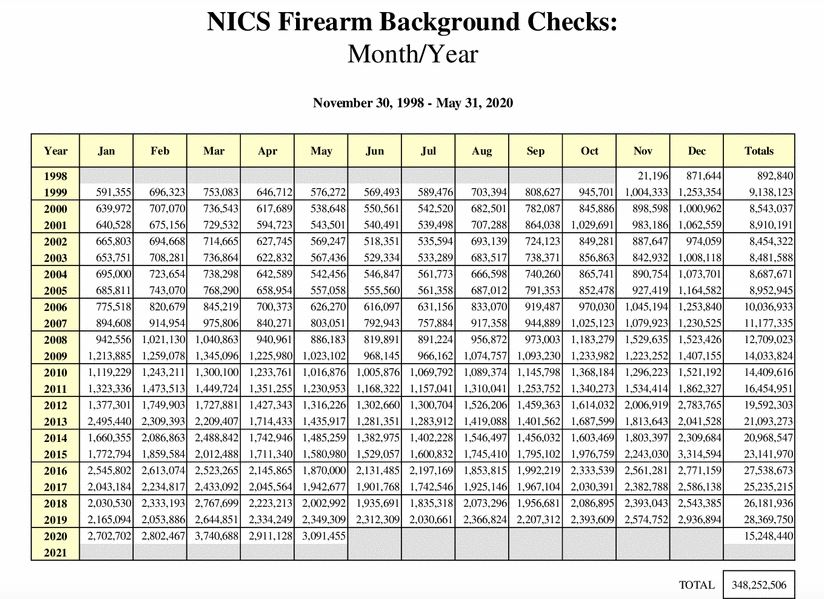
June 2020 update: The FBI reports there have been appx. 350 million NICS checks since the end of 1999, and every year since 2013 has been 20 million or more, every year since 2015 is 25 million or more. NICS checks numbers only capture approximately 40% of total sales... they don't include personal transfers in most states, they don't account for multi-firearm transactions (approximately 15% of all NICS transactions are multi-gun transactions), nor for transactions that don't require a NICS check (many states don't require NICS checks for people who already have concealed weapons permits, or for active law enforcement officers etc... 
And of course, that doesn't include the hundreds of millions that were manufactured between 1899 and 1968 (under most circumstances, the federal government doesn't consider guns made from the beginning of time, through December 31st 1898 to be firearms... though firearms capable of firing modern ammunition have been made since the 1870s...

Some states may vary, and there are special rules for machine guns, short barreled rifles and shotguns, guns that don't look like guns and the like, as regulated under title II of the national firearms act of 1934).

It also doesn't include the tens of millions of former military firearms that the government decommissioned and sold to the civilian market (m1911 .45acp pistols, 1903 Springfield and m1 garand rifles in .30-06, and m1 carbines in .30 carbine mostly).

Guns don't "go bad" with age, or generally wear out in ways that aren't easily fixed, so long as they are properly stored and maintained.

I personally own guns that old... 1891 that is, so 125 years old... that work just fine thanks.

... Clearly, we've added more than 350 million new guns to the public marketplace, in just the last 20 or so years, never mind all the firearms made and sold in the 100 years before that. 

So, like I said... the real number? At least 800 million on the conservative side, and I'm inclined to believe it's closer to 1 billion... maybe as much as 1.2 or 1.4 billion.

Monday, January 25, 2016

The Eternally Meaningless Caliber Wars

It's funny... as caliber wars become more pointless, they become more vocal and partisan...

This seems to actually be BECAUSE the data show the differential between chamberings is small, and has been getting smaller for decades. As datasets get larger, data and data analysis get better, and as ammunition gets better, the differences between common defensive pistol chamberings are progressively smaller, and less meaningful.

Pistols are Pistols, and Rifles are Rifles.

We have a saying "pistols are pistols, and rifles are rifles"; which means that the difference between reasonable defensive pistol chamberings is small, and effectively meaningless, compared to the difference between pistols, and long guns; both shotguns and rifles.

Compared to rifles, pistols are lost in the noise... and looking at the variability between different rifle chamberings, the differences can be greater than most powerful reasonable defensive pistol chamberings, and nothing at all.

In fact... if we just look at muzzle energy numbers, there can be greater variability within a single chambering.. say, something like subsonic .300blackout, and high velocity .300blackout, with something like 900ftlbs of energy difference between them, and the most powerful reasonable defensive pistol chamberings, such as hot and heavy .357 magnum, at something like 750ftlbs.

Pistols are pistols, and rifles are rifles. 

When there were thought to be larger differences, one could have clear advantages and disadvantages which could be argued. When the differences are small, it comes down to preference, individual performance, and small optimizations. Now, there can be no clear differentiation.

Because pistols are pistols, and rifles are rifles.

So, the caliber wars rage on

The most recent "major shakeup" has commenced, as many law enforcement agencies ( who moved to .40 and .45 in the late 90s and 2000s, after a series of notable failures in effectiveness of 9mm in the 80s and early 90s) have decided to move back to 9mm.

This is happening, because both ballistic testing, and empirical shooting data, show very little difference in effectiveness with modern high performance ammunition.

9mm has always had a few fairly significant advantages... and these are not controversial... that were thought to be offset by its reduced effectiveness compared to .40 and .45. It costs substantially less, it's smaller and lighter (more rounds in the same size, or smaller and lighter with the same round count); and smaller officers, and those who are less skilled with firearms, and who practice less, generally shoot better with it.

Since police generally open carry, large "duty" pistols, and in general are not good shots, who don't get to train very much, and don't have much money for ammo when training; and because there are more and more women and smaller officers on police forces, 9mm is at its greatest position of advantage, in police duty pistols.

With the data showing that modern high performance ammunition gives little or no effective difference between 9mm, .40, and .45; there is really no reason for police duty weapons NOT to move back to 9mm, and some good reasons to do so.

And so 9mm partisans in the non-police shooting world, believe they have scored a final victory over the dark forces of the .45acp.

... this war having been going on literally for over 100 years now by the way; the chamberings having been been developed in 1901 and 1904 respectively, and having first fought on opposite sides of world war one...

Of course, the police duty carry mission, is different from the many different concealed and open carry missions that non-police defensive pistol carriers have.

So the "decisive victory" is nothing of the sort... it's just another set of data points.

There's caliber wars, and there's actual reasonable argument with data.

Most people wouldn't know what the second is, never mind the third.

... Presuming modern premium defensive JHP ammunition, without restrictions...

Basically there is between a 10%-20% or so spread of expected effectiveness between .380+p and .45+p, depending on exactly which data you look at, presuming a human in standard street clothes, and no barrier penetration. About a 10% spread from 9mm (standard pressure) to .45+p and less than 5% from 9mm+p to .45+p... so...

When you factor in things like heavy clothing, barrier penetration and the like, the numbers get even more murky, and less reliable, and less useful...

Effectively, the differences between reasonable defensive chamberings don't matter.

20% is worth debating... 10% maybe... but not really too much, 5% really not at all. It's margin of error, a slight optimization, or a personal preference.

Is it worth upgrading from .380 to 9mm...?

...Sure, if you can shoot it just as well, and carry it just as well... 

Is it worth "upgrading to" .45...?

...Sure, if you can shoot it and carry it just as well...

...and you don't mind 2 or so fewer rounds in the same size package.

Is it worth "downgrading" to 9mm...?

...Sure if you can shoot and carry it just as well...

...and you want the 2 or so more rounds in the same size package.

What about .40?

It almost exactly splits the difference between .45 and 9mm, with none of the advantages of either, and all the disadvantages of both really... With modern ammunition, it's really no longer worth considering (except as a smaller version of 10mm, or the basis for .357sig), except "because I feel like it" or "because I shoot it well"... But it's also probably not worth trading or selling it for either 9mm or .45acp if you like it.

Functionally, the spectrum of defensive chamberings between 9mm+p and .45+p make no difference.

So... what DOES make a difference, and how much?

Ehh... not much, and not much...

Basically, a tiny bit with .357sig and a slight advantage with .357magnum and 10mm... and I don't consider .45lc and and .44magnum to be reasonable defensive chamberings for most people (they're effective, but they're bigger, more expensive, harder to shoot, and harder to carry than most will ever bother with).

There's a little bit of an advantage to .357sig, light .357 mag, and light 10mm over .45acp +p... maybe 5%.

There a slightly bigger advantage to medium .357mag and medium 10mm... a little more than 5% to maybe 10%

There's a slightly bigger advantage to hot .357mag and hot 10mm... a little more than 10% to maybe a little more than 15%, or even 20% under some circumstances (particularly with barrier penetration, and with tougher animals than humans).

However, for all of those upgrades, you get higher cost, more recoil, and its more difficult to shoot well...

In the case of medium and heavy 10mm and .357 in lighter easier to carry guns, it can actually be physically painful to shoot, and most people can't shoot them well at all.

Is it worth the upgrade to magnum class chamberings like these? 

Sure, if you can carry and shoot them just as well, don't mind the extra recoil and the extra cost.

Getting the picture here...?

It's not about the chambering... because pistols are pistols...


It's really about how well you can shoot, and carry the gun, in your chosen chambering... and in personal preference, and in small optimizations for particular missions.

So, what do I choose? What do I recommend?

I'm a really big guy, who can carry almost any sized gun reasonably comfortably. I live in a rural, cold, northern state, and at times have had to deal with wild animals.

Most importantly for my chambering selection, I shoot heavy recoiling guns pretty well, and the differences in recoil between 9mm+p and light .357 and 10mm are basically meaningless to me; with only a slight disadvantage to medium and heavy .357 and 10mm loads.

My pocket carry guns are a 5 shot .357 revolver, and a 7 shot .380... I like how both of them carry, and I can empty them both into a 4" or smaller circle at 10 or less yards with deliberate fire, and an 8" or smaller circle as fast as I can recover each shot... though neither have much in the way of sights.

Once I got the small .357 revolver, I pretty much stopped bothering carrying the .380 frankly, because I can shoot the .357 as well, it's no heavier, it carries just as well, and it's more reliable. I occasionally carry the .380, particularly in shorts, because it's a little flatter and slimmer... but that's really it.

My belt carry guns right now, are all 3-5" barreled 7-9 round .45 and 10mm 1911s... But at times have been 7 to 16 round 9mm, .40, and .357sig, and .357 magnum I've never felt insufficiently armed with any of them. I have never felt over armed with any of them. Though a couple have been a little bigger or heavier than ideal.

I don't feel that an 8 round .45 1911 is significantly more or less effective, for my personal defensive needs and missions, than a 13 round 9mm Browning hi-power. I happen to own a couple of good 1911s in .45 and 10mm that I like... I happen to have sold all my 9mm pistols a few years ago, including my 2 BHPs, expecting that I'd buy more, but I haven't been in a position to do so.

The only ones that I thought were in any meaningful way more effective, were the .357 magnums, and the 10mm, in both of which I carried loads suitable to heavier animals than people, because I lived in the north Idaho mountains. If I had to dispatch an elk or a moose, or god forbid deal with a bear, I wanted 158gr to 180gr at 1250-1350fps... The biggest advantages I could get in pistols that I felt like carrying every day, and could shoot well.

... and really... it's only a small advantage...

Because Pistols are Pistols, and Rifles are Rifles. 

Monday, November 05, 2012

Firearms Basics - Part 2: Cheap Optics?


This is the first full post in my new series "Firearms Basics", which I introduced here.

So, I got a question on a non-gun forum today, that I think is pretty common... and I haven't really seen what I consider to be a good and comprehensive answer around the gun blogs and gun forums (and I've seen a lot of bad advice, and a lot of derision and mockery about this sort of question).

 I'll paraphrase it here:
"I just bought a used 10/22, and I want to put an optic on it, but I don't want to spend too much money. 
It seems silly to spend more than $200 on a scope for a rifle that cost less than $200. 
I'm just going to be plinking at 25 or 50 yards anyway, I think I should probably just get a cheap red dot... It seems like they're a lot less expensive than scopes, and I don't really need magnification. 
I'd really like to spend less than $100 if I can get something good, but I suppose I can spend up to $200 if I need to."
Fair enough...

Though I disagree about it being silly to spend more for a scope than for the rifle you put it on... In fact I generally recommend you spend MORE for your scope than you did for your rifle (unless it's a high end custom rifle).

... for one thing, good optics are a lot more expensive than good guns.

But, if it's just a bone stock 10/22, you don't actually NEED "good" optics, you can get away with just "acceptable" if you have to (though you'd be surprised how little you have to spend to go from "acceptable" to "good").

And budgets are budgets...

Sometimes, you've only got $100 or $200, and you need an optic. When that's the case, it's not useful just to say "oh they're all garbage" or "don't be so cheap" (which unfortunately you'll hear a lot on firearms boards).

Conversely, it's also not good advice when people say "Oh, I love my NCStar, it works just fine, you all are idiots for spending more money" (which unfortunately you'll ALSO hear a lot of on gun forums and blogs); when in fact, NCStar "optics" are generally utter garbage that no-one should ever waste their money on.
Note: Yes, that's harsh on NCStar I know... but I stand by it. Buying junk is not even being cheap, it's just throwing away your money. If you got a "golden sample" that wasn't garbage, great for you... you're the exception.

That's the problem with quality control (and the overall field of quality management): There's no such thing as getting everything perfect all the time; there is only managing tolerances, defects, and deviations from standards. The more rigorous your standards are, and the closer to meeting that standard you have to be to pass your QC testing (and the more QC testing you do); the more expensive your manufacturing process is going to be.
A brand with good quality control will maintain very tight manufacturing tolerances, and strict standards; and they will require a minimum degree of deviation from the standard to pass their extensive quality control testing. This makes the product much more expensive, but you can count on it meeting spec, and being reliable (at least in theory...)
No-one sets out to make a crappy product that doesn't meet specs, even a junk brand like NCStar. An NCStar scope may actually meet standards, and be manufactured exactly as designed; but to keep costs minimal, they don't have much in the way of quality control... So a scope that isn't anywhere close to meeting standards will get shipped, just the same as one that is perfect and reliable and will last forever.... And you have no idea which one you'll get. If you got lucky and got a good one, great, if not, you're out of luck. Worse, you may not be able to tell you got a bad one, until you're actually depending on the product... and it fails...  
So, to business...

As always, my first recommendation is to buy for VALUE, not for price.

Sometimes cheap is good, just low cost. Sometimes cheap is just cheap. In general, you get better value paying a bit more, to get better quality and reliability.

My second recommendation, specific to a little .22 plinker; is rather than a red dot, to get a relatively low power, mid quality, variable magnification scope, with a medium sized objective; from a decent manufacturer, with a good warranty.

I just think that for most uses of a 10/22, you're going to get more use, and more enjoyment; out of a scope, than out of a red dot.

Yes, an acceptable quality scope is generally going to be more expensive than an acceptable quality red dot; but you can generally get into something reasonable for well under $200 pretty easily; and certainly under $250.

Nikon, Pentax, Redfield, Burris, and Vortex all have really quite good scopes available between $120 and $250, which will do just about anything you would want to do with a 10/22 or similar rifle... And still be useful for a longer range center fire rifle if you want to re-purpose it later.

There's no need to go down to wal-mart blister pack priced Bushnell and Simmons scopes; when you can get a Redfield or Vortex 2-7x32 with a lifetime warranty for $120, or a Nikon or Burris 3-9x40 for $140 (lifetime warranty on the Burris too).

As it happens, I use a Nikon ProStaff 3-9x40 on my 10/22, that I picked up for around $100 on special sale at Cabelas a few years ago (well under even online price actually. I think list on it is $240, and online prices are $140-$170).

It's a decent enough scope, with acceptable light gathering, acceptably smooth zoom operation, and repeatable adjustments that hold zero (that last bit is really important. Lower cost scopes are often somewhat imprecisely made internally; and their adjustment mechanisms don't produce repeatable precision, or hold zero under recoil or being banged about).

Also important, it's quick to acquire a sight picture at low magnification (the primary advantage of a red dot), but still has sufficient magnification for any distance I'd want to shoot my 10/22 at (I usually shoot it off my deck, with my suppressor. It's about 70 yards to the water; but I sometimes go over 100 yards at the range, or out in the woods, just for grins).

The secret to quick sight picture with a scope, is using relatively low power, with a relatively large objective lens, of sufficient quality to be bright, sharp, and clear, at all magnifications and in all lighting conditions you choose to shoot.

With proper scope selection, you can shoot just as quickly and simply with a scope as you can with a red dot sight.

Realistically, a 2-5x or 2-7x is perfectly adequate for most peoples .22 shooting; and a 3-9x is about the most you'll need for anything short of a benchrest competition (and most rimfire competitions don't allow optics anyway). There's really no need to go to 10x or higher; doing so will just add cost and weight, without giving you any real advantage (again, unless you're doing competitive long range rimfire shooting).

Remember, if you can see the holes your bullets make in the target at 10 yards, a 9x magnification (presuming good light, and a good quality scope), will let you see the holes at 90 yards. Most people rarely fire their .22s at longer than 25 yards (except when they're just goofing around), and very rarely at more than 50 yards, or 100 yards. Even if you can only see the holes you're making at 5 yards, a 9x will let you see them at 45 yards.

My vision isn't perfect, and with my glasses; on a high contrast target I can see individual .22 holes at somewhere between 15 and 25 yards depending on the exact target type, target background, and the lighting. With a shoot-n-c or something similar I can see the hits at well beyond 25 yards. I rarely turn my 3-9x up beyond 6x when shooting my 10/22.

A 32mm or 35mm objective lens is just fine for a 5x or 7x maximum magnification, and acceptable for 9x (unless you're shooting in dim light). A 40mm or 42mm objective is just fine for 9x max magnification; there's really no need to go bigger than 42mm for anything less than 10x (again, unless you're shooting in dim light).
Note: For a given quality level and magnification level; a bigger objective lens is going to give you a better, brighter image (particularly in dimmer light); at the expense of a higher cost, larger size, and higher weight. 
If you're going to be in bright sunlight most of the time, it won't make much difference (your pupils will be narrowed down to protect themselves from sunlight anyway, and can only use so much light); but in dim light, twilight (sunrise or sunset), a dark overcast etc... going with a bigger objective is generally a good choice. 
BUT... when you're deciding how to spend your money, you are probably better off going for a higher quality piece of glass, rather than a larger lens.
My third recommendation is that, in general, I find most optics under $100 to be... A poor value shall we say? Generally not worth the money, even at how little you may pay for them.

..But a budget is a budget; and there are at least some minimally acceptable options under $100, and a fair number well under $200.

Now, we've already talked a bit about lower cost scopes, so from here let's focus on "red dot" sights (unmagnified or low magnification optical sights that feature a lit dot or reticle, generally projected onto the back side of a glass lens, as the aiming point).

For a .22, if you're not shooting it very much, you can get away with a lot lower quality and toughness, particularly in a red dot; if you don't mind that at some point it's just going to die for no reason.

Not probably, definitely; and "some point" is going to probably be sooner than later...

By that standard, you can get at least minimally acceptable red dots under $100.

You can pick up some models of TruGlo red dot on sale for under $50 online; and most models are between $80 and $150. They're acceptable.

Millet has a line of relatively low end red dots, in the $60-$90 range. they're acceptable, and they've got a good warranty.

Simmons, same thing.

Tasco has two product lines for red dots, and the lower product line, same thing.

I group these brands together, because it seems they all use the same Chinese OEMs for their hardware.

That said, it isn't safe to assume that pieces that look the same externally ARE the same under the skin. The Chinese vendors will build several different models that look externally very similar, but may have VERY different quality of components, and overall quality control. Sometimes these different models will be at widely different price points; sometimes they are actually very close in price, but very different in quality.

I think Swift, BSA, Barska, and NCStar also use the same OEM; but as I said above, I have observed significant differences in quality between visually similar models, from what seem to be the same OEM, but sold under different brand names. Specifically, I have found that examples from these vendors are generally of unacceptable quality, and particularly of unacceptable reliability.

On the other hand, I have found the TruGlos to be of slightly higher, and frequently "acceptable" levels of quality. I even have a couple of them around to throw on guns for testing.

Others may have had different experiences of course... and as they say, the plural of anecdote is not data.

From "about the same" to "slightly higher" quality, and around the same pricing ($60 to $160) are Bushnells trophy line of red dots. They're acceptable.... Some of the higher end ones may even edge into "good" territory; and they have a decent warranty, and acceptable customer service.

Tascos higher end red dot line, the "pro points" use the same Chinese OEM as the Bushnell Trophy line. They're priced and specced similarly, and are of similar quality.

For a LOT higher quality and reliability, you can get into a Burris SpeedDot or Fastfire for as little as $180 (online, on sale); or an XTR or AR-Prism sight starting around $240.

I've owned and used several of them, and they're actually quite good. Also, Burris has great customer service and a great warranty (among the best in the business in fact).

At a similar quality level, you can get a Vortex strikefire for as little as $160. I have had several of them and like them very much. I haven't used their customer service myself, but I have heard from others that they have very good customer service (and an excellent warranty).

Now... my personal recommendation, is to skip the cheap stuff, and go straight to the midrange.

I guarantee you, if you actually use the thing, you will go through two or three of the TruGlo/Simmons/Tasco/Bushnell generic Chinese OEM sights; before you even put a ding in a Burris or Vortex...

...And in my experience, the Burris and the Vortex will take most of the punishment that a much more expensive (three to five times the price actually) Trijicon or Aimpoint will. Not all of the punishment necessarily, but most of it; and unless you're defending your life (or the lives of others) with it... I don't think the price difference is worth it. I'll take the Burris or the Vortex for most guns, in most circumstances, most of the time.

You're going to pay $60-$90 for a minimally acceptable red dot that isn't going to have repeatable adjustments, that IS going to lose zero, and that will generally fail, in a year or two at most (less if you shoot it more); that is only usable on your .22...

... or you're going to pay $100 more for a red dot that you probably can't kill (unless you're actually trying to), that WILL retain zero and make repeatable adjustments, and that you can use on anything you've got, now or in the future.

If you HAVE the $100 it's not even a question. If you don't, well then, you just don't have it.

But it still comes down to, buy for value, not for price.
Firearms Basics - Part 1: Introduction

I've been a shooter for almost 30 years, and a competitive shooter off and on for about 15 years. I'm an engineer by education and experience; and I'm a professional gunsmith, and firearms trainer. I've sold guns at the retail level, repaired them, customized them, modified them, even built them from the bare metal.

Firearms are one of the strongest pursuits and passions in my life.

God knows, I've written literally millions of words on firearms over the past... almost 20 years I guess (I started writing about guns on the internet in forums and newsgroups starting around 1993). I've been running running or co-running firearms forums for over 10 years. The last 8 years (well... 8 years in February) I've been writing on this blog (3600 or so posts so far; probably half of them about guns, and most of those over 1000 words).

I'm published on guns and shooting both online and in print; and I'm one of the most referenced and quoted sources on the technical aspects of firearms online.

I think I'm justified in calling myself a firearms expert; without others having to put scare quotes or "self proclaimed" around that.

I say this not for self aggrandizement, but to explain to those who don't know me, the context of the rest of this post.

While I'm a great'big'ol gunnut; guns are by no means my only personal or professional pursuits or interests; and I'm involved in several different interest centered "cultures" and social circles.

Generally speaking, outside of my "gun culture" social circles, I'm "the gun guy"; or at least "one of the gun guys" in any group.

And of course, I write a lot about firearms basics, mythbusting, basic equipment etc...

All of this leads to me getting a lot of questions from people who are entirely new to firearms, or who are just casually into them...

... or me hearing conversations (or seeing internet threads) just completely full of (generally well intentioned) utter crap. Bad advice,  "received wisdom" (which may have been true at one point, but may or may not be now), opinion and myth passed off as fact; even sometimes truly stupid, illegal, or potentially dangerous advice.

That's unfortunately the general level of discourse on most websites that aren't specifically gun related (and sadly, many that ARE... but that's another story entirely).

The good thing is though, being recognized as the "office expert" so to speak, in such groups; I can generally speak with some authority, and maybe give some GOOD advice, that maybe someone will take.

I figure, as a representative of "serious" gun culture, and "gun experts" etc... I kind of have a duty to do so when I can; and I enjoy doing so... at least when we can keep the general level of stupidity to a reasonable level.

Often these questions, and these discussions, fit into the post categories I already have (and have had for years now); "so you want to write about guns" or "firearms mythbusting".

Sometimes they don't however, and for those things, I'm starting a new series, "Firearms Basics".

I expect I'll be covering some of the same territory I've done with mythbusting etc... But mostly this series will be focused specifically on providing a foundation of basic firearms knowledge; and to answer questions that firearms beginners, or casual firearms owners/shooters might have.

I'll be posting the first in this series in a few minutes; but I want to put this out to my readers, and to the readers of THEIR blogs...

What basic firearms questions and issues would you like to see covered? Technical, political, legal, historical... model specific, ammo specific, whatever... so long as it's a relatively specific question, that won't take a full book to answer...

...Or maybe even then, if it's a good enough, interesting enough issue; that I know enough about to answer that comprehensively.

What basic or common questions would you like answered?

What pieces of received wisdom, or or common firearms advice would you like to see explained, verified, or corrected (this is where we overlap with the mythbusting bit)?

I figure I'll collect them all, and just start writing the posts to answer the folks, as the time is available and the inspiration strikes; with a goal of doing at least one a week.

So please, give me your questions; and those of you with your own blogs, if you feel it would provide value to your readers, link or repost this, and/or gather your readers questions.

If there's an area I don't know enough to cover properly, I may bring in a guest poster, or guest contributor to a post; and if you are an expert in a particular area and would like to help with this, drop me a line.

I've got a list of possible ideas myself of course, but I want to see all your ideas first.

...this could be kinda fun...


Monday, May 21, 2012

Patrol Platform

A friend, reader, and forum reader at the Guncounter forums put forth an idea yesterday that I thought might be interesting to talk about here.

"The Glock has replaced 1911s and other pistols in the hands of the police because a monkey can be trained to operate it and it is reliable even if not properly maintained.

I think the AK might be like the glock of rifles and would serve our police force better than the AR-15s.

In the hands of a trained operator* and when properly maintained the AR is a superior rifle to an AK. The AR is just as reliable, but easier to shoot well, and has a superior control layout. That said, at least 75% of the patrol force out there is incompetent, unmotivated, and downright stupid. Some of them shouldn't be issued anything more than an old 38, and no bullets. They will not undergo the training necessary to achieve proficiency with the operation of an AR, they will not practice with it to benefit from its accuracy, and they will not clean it to ensure its reliability.

The fact of the matter is that our cops are much like the group of people for whom the AK was designed. The reliability is an advantage because they won't maintain them, the lack of accuracy is not an issue since they can't shoot that accurately anyway.

So my argument is that instead of AR-15 rifles, our cops should be issued semi-auto AK-47 pattern rifles. Let the flame-war begin! "


Actually, I almost agree with him here, excepting the (intentionally... this person is a bombthrower by nature) inflammatory description of American patrol officers (there is SOME truth to the concept he's speaking of, but not to the degree he's talking about), and the two major problems that:

1. U.S. Police departments will almost certainly not be politically able to use AK pattern rifles.

I believe this one difficulty is insurmountable. The AK really is through of around the world, and particularly in the media, as a terrorist gun.

The sight of American cops shooting at American citizens (even if they are criminals) with AK pattern rifles, would be entirely politically unacceptable; even if the rifles were U.S. made, and looked nothing like the AK of the middle eastern terrorist etc...

2. An AK pattern rifle is longer, heavier, bulkier, less maneuverable, and more snagprone in vehicles, and tight quarters, than an AR pattern rifle of equivalent barrel length

Though this can be compensated for somewhat, with the right configuration and accessories; it can't be completely mitigated. Being made almost entirely of stamped or milled steel, the AK pattern rifle will always be heavier than the AR pattern rifle; and the receiver of the AK pattern rifle is considerably longer than the AR pattern rifle, and can't really be shortened.

And a few minor issues like:

3. The 7.62x39 round is louder, has more muzzle blast and recoil (though admittedly, not a hell of a lot), and is more likely than 5.56n to overpenetrate through obstacles (as opposed to people... and experience has shown that cops are far more likely to hit things other than people) while retaining wounding potential.

This of course could be compensated for by simply chambering the rifle in 5.56, or 5.45... or for that matter any number of other intermediate chamberings).

4. the AK pattern rifle is generally more difficult to adapt for accessories, adjustable stocks etc...

These accessories are actually very useful to the law enforcement mission and the mission impacting factors, of the patrol carbine. The issue is pretty easily addressed; however, when you do so, the rifle becomes just as expensive as an AR, negating one of the advantages of the AK platform.

Essentially, even excluding the insurmountable political issue; after modifying the AK platform to match the useful aspects of the AR which should be retained for the patrol carbine mission, I don't believe the AK platform presents sufficient advantage... or any advantage really... to warrant adopting the it over the AR.

All that aside... I think this is actually a good opportunity to address a more fundamental issue represented by the entire concept of the law enforcement patrol carbine.

In general, I believe that the U.S. law enforcement mission (at least in urban, and suburban environments, for local law enforcement) is better served by the patrol shotgun, than the patrol carbine.

Though I believe the patrol carbine is a useful tool to have, and we should retain it as an option available to officers; the patrol shotgun is more tactically appropriate and more mission appropriate, in most circumstances; and gives the officer more flexibility in response options, than the patrol carbine.

I have nothing against the patrol carbine. It fills a genuine need, while being familiar to many officers from military service and recreational shooting; as well as being understood and accepted by the general public (now anyway, more than 10 years post 9/11. When it was first becoming common in the early to mid 90s, it was a huge political issue).

...I just don't think the patrol carbine meets the urban and suburban law enforcement mission as well as another option might.

Note: I should say, I'm not exactly an original thinker in this. What I'm saying now has been said by hundreds of law enforcement trainers, and thousands of law enforcement officers, for years... But I have rarely seen this discussion in the gunblogger realm, and it's something I thought my readers might be interested in discussing, and in many cases may be able to contribute their firsthand or relevant knowledge and experience to

The two mission challenges addressed by the patrol carbine (as opposed to the personal sidearm, or patrol shotgun) are:

1. marksmanship and immediate response capabilities at 15-100 yard distances; to be able to rapidly respond to situations in that tactical regime without waiting for a SWAT callout.

2. Effective, immediate, response against lightly barricaded subjects (particularly those barricaded in or behind vehicles), or subjects wearing light to medium body armor; again, to allow an officer to rapidly respond to these situations without waiting for SWAT callout.

A note: I am qualifying myself with "urban and suburban" here, because there are some mission challenges in rural law enforcement, and in highway patrol, that may be better met by rifle caliber weapons. In these environments, an officer may be a very long distance (or long response time) away from backup, support, or enhanced capability response units.

Further, an officer may commonly encounter a need to respond to situations best met by a rifle. Dispatching wildlife, handling longer range engagements (lots of clear space around highways, and in rural areas, for hostile subjects to engage an officer), dealing with subjects that are more heavily barricaded or in deeper cover (or are barricaded at greater distances... particularly in or behind vehicles at greater distance), disabling vehicles; and in extremis, engaging rifle armed subjects (which, because of the time and distance involved, can't wait for a SWAT callout; if the organization even has such resources available).


I would advance the proposition that a better solution to the tactical challenge the patrol carbine addresses, at least for the urban and suburban patrol officer, may in fact be better addressed with a PDW concept weapon which gives armor penetration capability (such as the P90).

In general I would posit that the patrol officer does not need response capabilities for heavily armored, heavily barricaded, or excess of 100 yard situations; in which rifle caliber weapons would provide a decisive advantage over PDW concept weapons. These situations should be handled by SWAT or tactical response; or other heavy armor, and rifle equipped, response units.

The patrol officer is neither trained, nor equipped to handle this mission (nor should he be under normal circumstances), and should only be responding to these situations in extreme circumstances (except in a supporting role. Establishing and maintaining a perimeter, handling the public, etc...).

The PDW concept offers light weight, ease of maneuverability and handling, good ergonomics, rapid fire capability with little recoil, precision marksmanship within its accuracy envelope (100 yards and under), and armor penetration within its high percentage performance envelope (50 yards and under).

I believe these advantages and performance envelope are better matched to the needs of the urban or suburban patrol officer, than the advantages and performance envelope of the rifle caliber weapon.

As of 2012, there are several PDW concept weapons that have been proven effective in operational use (most notably the P90, but there are others).

I believe the PDW concept may not yet be mature enough to consider for wholesale adoption by American law enforcement (and I remain doubtful as to the general military mission for the class of weapon); however, it may present a better solution in general, to the patrol officers mission challenges, than the rifle caliber patrol carbine.