Due to the fact that I am an idiot, and don't know when to quit working and playing, and rest so I can get better; the cold that our oldest took home from school with her two weeks ago (and everyone else is already recovered from), has in my case metastisized into a lovely sinus and upper respiratory infection (which I am currently, slowly, recovering from).
I'm in the middle of the nastiest case of the crud I've had in over a year. I've been sicker, in that I've had fevers and whatnot, but I havent had this level of chest and sinus congestion in a while; thus why I call it "the crud", as in what is completely filling every breathing passage of my body at least 50% of the time.
I'm staying upright and breathing due to the wonders of modern pharmeceuticals; a combination of Sudafed, and Oxymetazoline. Of course when the oxymetazoline wears off the crud slingshots back worse; but that's livable, so long as I'm taking the REAL Sudafed, or it's generic equivalent.
Let me just note, the new, fake, sudafed works... for about 20 minutes, no matter how much of it you take.
Pseduoephedrine hydrochloride, is the most effective nasal decongestant known to man; and it doesnt cause rebound rhinitis. Phenylephrine hydrochloride, the ingredient manufacturers are substituing for PsE-Hcl, to put it mildly, is not as effective... or even 1/10th as effective for that matter; and it DOES cause rebound rhinitis.
Of course, pseudoephedrine has some nasty side effects, including increases in blood pressure, pulse and respiratory rate, perspiration etc..., as well as vasco dilation to a significant degree.
But that's not why its a "problem"; its a problem, because it's also the primary ingredient in Methamphetamine; and therefore the government has declared war on it...
...declared war, on a nasal decongestant.
The war on some drugs has made getting the actual medications that work, a lovely process where you must give your drivers license to a clerk, where they record and report on your purchases; and in most stores in most states, you can't purchase more than 1 weeks worth of recommended adult dosage at a time.
Of course the so called adult dosage is calculated so that a 90lb woman can take 4 times the recommended dosage four times as frequently as recommended and not hit the LD50. For a 370lb, highly drug tolerant man, the amount required to obtain the desired result is... significantly higher shall we say?
I used to be able to get 90mg pseudoephedrine pills, mail order, in bulk; take 1, and be good for 4 hours. Now, because of the "meth war", the strongest I can get at my local pharmacy is a 24 count box of 30mg each, which don't even make a dent, so I have to take 4 of them. The pharmacy will only sell me 1 box per week, or 3 boxes per month.
I can order them over the internet for a 48ct box of 60mg each, but again, only one box per order, and only one order per week, or three boxes per month.
A federal law, snuck into a terrorism bill, says that I, an adult; may only purchase a maximum of 3.6grams of pseudoephedrine per day; and a maximum of 9 grams per month, or 7 grams if buying by mail order.
So, in order to obtain relief, I take 120mg two or three times a day (yes, it only lasts full effect for about 4 hours, but I can live with that); for 240mg to 360mg a day; and I've been sick for 12 days, with probably another 3 or four days to go. Lets call it 15 days, for a total of 3.6 grams.
So, by federal law, I, as an adult, can purchase one course of treatment for myself in one day; if I can get a retailer to sell it to me.
However, those retailers are paranoid about being persecuted in the drug war, so I can't buy a full course of treatment; the most I can buy in my local pharmacy is actually two or three days worth. So after my two or three days are up, can I go buy more? Nope I have to wait until next weekk to buy another two or three days worth.
If I buy on the internet, I can get a weeks worth, or maybe even two weeks if I limit my dosage.
But what if there's more than one sick person in my house? What if I want to stock up for the winter? what if I want to buy in bulk to save money?
I buy most of my OTC medications in bulk from Costco, because it's a heck of a lot cheaper. I can by as much dextromorphan, or diphenhydramine as I want; in fact I buy it from Costco in 300ct bottles or 50mg each. Both drugs are halucinogenic in large quantities; both drugs are euphoric and stuporific in large quantities, both drugs have a large potential for abuse etc...
So I can buy these "dangerous' drugs, in 300ct bottles; but I can't do the same with the most effective nasal decongestant known to man?
Nope, federal law also says that each individual dosage must be packed in blister packs; because it's more work for someone trying to make meth to pop them out, then to pour out a bottle of mini-thins.
Mini-thins are tiny little 25mg pseudoephedrine pills that used to sell in 120ct bottles for $5-$8 mail order. They were the most popular brand of pseudoephedrine for making meth; because you could buy them by the palletload online, and they had less binders and fillers than any other brand, so you got more of the drug for the bulk of the pills.
They were specifically targeted by congress, and the legislatures of several states; so the manufacturer added guaifenesin to it; which makes it useless for meth (it's a very strong expectorant, and in high does an emetic, that can't be cooked out in the meth manufacturing process. If you took meth made with it, you'd drown in your own bodily fluids, or possibly vomit to death. It's happened a few times). They also repackaged it in 144ct blister packs, for $30 a bottle.
Blister packs are bloody expensive in case you didn't know. It was $8 for 120 pills; now, it's $8 for a 24 count pack of 30mg of pseudoephedrine each, in little individual blisters. Each of those pills now costs 35 cents, vs. 7 cents each.
Also, have you ever tried to get your pills out of a blister pack when you're really really sick? I've been sick enough that I could just barely do it; and I'm a big strong man. What about it you have severe arthritis?
So let's review: I am a grown man, a legal adult, licensed to drive a car, fly a plane, and carry a concealed weapon... I am a parent, trusted to raise my children (well.. that's another rant for another day). I can buy as much alcohol as I can carry away with a forklift. I can go into a home depot and buy enough poisions to kill thousands of people should I so wish...
...but I can't buy enough decongestant to relieve my sinus infection for a week?
...and people actually support this policy?
Monday, December 11, 2006
Saturday, December 09, 2006

Friday, December 08, 2006

A Perverse Incentive
A Question was asked by a reader:
I was watching the history channel, or discovery channel or some such, and they were talking about SWAT training. They mentioned 5 towns in rural Illinois I just happen to know about, as all having full time SWAT teams, equipped with fully automatic weapons, and full ninja gear etc...
As I said, I know these towns. None of them are bigger than 30,000 people. None of them have a real crime problem. The only crime issue they have is meth labs; but no more than anywhere else in the American midwest these days.
But all five towns have full time SWAT teams; and those teams existence has to be justified somehow.
Last I checked, more than 60% of all departments now had at least part time swat teams or something similar (ESU, high risk warrant squad etc...); now really, is there a need for even HALF of these teams, for a quarter of them?
I understand the need for officer safety; and how the movement of meth into rural America has changed the risks and difficulties of law enforcement for a large portion of the country; but is there any reason on this earth why a town of 24,000 people, where the only real violent crime is domestic; should have a five man full time SWAT team?
Of course not. Most of those SWAT teams didn't exist before 1994; which coincidentally is when federal funding, and equipment purchase programs were ramped up for SWAT type teams, so that local law enforcement organizations could better fight "the war on drugs".
Of course most place dont NEED a SWAT team, but almost any law enforcement organization could use more money, more training, more equipment etc... The incentive was there for federal funding to be spent, and federal equipment to be acquired; and where there's financial incentive, there will be a means created to fulfill that incentive.
Now that they are there, they need to justify their continued existence; so what used to be a normal warrant service all of a sudden ends up with 5 guys with machine guns and balaclavas busting a 90 year old womans door down in the middle of the night.
And this sort of thing is 1500 times a day all over this country. Now of course, most of those SWAT raids are on genuine bad guys (drug dealers mostly, who aren't exactly boy scouts); but some of them most definitely are not necessary, or worth the higher risk of injury or death to the general public... in fact Id wager a guess a hell of a lot of them are not.
Of course the police will say it's all about officer safety; but in reality more officers are shot on raids than in standard warrant service (and we're going to get into a correlation vs. causation issue here)... oh and the number of officers shot in any other circumstances are dwarfed by officers being shot in domestic disturbances, and traffic stops (especially felony traffic stops, which are in fact how most criminals end up getting arrested).
So, in the name of oficer safety; and of course in preventing the evidence from being flushed down the toilet; purse snatchers, and 90 year old women with joints, end up getting killed.
This is properly decried wherever it happens; but police being what they are, the blue wall goes up, defending policy and officer actions; and gets higher, and tighter; separating the police from the public they serve, ever more, with every raid.
Corruption? Not the way most people mean it. Just the perverse incentive toward the militarization of the police, and their estrangement from the public
1500 SWAT raids a day.... Has the Drug War completely corrupted our legal system?It depends on what you mean by corrupted. It is certainly corrosive to the souls of the police, and their relationship with the public they are, and must be, inextricably a part of.
I was watching the history channel, or discovery channel or some such, and they were talking about SWAT training. They mentioned 5 towns in rural Illinois I just happen to know about, as all having full time SWAT teams, equipped with fully automatic weapons, and full ninja gear etc...
As I said, I know these towns. None of them are bigger than 30,000 people. None of them have a real crime problem. The only crime issue they have is meth labs; but no more than anywhere else in the American midwest these days.
But all five towns have full time SWAT teams; and those teams existence has to be justified somehow.
Last I checked, more than 60% of all departments now had at least part time swat teams or something similar (ESU, high risk warrant squad etc...); now really, is there a need for even HALF of these teams, for a quarter of them?
I understand the need for officer safety; and how the movement of meth into rural America has changed the risks and difficulties of law enforcement for a large portion of the country; but is there any reason on this earth why a town of 24,000 people, where the only real violent crime is domestic; should have a five man full time SWAT team?
Of course not. Most of those SWAT teams didn't exist before 1994; which coincidentally is when federal funding, and equipment purchase programs were ramped up for SWAT type teams, so that local law enforcement organizations could better fight "the war on drugs".
Of course most place dont NEED a SWAT team, but almost any law enforcement organization could use more money, more training, more equipment etc... The incentive was there for federal funding to be spent, and federal equipment to be acquired; and where there's financial incentive, there will be a means created to fulfill that incentive.
Now that they are there, they need to justify their continued existence; so what used to be a normal warrant service all of a sudden ends up with 5 guys with machine guns and balaclavas busting a 90 year old womans door down in the middle of the night.
And this sort of thing is 1500 times a day all over this country. Now of course, most of those SWAT raids are on genuine bad guys (drug dealers mostly, who aren't exactly boy scouts); but some of them most definitely are not necessary, or worth the higher risk of injury or death to the general public... in fact Id wager a guess a hell of a lot of them are not.
Of course the police will say it's all about officer safety; but in reality more officers are shot on raids than in standard warrant service (and we're going to get into a correlation vs. causation issue here)... oh and the number of officers shot in any other circumstances are dwarfed by officers being shot in domestic disturbances, and traffic stops (especially felony traffic stops, which are in fact how most criminals end up getting arrested).
So, in the name of oficer safety; and of course in preventing the evidence from being flushed down the toilet; purse snatchers, and 90 year old women with joints, end up getting killed.
This is properly decried wherever it happens; but police being what they are, the blue wall goes up, defending policy and officer actions; and gets higher, and tighter; separating the police from the public they serve, ever more, with every raid.
Corruption? Not the way most people mean it. Just the perverse incentive toward the militarization of the police, and their estrangement from the public


Thursday, December 07, 2006
December 7th, 1941 - 65 years on
"Yesterday, December 7, 1941 - a date which will live in infamy - the United States of America was suddenly and deliberately attacked by naval and air forces of the Empire of Japan.
The United States was at peace with that nation and, at the solicitation of Japan, was still in conversation with its Government and its Emperor looking toward the maintenance of peace in the Pacific. Indeed, one hour after Japanese air squadrons had commenced bombing in Oahu, the Japanese Ambassador to the United States and his colleague delivered to the Secretary of State a formal reply to a recent American message. While this reply stated that it seemed useless to continue the existing diplomatic negotiations, it contained no threat or hint of war or armed attack.
It will be recorded that the distance of Hawaii from Japan makes it obvious that the attack was deliberately planned many days or even weeks ago. During the intervening time the Japanese Government has deliberately sought to deceive the United States by false statements and expressions of hope for continued peace.
The attack yesterday on the Hawaiian Islands has caused severe damage to American naval and military forces. Very many American lives have been lost. In addition American ships have been reported torpedoed on the high seas between San Francisco and Honolulu.
Yesterday the Japanese Government also launched an attack against Malaya. Last night Japanese forces attacked Hong Kong. Last night Japanese forces attacked Guam. Last night Japanese forces attacked the Philippine Islands. Last night the Japanese attacked Wake Island. This morning the Japanese attacked Midway Island.
Japan has, therefore, undertaken a surprise offensive extending throughout the Pacific area. The facts of yesterday speak for themselves. The people of the United States have already formed their opinions and well understand the implications to the very life and safety of our nation.
As Commander-in-Chief of the Army and Navy, I have directed that all measures be taken for our defense.
Always will we remember the character of the onslaught against us. No matter how long it may take us to overcome this premeditated invasion, the American people in their righteous might will win through to absolute victory.
I believe I interpret the will of the Congress and of the people when I assert that we will not only defend ourselves to the uttermost but will make very certain that this form of treachery shall never endanger us again.
Hostilities exist. There is no blinking at the fact that our people, our territory and our interests are in grave danger.
With confidence in our armed forces - with the unbounded determination of our people - we will gain the inevitable triumph - so help us God.
I ask that the Congress declare that since the unprovoked and dastardly attack by Japan on Sunday, December seventh, a state of war has existed between the United States and the Japanese Empire."
December 7th, 1941, 0753 - 0923HST
The first torpedo bombing runs on pearl harbor begin.
Two waves of attack break over the mostly unprepared base.
The first wave of attack consisted of 49 level bombers, 51 dive bombers, 40 torpedo bombers and 43 fighter planes (a total of 183 planes) started from north of Oahu, led by Lieutenant-Commander Mitsuo Fuchida.
The second wave consisted of 54 level bombers, 78 dive bombers and 35 fighter planes (a total of 167 airplanes), launched from much the same location.
The surprise is near total, as is the devestation. Only 25 sorties are able to be flown in opposition. Most offensive aircraft on the island are destroyed on the ground.
In 90 minutes, 2,403 Americans were killed, and 1,178 wounded. 18 ships were destroyed, including 5 battleships; the sinking of one of which, the Arizona, itself generated 1,102 of those deaths (and 75 additional casualties), almost half the fatal casualties of the attack. 188 aircraft were destroyed, 155 of them on the ground.
The Japanese only took 64 casualties in the attack.
Two waves of attack break over the mostly unprepared base.
The first wave of attack consisted of 49 level bombers, 51 dive bombers, 40 torpedo bombers and 43 fighter planes (a total of 183 planes) started from north of Oahu, led by Lieutenant-Commander Mitsuo Fuchida.
The second wave consisted of 54 level bombers, 78 dive bombers and 35 fighter planes (a total of 167 airplanes), launched from much the same location.
The surprise is near total, as is the devestation. Only 25 sorties are able to be flown in opposition. Most offensive aircraft on the island are destroyed on the ground.
In 90 minutes, 2,403 Americans were killed, and 1,178 wounded. 18 ships were destroyed, including 5 battleships; the sinking of one of which, the Arizona, itself generated 1,102 of those deaths (and 75 additional casualties), almost half the fatal casualties of the attack. 188 aircraft were destroyed, 155 of them on the ground.
The Japanese only took 64 casualties in the attack.
December 7th, 1941, 0700 HST (appx)
Under the orders of Vice Admiral Chuichi Nagumo, the attacks are launched from approximately 200 miles north and west of Oahu.
December 7th, 1941, 0637 HST
The Destroyer, USS Ward, fires on and sinks a Japanese midget submarine just off the waters of pearl harbor, Oahu.
The first official American shots in anger in World War Two have just been fired.
The first official American shots in anger in World War Two have just been fired.
Camp and Field Knives
Last week, at the gun show, I bought a new knife.
No, not a "gunshow knife", a real decent camp knife, hand made up in the Prescott area by Lynn & Cook Knives. This is my second knife from them, and I've been very happy with them. I think they make excellent knives, and they make them to the exact specification you want.
In particular, I bought a similar model to this one:
 This is a Lynn & Cook Saturn; which I ordered in 3/16" ats34, no scalloping on the blade spine, dark red, heavily figured redwood burl scales with mosaic rivets, and a hand tooled leather sheath. I don't have it here for a pic right now, because mine was a custom order; so I could get exactly what I want (it's usually in 5/32" 440c, with the vine pattern on the spin, and a kydex sheath).
Coincidentally, I've also had a couple of readers email me recently about camp and field knives.
Now, what exactly is a camp and field knife?
Well, to my mind that would be a general purpose sheath knife, with a general utility edge (meaning one that is useful for multiple purposes, nothing specialized), including a fair belly; a strong shape, point, and grind; and a blade length between 4-1/2" and 7-1/2". For me it also means a full smoothe edge, no serrations.
I already have a few knives in this category; but this one caught my eye on the table, and when I picked it up it felt great in my hand (which is one of the most important factors in picking out a knife), and it was gorgeous; so I plunked down my cash, and they promised delivery in time for Christmas.
Camp knives tend toward the shorter side of that blade length range, usually in the 4.5" to 6" range; because shorter blades are more useful for fine work, and the general utility work around the camp, as well as use as a skinner if necessary etc... Longer blades are a little more difficult to control, and harder to use in tight quarters.
Field knives on the other hand tend toward the longer end of that range; for extra slashing, slicing, and chopping power.
So, what do I recommend specifically in camp and field knives?
That's easy, though there are a lot of choices in factory knives.
Now as I said, there are hundreds of good choices in factory knives alone; and near infinite options in custom knives; so obviously this can be nothing more than a representative sample, but there are a few general features I'd recommend:
1. 4.5" to 7.5" length: 4.5 to 6" for camp knives, and 5.5" to 7.5" for field knives.
2. Good steel, and heat treat: A very high quality stainless (like ATS34), or high carbon with a tough corrosion resistant finish (like the epoxied Carbon V that cold steel uses), and proper heat treating for the steel and grind are absolutely critical. You can't jsut say "heat treat it to 58rc", or some such, because different steels, and grinds, require different hardness levels.
4. A strong, sharp point: A modified clip, drop, or saber point, for both piercing power, and tip strength. Tantos aren't really appropriate here; because although they have a strong point, their secondary edge and point are poor for a lot of camp and field tasks like skinning.
5. A versatile blade shape and grind: I like a fair bit of belly to the blade, for slashing power, slicing power, maneuverability, and skinning ability. I also like A good length of straight plain edge near the hilt, for chopping, shaving and whittling, slicing cord, and good control for push and pull cutting work. I don't like serrated edges on camp or field knives. As to grind, I prefer hollow or saber ground blades, though a well executed flat ground blade is better if the blade is deep (like the Campe Tramp or Recon Scout). Again, tantos are not appropriate here as described above.
6. Strong, safe, and ergonomic construction: Either a one piece, full tang, or full length tang; with comfortable and durable scales or hilt that provides adequate grip and finger protection. I prefer a full cross hilt on a field knife, but a finger guard with a flat or serrated blade spine you can rest your thumb on gives you better control on a camp knife.
7. A lanyard loop or hole: Believe me, this is NECESSARY for a camp or field knife. One, when it gets wet, and muddy, and nasty, and you absolutely MUST hold on to your knife or end up dead; you have to have a lanyard. Two, you'd be surprised at how useful a spear can be in a survival situation.
Anyway, if you can meet all those requirements, you're going to get a good solid camp or field knife.
Check out my earlier piece "The Gift of a Knife" for more hints and tips on buying a knife.
No, not a "gunshow knife", a real decent camp knife, hand made up in the Prescott area by Lynn & Cook Knives. This is my second knife from them, and I've been very happy with them. I think they make excellent knives, and they make them to the exact specification you want.
In particular, I bought a similar model to this one:
This is a Lynn & Cook Saturn; which I ordered in 3/16" ats34, no scalloping on the blade spine, dark red, heavily figured redwood burl scales with mosaic rivets, and a hand tooled leather sheath. I don't have it here for a pic right now, because mine was a custom order; so I could get exactly what I want (it's usually in 5/32" 440c, with the vine pattern on the spin, and a kydex sheath).Coincidentally, I've also had a couple of readers email me recently about camp and field knives.
Now, what exactly is a camp and field knife?
Well, to my mind that would be a general purpose sheath knife, with a general utility edge (meaning one that is useful for multiple purposes, nothing specialized), including a fair belly; a strong shape, point, and grind; and a blade length between 4-1/2" and 7-1/2". For me it also means a full smoothe edge, no serrations.
I already have a few knives in this category; but this one caught my eye on the table, and when I picked it up it felt great in my hand (which is one of the most important factors in picking out a knife), and it was gorgeous; so I plunked down my cash, and they promised delivery in time for Christmas.
Camp knives tend toward the shorter side of that blade length range, usually in the 4.5" to 6" range; because shorter blades are more useful for fine work, and the general utility work around the camp, as well as use as a skinner if necessary etc... Longer blades are a little more difficult to control, and harder to use in tight quarters.
Field knives on the other hand tend toward the longer end of that range; for extra slashing, slicing, and chopping power.
So, what do I recommend specifically in camp and field knives?
That's easy, though there are a lot of choices in factory knives.
So, those are all what I'd call camp and field knives. I'd say they're about the second most useful category of knives there are (behind a good solid pocket knife); and among the most demanding uses of them; so it's important to pick quality, and utility.
The "default" choice a lot of folks make, is a Ka-Bar pattern knife; and I think that's a good one, though I like the shorter 5-1/4" Kraton handled versions rather than the longer 7" original leather versions.
That one is a Ka-Bar 1258, and if someone wants a Ka-Bar, that's the model I recommend. I have one of those, and a Ka-Bar Bob Dozier fighter, model KBD-1.
As I said, I myself own a few Ka-Bars, and I think they're great knives, but they aren't my first choice. The hilt design provides no lanyard loop, and the hilt is somewhat poorly designed for precise control. It makes a great combat knife, but there are better choices for camp and field knives. Not that they won't do the job, they definitely will; they're tough, and they're sharp, and that's what you need.
I HIGHLY recommend Ontarios "Rat" Series of knives; which stands for "Randall Adventure Training". These are hard core field knives, inspired by the handmade custom knives from Randall, Brown, Emerson, Busse, and others; but costing a whole heck of a lot less.
My personal choice in this line would be the RAT-5, RAT-7 (above), or TAK.
I also like the Becker line, from Camillus; especially their "Companion" model here:
Then there are the Anza:
and Chris Reeve knives:
All of which I'll highly recommend. Honestly, nobody makes a tougher knife than Reeves; though the ergonomics of his one piece knives don't suit me entirely.
Still though, not my first choice... actually not my first five choices. When I go out in the field, it's with one of these five knives, in no particular order.
1. Swamp Rat Camp Tramp:
I'm not sure if you can still buy one of these from SRKW anymore; their web site has removed all product links. I'd be irritated if you can't because I no longer have mine, and I want another. It appears the only way to see their product line is in their forum link here.
This is honestly one of the best knives ever made. Coming from the same folks that make Busse Combat (Jerry Busse and his family), and built to the same standard of toughness and utility as his legendary battle master knives (though obviously nowhere near the same level of fit and finish), this is almost the perfect long field knife. The only problem I have with it, is that it is quite long, and quite heavy. Damn near indestructible though; and I wouldnt hesitate to recommend any Busse, or Swamp Rat knife; and that new M6 mischief (check that forum link) looks real interesting.
2. Cold Steel SRK
Another of my favorite knives of all time; I'm on my third SRK, the first one having been lost on a FieldEx, and the second being stolen. This knife has nearly ideal proportions, with a 6" blade, a 4.5" hilt, a good solid finger guard, and a nice 3/16" thick have duty Carbon V blade. There areonly two things I would change on an SRK: make the blade just a bit deeper with a bit more belly, and make the hilt maybe 1/2" longer with a full cross hilt rather than just the finger guard.
Which would make it a lot like the camp tramp actually, only shorter, a bit lighter, and a bit more maneuverable... 'cept it's a hell of a lot cheaper (though the steel isnt as good on the SRK).
How tough is this knife? Well, I once used one to chop entirely through an aircraft fuselage (not chopping a hole, chopping all the way around a tailcone), and it was barely marred.
3. Cold Steel Recon Scout
If you want a large, traditional bowie type blade, this is the one I recommend over just about any other. It's a great, tough, sharp, easy to handle knife, that doesnt cost an arm and a leg.
They make a bigger one, the Trail Master, but at 7.5" this is really the longest I want. Oh and those changes I mentioned wanting on the SRK? Well if you made this knife the same length as the SRK, and maintained the aspect ratio, then that would be just about what I'm looking for.
4. Katz BlackKat or WildKat
I love this knife. It fits my hand perfectly, its incredibly tough, incredibly sharp, and yet it's light and maneuverable. I own the model pictured here, the BK-300 (as well as the similar WildKat), which is the 5" model, with a 5" hilt, and only 8oz weight. They make models from 3.75" to 8" in length; all with the same japanese vacuum crucible steel. They also make otherwise identical metal bolster models in their LionKing line.
Oh, and another toughness story. A couple years ago I was hiking the river canyon up in Zion. The water started speeding up on me and rising a bit faster than I liked; when I got swept off my feet, twisted my knee, and lsot my walking stick down stream. I had to cut down a 2" thick sapling to threeleg it back down stream, and this knife managed to chop through it in two to three chops on each side (very good for such a light weight knife), without the slightest bit of damage. I have used this knife regularly since I bought it a few years ago; and I haven't yet had to sharpen it; only steeling it a few times.
5. Elishewitz Nimravus
The model I own is an Elishwitz made prototype model for the Benchmade production line knives. It's in M2 tool steel, with a slightly different blade and hilt shape, hand sculpted linen micarta scales, and a custom concealment sheath.
This knife is one of the sweetest handling I've ever owned. It's thin, light, easily wearable (you don't even notice it); and it's one of the sharpest, toughest, and easiest to control knives I've ever owned.
Unfortunately, the Nimravus I have, is nothing like the production model Benchmade is selling today, and I don't know how well the new production model works. I DO know I hate the new sheath and the scales; but the blade seems to be the same (though they arent using M2 anymore either).
Actually, that brings something to mind. Although Benchmade still makes excellent knives; I've noticed a very definite decrease in quality over the past few years across their whole line. This became apparent after they started their quality color coding scheme a few years back, and has regressed steadily since.


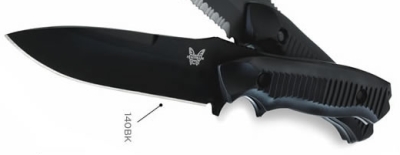
Now as I said, there are hundreds of good choices in factory knives alone; and near infinite options in custom knives; so obviously this can be nothing more than a representative sample, but there are a few general features I'd recommend:
1. 4.5" to 7.5" length: 4.5 to 6" for camp knives, and 5.5" to 7.5" for field knives.
2. Good steel, and heat treat: A very high quality stainless (like ATS34), or high carbon with a tough corrosion resistant finish (like the epoxied Carbon V that cold steel uses), and proper heat treating for the steel and grind are absolutely critical. You can't jsut say "heat treat it to 58rc", or some such, because different steels, and grinds, require different hardness levels.
4. A strong, sharp point: A modified clip, drop, or saber point, for both piercing power, and tip strength. Tantos aren't really appropriate here; because although they have a strong point, their secondary edge and point are poor for a lot of camp and field tasks like skinning.
5. A versatile blade shape and grind: I like a fair bit of belly to the blade, for slashing power, slicing power, maneuverability, and skinning ability. I also like A good length of straight plain edge near the hilt, for chopping, shaving and whittling, slicing cord, and good control for push and pull cutting work. I don't like serrated edges on camp or field knives. As to grind, I prefer hollow or saber ground blades, though a well executed flat ground blade is better if the blade is deep (like the Campe Tramp or Recon Scout). Again, tantos are not appropriate here as described above.
6. Strong, safe, and ergonomic construction: Either a one piece, full tang, or full length tang; with comfortable and durable scales or hilt that provides adequate grip and finger protection. I prefer a full cross hilt on a field knife, but a finger guard with a flat or serrated blade spine you can rest your thumb on gives you better control on a camp knife.
7. A lanyard loop or hole: Believe me, this is NECESSARY for a camp or field knife. One, when it gets wet, and muddy, and nasty, and you absolutely MUST hold on to your knife or end up dead; you have to have a lanyard. Two, you'd be surprised at how useful a spear can be in a survival situation.
Anyway, if you can meet all those requirements, you're going to get a good solid camp or field knife.
Check out my earlier piece "The Gift of a Knife" for more hints and tips on buying a knife.
Wednesday, December 06, 2006
Just how inefficient is my house
Ok, so I was just running the numbers on my electric power usage for the year and DAMN my house is inefficient.
Ok, the average residential power usage in this country, is 9000 kilowatt hours per year. Very efficient new construction averages between 3,000 and 5,000 kwh per year depending on wher ethey are located, what their heat and AC systems are etc... and a maximum efficiency, single person home can be as efficient as 1000-1200kwh per year.
My house was built in 1953; and is essentially uninsulated filled cinderblock (r value is between 5 and 9, but my AC guy estimated about 8). Theres some insulation in the roof and between some of the interior walls, but for the most part I'm just bare concrete here. Even better, I've got single pane windows, and huge air gaps all over the place.
Basically the only way my house could be more inefficient is if it ws made of overlapping sheets of tin bundled together with copper wire.
Anyway, that national average of 9,000kwh per year? Yeah I did that in August, September, and half of October.
In the nine months since we moved to this new house, we've used a grand total of 20,900kwh, with a peak usage of 3700kwh in september, and a minimum usage of 840kwh in March.
April was almsot exactly twice as much usage as March, because it was the end of march when the AC had to go on.
For this amazingly massive use of power I've paid about $2500; with another three months of relatively small ($120 a month or so) bills to go.
As I write that, I can hear my California readers weaping, because they pay something like 3-5 times what I do for power.
Ok, some allowances have to be made; this is Arizona after all, and summer is damn hot. The air conditioning is literally running 24 hours a day, seven days a week here from about June, until about September (and probably 12hr a day for april, may, and october), just to get the house down to between 74 and 78 .
Hell, It's December 6th, and we used our heat for the first time since March, just last week (we've got gas heat and hot water); and we had a sudden warm spell for a couple days here and used the AC for about an hour yesterday (it got up to 79 in the house).
That said though, the fact that my AC alone is taking up to 3,000 kwh a month is disconcerting.
Presuming 840kwh a month as our baseline usage, that puts us in jsut a bit over the national average, at about 10,000kwh per year; with the remaining 13,000-14,000kwh taken up just in air conditioning.
That's insane. That means I'm paying about $1400 a year in electric bills just to cool my house.
Now, I'm on an LTO arrangement here, so I don't own the house yet, but I'm planning on buying it. I've said before, the very first thing I'm doing when I buy is replacing the windows, and insulating the place.
I've only got 9 windows (Three large triple width casements, and 6 small casements), 2 entry doors, and 2 sliding glass doors in the house; it shouldn't be too expensive to replace the windows and doors with insulated models. The size I'm looking at would be about $600 a piece for the three big windows, and less than $200 each for the small ones. Then there's the $800-1200 each for the insulated sliding glass doors (why are they so damn expensive), and about $300 each for the entry doors.
Total on the windows and doors, about $5,000.
Next step, insulating the house.
First I go around plussing the holes, sealing and filling etc... Then I hit the roof. Roof insulation is cheap and relatively easy. I can revent the roof PROPERLY, and attic mat the whole place to r30 for about $1200.
I would guess that the $6000 or so dollars I'd spend on just those two things, would probably cut the cooling portion of my energy bills in half; so saving something like $750 to $1000 a year. Even being pessimistic I'd guess a minimum of $500 a year savings, so the costs would be recouped in as little as 6-7 years, and as many as 10-12 years.
Next step, we need a new oven, cook top and fridge. The ones I've got are from the late 70s to early 80s; and todays models are between 2 and 8 times as efficient. I dont expect a huge energy savings from those, but we need new ones anyway, and esepcially the fridge will make a big difference.
I already use a bunch of compact flourescents where I can, so there's not much to be saved there; and both Mel and I used laptops most of the time, so the desktop is in standby most of the time; and the other computers are all turned off unless we're directly using them.
We do have a little problem of habits as well.
Mel has this tendency to turn on every light in the house (no I'm not exaggerating, she turns on every single light), and she leaves them on all the time. She doesnt even notice. She also leaves the TV on all the time when she leaves the room or goes to bed, the stero, the computer etc...
No matter what I do, I can't seem to break her of this habit. She really just doesnt seem to notice what she's doing. She swears she's going to modify this behavior.
Ok, so then we've got two major problems left: the uninsulated walls, and the 20 year old air conditioner.
The AC unit I've got isn't actually all that bad, but it's too small for the house, and a newer more efficient model, combined with better ductwork (my ducts vent into uninsulated open dropped cieling space), and the better roof insulation should further cut the power usage for cooling a hell of a lot.
The unit I've got, is a Lennox, HS14-411V-6P; which for 1988 was one of the top 3 ton AC units, with an SEER of 15, and a 40,000 BTU per hour cooling rating.
The only problem is that this house as it's currently insulated needs something like a 50,000 btu per hour rating to maintain proper duty cycle; which is a bit over 4 tons. So, my AC unit is working too hard, all the time, and running inefficiently. These days, I can pick up a 4 ton unit, with an SEER of up to about 18, which means more cooling, for less juice used, more cooling overall, and more reliability.
My current 40,000 BTU unit operating at an SEER of 15, operating an average of about 4500 cooling hours a year (yes, that's really how much it's operating; about twice as much as a 4 ton unit in a well insulated house would) puts out about 180,000,000 btu of cooling a year; for an energy usage of about 12,000kwh; which after taxes and fees et all, costs me about $1200 a year.
That jibes with about how much juice I'm using currently... actually I think I'm using maybe 14,000kwh per year on cooling, or about $1400, but that's still pretty close.
With a cooling rating of 50,000 btu/hr, and a SEER of 17.8 (the trane 4 ton XL19i); a new high efficiency unit, should only have to run about 2200 cooling hours (given the new windows, doors, and insulation, maybe less) for about 110,000,000 btus, and about 6200kwh; which would cost me about $600 a year.
The problem is, one of those things aint cheap at about $5,000 for the compressor/condenser unti, and another $3000 for the air handler and assorted hardware; even saving us somewhere around $600-$800 per year.
Now we could go with a less efficient (15 SEER) 4 ton unit, for about $2,000 and still be running for less than half the time of the current 3 ton unit, at the same energy efficiency rating as currently, but with 25% more btus, thus saving about $300-400 a year instead of $600-$800 a year.
I figure between the windows and doors, the roof, new appliances, and new AC unit, we're looking at about $15,000 to $20,000 in costs; with a total of about $1000-$1200 a year in energy savings.
That means recouping the costs in about 15-20 years... Of course I don't plan on being in this house for 15 years... but the AC unit is coming up on 20 years old, the appliances are all about the same age etc... and the windows are original to the house, so they would all need replacing in the time we plan on living here anyway...
The value proposition is definitely there, but it sure does take a lot of cash up front to be energy efficient.
Ok, the average residential power usage in this country, is 9000 kilowatt hours per year. Very efficient new construction averages between 3,000 and 5,000 kwh per year depending on wher ethey are located, what their heat and AC systems are etc... and a maximum efficiency, single person home can be as efficient as 1000-1200kwh per year.
My house was built in 1953; and is essentially uninsulated filled cinderblock (r value is between 5 and 9, but my AC guy estimated about 8). Theres some insulation in the roof and between some of the interior walls, but for the most part I'm just bare concrete here. Even better, I've got single pane windows, and huge air gaps all over the place.
Basically the only way my house could be more inefficient is if it ws made of overlapping sheets of tin bundled together with copper wire.
Anyway, that national average of 9,000kwh per year? Yeah I did that in August, September, and half of October.
In the nine months since we moved to this new house, we've used a grand total of 20,900kwh, with a peak usage of 3700kwh in september, and a minimum usage of 840kwh in March.
April was almsot exactly twice as much usage as March, because it was the end of march when the AC had to go on.
For this amazingly massive use of power I've paid about $2500; with another three months of relatively small ($120 a month or so) bills to go.
As I write that, I can hear my California readers weaping, because they pay something like 3-5 times what I do for power.
Ok, some allowances have to be made; this is Arizona after all, and summer is damn hot. The air conditioning is literally running 24 hours a day, seven days a week here from about June, until about September (and probably 12hr a day for april, may, and october), just to get the house down to between 74 and 78 .
Hell, It's December 6th, and we used our heat for the first time since March, just last week (we've got gas heat and hot water); and we had a sudden warm spell for a couple days here and used the AC for about an hour yesterday (it got up to 79 in the house).
That said though, the fact that my AC alone is taking up to 3,000 kwh a month is disconcerting.
Presuming 840kwh a month as our baseline usage, that puts us in jsut a bit over the national average, at about 10,000kwh per year; with the remaining 13,000-14,000kwh taken up just in air conditioning.
That's insane. That means I'm paying about $1400 a year in electric bills just to cool my house.
Now, I'm on an LTO arrangement here, so I don't own the house yet, but I'm planning on buying it. I've said before, the very first thing I'm doing when I buy is replacing the windows, and insulating the place.
I've only got 9 windows (Three large triple width casements, and 6 small casements), 2 entry doors, and 2 sliding glass doors in the house; it shouldn't be too expensive to replace the windows and doors with insulated models. The size I'm looking at would be about $600 a piece for the three big windows, and less than $200 each for the small ones. Then there's the $800-1200 each for the insulated sliding glass doors (why are they so damn expensive), and about $300 each for the entry doors.
Total on the windows and doors, about $5,000.
Next step, insulating the house.
First I go around plussing the holes, sealing and filling etc... Then I hit the roof. Roof insulation is cheap and relatively easy. I can revent the roof PROPERLY, and attic mat the whole place to r30 for about $1200.
I would guess that the $6000 or so dollars I'd spend on just those two things, would probably cut the cooling portion of my energy bills in half; so saving something like $750 to $1000 a year. Even being pessimistic I'd guess a minimum of $500 a year savings, so the costs would be recouped in as little as 6-7 years, and as many as 10-12 years.
Next step, we need a new oven, cook top and fridge. The ones I've got are from the late 70s to early 80s; and todays models are between 2 and 8 times as efficient. I dont expect a huge energy savings from those, but we need new ones anyway, and esepcially the fridge will make a big difference.
I already use a bunch of compact flourescents where I can, so there's not much to be saved there; and both Mel and I used laptops most of the time, so the desktop is in standby most of the time; and the other computers are all turned off unless we're directly using them.
We do have a little problem of habits as well.
Mel has this tendency to turn on every light in the house (no I'm not exaggerating, she turns on every single light), and she leaves them on all the time. She doesnt even notice. She also leaves the TV on all the time when she leaves the room or goes to bed, the stero, the computer etc...
No matter what I do, I can't seem to break her of this habit. She really just doesnt seem to notice what she's doing. She swears she's going to modify this behavior.
Ok, so then we've got two major problems left: the uninsulated walls, and the 20 year old air conditioner.
The AC unit I've got isn't actually all that bad, but it's too small for the house, and a newer more efficient model, combined with better ductwork (my ducts vent into uninsulated open dropped cieling space), and the better roof insulation should further cut the power usage for cooling a hell of a lot.
The unit I've got, is a Lennox, HS14-411V-6P; which for 1988 was one of the top 3 ton AC units, with an SEER of 15, and a 40,000 BTU per hour cooling rating.
The only problem is that this house as it's currently insulated needs something like a 50,000 btu per hour rating to maintain proper duty cycle; which is a bit over 4 tons. So, my AC unit is working too hard, all the time, and running inefficiently. These days, I can pick up a 4 ton unit, with an SEER of up to about 18, which means more cooling, for less juice used, more cooling overall, and more reliability.
My current 40,000 BTU unit operating at an SEER of 15, operating an average of about 4500 cooling hours a year (yes, that's really how much it's operating; about twice as much as a 4 ton unit in a well insulated house would) puts out about 180,000,000 btu of cooling a year; for an energy usage of about 12,000kwh; which after taxes and fees et all, costs me about $1200 a year.
That jibes with about how much juice I'm using currently... actually I think I'm using maybe 14,000kwh per year on cooling, or about $1400, but that's still pretty close.
With a cooling rating of 50,000 btu/hr, and a SEER of 17.8 (the trane 4 ton XL19i); a new high efficiency unit, should only have to run about 2200 cooling hours (given the new windows, doors, and insulation, maybe less) for about 110,000,000 btus, and about 6200kwh; which would cost me about $600 a year.
The problem is, one of those things aint cheap at about $5,000 for the compressor/condenser unti, and another $3000 for the air handler and assorted hardware; even saving us somewhere around $600-$800 per year.
Now we could go with a less efficient (15 SEER) 4 ton unit, for about $2,000 and still be running for less than half the time of the current 3 ton unit, at the same energy efficiency rating as currently, but with 25% more btus, thus saving about $300-400 a year instead of $600-$800 a year.
I figure between the windows and doors, the roof, new appliances, and new AC unit, we're looking at about $15,000 to $20,000 in costs; with a total of about $1000-$1200 a year in energy savings.
That means recouping the costs in about 15-20 years... Of course I don't plan on being in this house for 15 years... but the AC unit is coming up on 20 years old, the appliances are all about the same age etc... and the windows are original to the house, so they would all need replacing in the time we plan on living here anyway...
The value proposition is definitely there, but it sure does take a lot of cash up front to be energy efficient.

Ok folks, this one is going to be a big deal (eventually)
Electricity is expensive. It takes a lot of capital to build the ifnrastructure required to produce and distribute it, a lot of fuel to produce it, and a lot of time and (personal) energy to regulat, bill, and pay for it.
It's also the most useful form of energy we've got; and our modern wourld could not exist without it.
Over the years; there have been a hell of alot of attempts at ways to replace centralized fossil fuel, or nuclear electrical generation; but none of them are really practical on a large scale, because of their general costs and inefficiencies.
The most promising technology for providing off grid power for individuals is fuel cells; but they still require a uitlity connection (either startup electricity for the water cracker, or a natural gas line).
If you want to be off the grid entirely; without relying on fuels which either runout, or require a centralized distribution system; you rbest option is solar.
The problem again though, is cost, and efficiency.
Up 'til today, the general run of photovoltaic cells (solar cells), has been about 6-8% efficient; with some super efficient, super expensive cells going to 12-14 or even 16-18%, and some ourageously expensive (100 times the cost of the 8% efficient cells), miracle, nearly unproducable ones all the way up at 24% (or even 30%, but those are pretty much only used by NASA for sattelites and the like, and they're even MORE expensive than the 24% efficient cells).
What that means, is for every 100 watts of sunlight it recieved (between 125 and 375 watts per sq meter average during daylight hours over a day; up to 1000watt per sq m at noon in high summer), a photovoltaic cell would produce between 8 and 30 watts.
Now, 24% efficiency isn't too bad. That's about the same energy efficiency the best internal combustion engines can do (most are below 15%); but it isn't enough to make converting to solar energy on a large scale very practical.
The breakeven point for solar (presuming a resonable cost per cell, and a reasonable cell lifetime), is generally reckoned at around 40% efficiency.
In practical terms, what's that mean?
Well, a typical household will use about 9000 kilowatt hours per year; and a super efficient house can (in moderate climates), get down to as low as about 1000 kilowatt hour. Without too much work, a typical family in a temperate climate could reduce their consumption down to 3000-5000 kilowatt hours for example. Obviously Alaska and Arizona are the outliers here; and older homes and appliances in general arent very efficient.
Okay so like I was saying, the average power use in the US is 9000 kilowatt hours; and the average power bill according to several net sources, in the US is about $3600 a year... hich seems awfully high to me, because the average cost of electricity is about 6 cents a killowatt hour, with fees and charges and taxes usually about doubling that. That cost may include heating, cooling, cooking, and general electric (so gas, oil, and electric) though.
With an 8% efficient cell, at 125watts per square meter, you get about 10 watts per square meter; for on average 220 days per year; and an average of 10 hours per day. That gives you 22 kilowatt hours per sq meter, per year.
These are worst case numbers by the way, because you don't plan power consumption on anything other than worst case; unless you feel like brownouts.
Anyway, with that low a power output; we're talking about a household needing 410sq meters of cells to meet their power needs; and that's assuming a uniform output, and a uniform demand, with a 100% efficient power storage system; none of which are actually possible.
Now, my house is about 52ft long, and 56 ft wide, in an L shape; so about 25% of that area is part of my driveway. It's a fairly typical house, with about 1800 sq ft of usable space; but I've got a porch, a covered parking area etc... so my total roof sq footage is probably about 2500 sq ft. 1sq ft is 0.0929 sq meters; so my roof has about 232sq meters of surface area.
So, to meet our entire energy needs with solar; we'd need to have a minimum of about twice our roof area.
Oh, and did I mention that it would cost at least $250 per sq. meter (that's including tax credits and environmental rebates etc... currently a 1sq meter panel can run as high as $2400 for the 18% efficient cells, and at a minimum run about $500), with an expected lifespan of about 25 years; and adding in an additional 20% for the wiring and battery cost. Would you like to spend $125,000 on your electric bill over 25 years? That's about $420 a month. Now I dunno about you, but my electric bill is a about $3000 a year.
Even if we best case it to 375 watts, and 300 sunny days a year for an average 10 hours per day (which even in Arizona is a bit unrealistic), and we presume a 3000 kwh per year home (which would be difficult given AC costs here, but with really good insulation could be achievable); we're still looking 90kwh per sq meter, and looking at needing 40sq meters of cells.
Let's be totally unscientific and split the difference. Say we need the whole 232sq meters of my roof; and we manage to get the costs downs to the $250 per sq meter I mentioned; then add about 20% for the associated hardware and storage costs (like huge battery and inverter banks). That's still about $70,000 for my house, and amortized over 25 years, it's just about breakeven; but agian that assumes a uniform demand, 100% efficient storage, and the ability to completely cover my roof with solar cells.
Ok, so let's assume we shell out the bucks for a much more expensive, and much more efficient cell. GE has a cell that they claim will put out 110 watts per sq meter on a 1000 watt day (about 11% efficient); it costs appx $600 per sq meter in bulk, and is warranted for 35 years.
Presuming again, a 100% efficient storage system, an even load, 300 completely sunny days a year for 10 hours a day (all completely pie in the sky); and that average of 375 watts per hour, thats 124kwh per year per meter; so we'd need about 73sq meters of cells. Again, let's split the difference between the minimum and maximum efficiency and say we really need 150sq meters at $800 per meter; and lets assume 20% additional cost for the wiring and battery network; for a total of about $145,000, or about $4,000 per year.
Still, a lot more up front cost than almost anyone would be willing to pay.
Today, the DOE has announced they have a new 40.7% efficient solar cell; at what they call a cost of $3 per watt (assuming a 1000w/sqm solstice noon). That's 407 watts per sq meter, or a cost of $1220 per sq meter.
Ok, so what does that do to our numbers?
Assuming the 375 watt maximum average, over 300 sunny days 10 hours per day, and 40.7% efficiency; to meet our 9000 kwh households electrical needs, we would only need 20sq meters of cells, at $1220 per meter; for a total of $24,000 without the supporting infrastructure.
Even assuming the worst case, of 125 watts per hour average, over 200 sunny days, 10 hours per day; you only need about 88sqm of cells, for about $110,000.
Again, we split the difference, and get about 55sqm, for about $67,000. Adding in 40% (because the cell cost is so much less than other designs) for the cost of the supporting infrastructure, and we still get $95,000. Amortized over 35 years, thats about $2700 per year; or about $225 a month.
That's quite a lot less than I pay for power right now; and I live in one of those areas where you really do get 300 plus watts of sunlight average; and I would only need to cover between 1/5 and 1/3 of my roof.
If we went and got all efficient about things with appliances and insulation, we could cut that down to 3000kwh per year, for between 10, and 30 sqm of cells (plus about $20k for the infrastructure) and between about $35,000 and $60,000; again amortized over 35 years, for $1000 to $1700 a year in power costs; or $85 to $140 a month for power.
And that folks; is when people start ponying up the extra on the front end. 15 or 20 percent more up front cost, for a house that will never have a power bill? Yeah I'd do that.
It's also the most useful form of energy we've got; and our modern wourld could not exist without it.
Over the years; there have been a hell of alot of attempts at ways to replace centralized fossil fuel, or nuclear electrical generation; but none of them are really practical on a large scale, because of their general costs and inefficiencies.
The most promising technology for providing off grid power for individuals is fuel cells; but they still require a uitlity connection (either startup electricity for the water cracker, or a natural gas line).
If you want to be off the grid entirely; without relying on fuels which either runout, or require a centralized distribution system; you rbest option is solar.
The problem again though, is cost, and efficiency.
Up 'til today, the general run of photovoltaic cells (solar cells), has been about 6-8% efficient; with some super efficient, super expensive cells going to 12-14 or even 16-18%, and some ourageously expensive (100 times the cost of the 8% efficient cells), miracle, nearly unproducable ones all the way up at 24% (or even 30%, but those are pretty much only used by NASA for sattelites and the like, and they're even MORE expensive than the 24% efficient cells).
What that means, is for every 100 watts of sunlight it recieved (between 125 and 375 watts per sq meter average during daylight hours over a day; up to 1000watt per sq m at noon in high summer), a photovoltaic cell would produce between 8 and 30 watts.
Now, 24% efficiency isn't too bad. That's about the same energy efficiency the best internal combustion engines can do (most are below 15%); but it isn't enough to make converting to solar energy on a large scale very practical.
The breakeven point for solar (presuming a resonable cost per cell, and a reasonable cell lifetime), is generally reckoned at around 40% efficiency.
In practical terms, what's that mean?
Well, a typical household will use about 9000 kilowatt hours per year; and a super efficient house can (in moderate climates), get down to as low as about 1000 kilowatt hour. Without too much work, a typical family in a temperate climate could reduce their consumption down to 3000-5000 kilowatt hours for example. Obviously Alaska and Arizona are the outliers here; and older homes and appliances in general arent very efficient.
Okay so like I was saying, the average power use in the US is 9000 kilowatt hours; and the average power bill according to several net sources, in the US is about $3600 a year... hich seems awfully high to me, because the average cost of electricity is about 6 cents a killowatt hour, with fees and charges and taxes usually about doubling that. That cost may include heating, cooling, cooking, and general electric (so gas, oil, and electric) though.
With an 8% efficient cell, at 125watts per square meter, you get about 10 watts per square meter; for on average 220 days per year; and an average of 10 hours per day. That gives you 22 kilowatt hours per sq meter, per year.
These are worst case numbers by the way, because you don't plan power consumption on anything other than worst case; unless you feel like brownouts.
Anyway, with that low a power output; we're talking about a household needing 410sq meters of cells to meet their power needs; and that's assuming a uniform output, and a uniform demand, with a 100% efficient power storage system; none of which are actually possible.
Now, my house is about 52ft long, and 56 ft wide, in an L shape; so about 25% of that area is part of my driveway. It's a fairly typical house, with about 1800 sq ft of usable space; but I've got a porch, a covered parking area etc... so my total roof sq footage is probably about 2500 sq ft. 1sq ft is 0.0929 sq meters; so my roof has about 232sq meters of surface area.
So, to meet our entire energy needs with solar; we'd need to have a minimum of about twice our roof area.
Oh, and did I mention that it would cost at least $250 per sq. meter (that's including tax credits and environmental rebates etc... currently a 1sq meter panel can run as high as $2400 for the 18% efficient cells, and at a minimum run about $500), with an expected lifespan of about 25 years; and adding in an additional 20% for the wiring and battery cost. Would you like to spend $125,000 on your electric bill over 25 years? That's about $420 a month. Now I dunno about you, but my electric bill is a about $3000 a year.
Even if we best case it to 375 watts, and 300 sunny days a year for an average 10 hours per day (which even in Arizona is a bit unrealistic), and we presume a 3000 kwh per year home (which would be difficult given AC costs here, but with really good insulation could be achievable); we're still looking 90kwh per sq meter, and looking at needing 40sq meters of cells.
Let's be totally unscientific and split the difference. Say we need the whole 232sq meters of my roof; and we manage to get the costs downs to the $250 per sq meter I mentioned; then add about 20% for the associated hardware and storage costs (like huge battery and inverter banks). That's still about $70,000 for my house, and amortized over 25 years, it's just about breakeven; but agian that assumes a uniform demand, 100% efficient storage, and the ability to completely cover my roof with solar cells.
Ok, so let's assume we shell out the bucks for a much more expensive, and much more efficient cell. GE has a cell that they claim will put out 110 watts per sq meter on a 1000 watt day (about 11% efficient); it costs appx $600 per sq meter in bulk, and is warranted for 35 years.
Presuming again, a 100% efficient storage system, an even load, 300 completely sunny days a year for 10 hours a day (all completely pie in the sky); and that average of 375 watts per hour, thats 124kwh per year per meter; so we'd need about 73sq meters of cells. Again, let's split the difference between the minimum and maximum efficiency and say we really need 150sq meters at $800 per meter; and lets assume 20% additional cost for the wiring and battery network; for a total of about $145,000, or about $4,000 per year.
Still, a lot more up front cost than almost anyone would be willing to pay.
Today, the DOE has announced they have a new 40.7% efficient solar cell; at what they call a cost of $3 per watt (assuming a 1000w/sqm solstice noon). That's 407 watts per sq meter, or a cost of $1220 per sq meter.
Ok, so what does that do to our numbers?
Assuming the 375 watt maximum average, over 300 sunny days 10 hours per day, and 40.7% efficiency; to meet our 9000 kwh households electrical needs, we would only need 20sq meters of cells, at $1220 per meter; for a total of $24,000 without the supporting infrastructure.
Even assuming the worst case, of 125 watts per hour average, over 200 sunny days, 10 hours per day; you only need about 88sqm of cells, for about $110,000.
Again, we split the difference, and get about 55sqm, for about $67,000. Adding in 40% (because the cell cost is so much less than other designs) for the cost of the supporting infrastructure, and we still get $95,000. Amortized over 35 years, thats about $2700 per year; or about $225 a month.
That's quite a lot less than I pay for power right now; and I live in one of those areas where you really do get 300 plus watts of sunlight average; and I would only need to cover between 1/5 and 1/3 of my roof.
If we went and got all efficient about things with appliances and insulation, we could cut that down to 3000kwh per year, for between 10, and 30 sqm of cells (plus about $20k for the infrastructure) and between about $35,000 and $60,000; again amortized over 35 years, for $1000 to $1700 a year in power costs; or $85 to $140 a month for power.
And that folks; is when people start ponying up the extra on the front end. 15 or 20 percent more up front cost, for a house that will never have a power bill? Yeah I'd do that.
Tuesday, December 05, 2006
Woo Hoo 368
So, on Monday, I'll have been on this diet for three months exactly; and this morning I weighed in at 368lbs.
Presuming I make it to 365 by Monday, that will be 60lbs lost in three months.
That's pretty damned impressive if I do say so myself; especially since my excercise program has been inconsistent. I swear there's a conspiracy against me; I get a good routine going for a few weeks, then I manage to buger my knees up but good, and the second my knees feel better, I get hit with the creeping crud (holding on through its 8th day at the moment).
Mel has gone down to 210 (from 225); and seems to have stalled out a bit; but she's still slowly losing.
Presuming I make it to 365 by Monday, that will be 60lbs lost in three months.
That's pretty damned impressive if I do say so myself; especially since my excercise program has been inconsistent. I swear there's a conspiracy against me; I get a good routine going for a few weeks, then I manage to buger my knees up but good, and the second my knees feel better, I get hit with the creeping crud (holding on through its 8th day at the moment).
Mel has gone down to 210 (from 225); and seems to have stalled out a bit; but she's still slowly losing.
Where have YOU been?

create your own visited country map
The America only version of this one went around a few months back, but i've been to all 50 states, so it's a bit boring.
The big hole there, is most of Africa. I'd really like to visit some of them before they become totally unrecoverable... 'course it's too late for a lot of Africa. Other than SA and Egypt which I don't really count as Africa, I've only been to Kenya and Nigeria (both for contracts); and I haven't really seen the good and intersting stuff.
Central Asia is pretty bare for me too, but theres not a lot there for me to visit.
Also, most of these places I was either traveling through, or I got off a plane, went to a site, did a job, got back on a plane, and left. I'd like the chance to get a lot more "fun" stuff done in a lot of those places.
Also, the map looks a lot more impressive than it really is, because most of the time I visited one single city; and theres a whole country filled in.
So, where've you been?
Monday, December 04, 2006
That's because it does
 Every day off I take costs me a bloody fortune (about $400 after taxes). My co-workers OTOH get 15-20 days of PTO a year. Consequence? I end up doing a lot of holiday and vacation coverage; and I took off a total of two non-company holiday days this year.
Sunday, December 03, 2006

Saturday, December 02, 2006
What Dreams May Come
Cowboy Blob is having another caption contest this weekend. I was planning on doing a riff on the St. Crispins day speech, but Law Dog beat me to it, so here's my shot.

"To nap, or not to nap, that is the question. Whether tis nobler in the mind to suffer the squirt guns and yip dogs of outrageous fortune; or to take up paws against a see of rocking chairs, and by opposing them, to end them.UPDATE: Looks like LawDog and I shared in our poetic victory
To purr, to sleep -- and by a sleep to say we end the string chase, and the thousand natural static shocks our fur is heir to. Tis a scratching devoutly to be wished.
To nap, to sleep, perhance to dream... aye, theres the belly rub. For in that overfed sleep in a sunny warm place, what dreams of chasing dust motes may come"
Thursday, November 30, 2006
Aargh, I hate being sick
Which I have been for a couple days now (yes, including while in court yesterday, which did suck mightily indeed).
Of course we have a 4 year old in pre-kindergarten, so we've got hot and cold running plagues in the house; but amazingly enough I managed to avoid being REALLY sick for the best part of the past year.
I think I've got some kind of sinus infection; pretty mild though, unlike my yearly amjor sinus hell weeks. I had a slight fever yesterday, and theres been some joint pain, oversensitivity to light and noise etc, and of course, the sinus pressure and drainage, but no nausea or anything.
I s'pose it's been complicated by the fact that I'm in the middle of a major insomniac episode. Last night was the first time I'd slept more than two hours at a time in about a week.
So pretty much just bleagh, sneeze, blagh sniffle, blagh.
Of course we have a 4 year old in pre-kindergarten, so we've got hot and cold running plagues in the house; but amazingly enough I managed to avoid being REALLY sick for the best part of the past year.
I think I've got some kind of sinus infection; pretty mild though, unlike my yearly amjor sinus hell weeks. I had a slight fever yesterday, and theres been some joint pain, oversensitivity to light and noise etc, and of course, the sinus pressure and drainage, but no nausea or anything.
I s'pose it's been complicated by the fact that I'm in the middle of a major insomniac episode. Last night was the first time I'd slept more than two hours at a time in about a week.
So pretty much just bleagh, sneeze, blagh sniffle, blagh.
Fun Little Quiz
Found this one at Ride-n-shoot "Gun Nut Quiz":
There were a few trick questions; but I recognized them as trick questions.
David E. Petzal's Gun Nut Quiz
Your score is: 20 out of 20
Scatology
Unc is going through the fun of potty training, and so are we.
Our youngest was 3 in September; and she was making progress on peeing in the potty for a while, but then she completely backslid. Oh she'll still sometimes go to pee in the potty, but most of the time she's perfectly happy to have that warm relief in her pullups.
Thing is, she just doesnt want to give up her diaper. She likes being able to crap in her pants whenever she wants to, and doesnt want to have to go potty.
I can sympathize I suppose; taking bathroom breaks when you REALLLY want to figure out Blues next clue must be a real inconvenience.
What she's coming up against though, is pre-school. She wants to go to pre-school next year like her sister (who'll actually be in Kindergarten next year), and she can't go if she's not potty trained.
You can see it like a little war inside her head "Donwanna use the potty... wanna go school like big girl, like my sister... but donwanna stop my diaper"
She's waking up dry most of the time these days; and if she wanted to use it, she'd have the control, she just doesn't want to. As far as she's concerned, things are jsut fine the way they are thank you very much, and ooops, I jsut crapped my pants, isn't that funny mommy.
On the one hand it's hilarious; on the other hand pullups are expensive, changing her all the time is a PITA, and of course there's the pre-school issue.
Ahh the perils and adventures of being a suburban dad
Our youngest was 3 in September; and she was making progress on peeing in the potty for a while, but then she completely backslid. Oh she'll still sometimes go to pee in the potty, but most of the time she's perfectly happy to have that warm relief in her pullups.
Thing is, she just doesnt want to give up her diaper. She likes being able to crap in her pants whenever she wants to, and doesnt want to have to go potty.
I can sympathize I suppose; taking bathroom breaks when you REALLLY want to figure out Blues next clue must be a real inconvenience.
What she's coming up against though, is pre-school. She wants to go to pre-school next year like her sister (who'll actually be in Kindergarten next year), and she can't go if she's not potty trained.
You can see it like a little war inside her head "Donwanna use the potty... wanna go school like big girl, like my sister... but donwanna stop my diaper"
She's waking up dry most of the time these days; and if she wanted to use it, she'd have the control, she just doesn't want to. As far as she's concerned, things are jsut fine the way they are thank you very much, and ooops, I jsut crapped my pants, isn't that funny mommy.
On the one hand it's hilarious; on the other hand pullups are expensive, changing her all the time is a PITA, and of course there's the pre-school issue.
Ahh the perils and adventures of being a suburban dad
Tuesday, November 28, 2006
I hate court, yet still I go
Chris, my parents, and I head to court tomorrow morning.
I hate court. Really, really, hate court. If I had my choice I would do everything ethically possible to avoid court. Court is not for nice people, and I really HATE having my name dragged through the mud.
But I can't avoid it without things getting worse, and therefore we go.
Once again I won't post any details, other than I wish this entire thing was already over.
That being said, please wish us luck and if you are so inclined, pray for us.
Mel
UPDATE:
Okay, that went a lot better than we expected. Not the absolutely best outcome that could have come about, but definitely good. We go back to court in January.
I hate court. Really, really, hate court. If I had my choice I would do everything ethically possible to avoid court. Court is not for nice people, and I really HATE having my name dragged through the mud.
But I can't avoid it without things getting worse, and therefore we go.
Once again I won't post any details, other than I wish this entire thing was already over.
That being said, please wish us luck and if you are so inclined, pray for us.
Mel
UPDATE:
Okay, that went a lot better than we expected. Not the absolutely best outcome that could have come about, but definitely good. We go back to court in January.
Saddling Up
So, a friend of mine posited the question, what would you have to do if you had to saddle up again; by which he meant you had to make a deployment, irregular or regular. What would you take with you, if you had a choice.
Assume two scenarios:
One: just you, any choice of weapons legally available to you within the means of a normal man (lt's say middle class to upper middle class) dedicating his entire financial worth to this project.
Two: You, and 3-7 other guys (for 4-8 total), presume limited availability of military hardware; such as security contracting companies have access to. Anything that's on the commercial market is fair game.
Presume you have time to train and condition, with the hardware you acquire, together as a team, before you have to deploy.
Those specific parameters are mine, not his; I chose them as seemingly reasonable for an excercise of this type.
He also posits a mission: After you have trained up, while awaiting deployment, your wife and daughter are trapped in central Mexico by a local "revolucion". They are in sometime communication, and are not being held by revolucionaries; but they will not be able to exit the area without armed escort, and possible direct force.
There have been border skirmishes between U.S. and Mexican troops and/or irregulars; and no governmental agency is willing or able to get them out (you could transpose this same situation to other AO).
Who and what do you do it with?
I'm game for this; could be fun eh.
Ok, first scenario, just me.
Primary weapon: Smith EBR M14 conversion, sage system, night force and an acog on QD mounts, plus BUIS, and an M6 (the big one, not the little one) on the rail with a QD. IR laser on the rail. A conversion sling (2 point, 3 point, 4 point switchable with QDs), and an LWS suppressor on a QD.
Sidearm: HK USP tactical, gemtech or LWS suppressor, M6 combo light with the IR laser.
10 spare M-14 mags (1 in the rifle), loaded up with 180gr Sierra Match King, and pouches. 4 spare mags for the USP (plus one in the pistol), 230gr .45 +p+/super hornady XTP loaded to just barely subsonic, with pouches.
Pop for a PVS7 (about 5 grand last I checked), or PVS14, a Dragon Skin, and a Blackhawk LBE setup, with a back frame (to lash the backup to, among other things), ass pack, and assault ruck with a 2 gallon hydration bladder.
Gerber multipro with toolkit, swamp rat camp tramp, a good set of dikes, a multi driver tool. a decent field spares kit with 2 of every pin, clip and spring, and a good cleaning kit with a couple punches.
20m braided spectrashield sheathed line, and 50m 550 cord, anchors, descenders, ‘biners. 50 zip ties of assorted sizes, 10 bungies of assorted size, 2 medium rolls hun-tape, 1 roll heat shrink electrical tape. 12 assorted cyalumes, pen pop flares, mini flares, two micro strobes, and 4 small personal lights. 2 full spare sets of batteries for everything. Baby wipes, simple green wipes (there are alcohol wipes and betadine wipes in the EFS kit), a bicycle inner tube, superglue, extra heavy duty aluminum foil, some microfiber cloth, baggies bags, rubbers or heavy duty baloons, clear nail polish, q-tips, some pencils WITH erasers, needles and thread (other than in the med gear), spool of fine safety wire, Lighter fluid (the ronsonol kind) or another flammable solvent, a half dozen disposable cigarette lighters, and a zippo
I can think of about a million little things that you’d absolutely kill for when you need’em, and you need’em more often than you’d think.
I’ll leave out the details of nav, comm, med gear, and food; suffice it to say I won’t go anywhere without an EFS kit, a double stuffed trauma pack plus SAM splints, my serious meds kit, a solid GPS, 2 short range comms and a long range comm plus spares (the choice varies depending on mission requirements, and support), and 5 days of minimally decent high calorie field food, plus about 15 energy bars, and 20 packets of gatorade.
Total load out, about 100 lbs including the weight of the food, water, LBE, sack, pack, and armor; most of which I had at one time, and had no problem with for short hauls (meaning less than 10 miles. You can generally handle about 1/3 your body weight for extended periods of time, and a lot of that weight is in consumables). Of course I’ll need a year to get back to where I can do it again, and I’ll need two solid knee braces, and a solid collapsible walking staff (cold steel and others make good weaponised examples).
Then give me a good 4x4 ATV, with a backrest pack setup, and front and rear rack setups; loaded up with ammo (say another 10 mags for the M-14), a shotgun as below, fuel, water, and spares... oh and a field genset, storage battery, a winch, a compressor, and another longer range com with a longwire setup. Seal the tires up with green slime. Give me a field bivvy with a breakup net over it for me and the quad. I may need to worry about transporting the rescuees back, so maybe throw in a trailer.
Another option would be a disguised 4x4. Stick all your Mil gear in with old tools, regular camping gear, etc.. and strap various items to undercarriage or under bodywork.
If I can pick out 3-7 other guys, things change completely. I’ve based this on hardware I own or can easily acquire, legally, within the next few months. If I have access to military hardware things change substantially, but not completely.
Second situation, you have backup. Now, I said if I had otherguys things changed completely, and I meant it. Let’s explore that here.
First step, training. I need guys who do not quit, ever, no matter what. A man is never defeated until he concedes defeat to himself. I know some folks who’ll do.
Assume 4 man team total (the most likely scenario actually, and the easiest to insert and support) including myself. Everybody crosstrains on comms, and medical; with two specialists in both (I’m well qualified in either, but I could use an update on both). Everybody crosstrains on demo, with two specialists. Everybody crosstrains in basic vehicle maintenance. Everybody crosstrains on basic spanish (or the language of choice for the AO), with two specialists. Everybody crosstrains on navigation. I want two fixed wing pilots (I’m one), and two rotorheads if I can get them.
Physical conditioning. Runs are great for young guys, but don’t do much for knock knees like me. I can walk all day if I have to (it hurts, but I can do it). I can walk for four hours with my 50lb little girl on my back, but I can’t run for five minutes even when I get my fat ass back down to fighting weight, or my knees will collapse. That means hiking, in mixed terrain and hot weather, with field loads, in good boots. Minimum 5 miles per day, up to 20 miles per day. Bicycling, and circuit training for strength and endurance. Good supplemental regimen in place.
Gear loadout is a bit different. Still presuming no access to non-civvy gear, I change the mix up some. Everybody gets substantially the same personal gear I mentioned, but the doubled items get cut down to one per person, and some of the single items get cut down to two for the whole team. For example I’d mix it up with One heavy med kit, one medium kit (and two personal kits of course) the guys not carrying the big meds haul extra ammo, food, and water; along with 5ks each of commercial plastic explosives, and detonators; and some civvy flashbangs.
With 4 guys, I change out the weapons a bit. First thing, we all get the same primary weapon, but in different configurations. 7.62X39 ARs, with an AK magwell and a piston upper (I just don’t like the AK). Two configured as entry guns, two as DM rifles. Yes, the round is marginal for DM use, but I want to be able to “field resupply” if possible.
Second, two shotguns as secondary weapons: SBS mossy 590 with the Knoxx CopStock folder, a breacher standoff, side saddle, surefire forend (cut to clear), a ghost ring setup, and an IR laser. Fold the stock and lash it to the pack frame. 20 reduced recoil 00 buck shells, 10 hornady SST slugs, and 5 breachers, plus pouches..
Third, we change the pistols to 9mm, again for field resupply. I think I’d stay with the USP, but switch to the 9mm version; and an extended threaded barrel. Otherwise a Sig P226, same type of barrel.
Why the emphasis on field resupply with 4 when I went all out on power with 1? Because with one guy operating alone, I’m doing every single possible thing I can do to avoid ever having to use ANY of my ammo; and I may be able to get away with it. With 4 guys, the liklihood of getting into an extended firefight of some kind is much higher, as is the lilihood of needing to provide suppressive fire etc…
Also, everyone still gets two short range comms, but there are only two long range comms in the personal packs total.
We organize as mutually supporting pairs; one entry gun with one DM gun; and those pairs never have both pilots, both medics, both linguists etc.. if possible. We designate a commander, an XO, one primary RTO, and one primary medic, with their alternates.
If we get six guys, the equation changes a bit more. I still like the weapons mix, but with six, I really need some heavier weapons. At that point I have to have an LMG of some kind (with an SMG, or assault carbine as a secondary weapon), and one of the guys should have a long boltie in something heavy, maybe a .338. Also, with six or more, I need at least two ‘naders, and some personal frags, and some flashbangs. The infrastructure load out is spread out more, but we still maintain double coverage on all items and specialties. Instead of six atvs we go to two custom jeeps, or land rover defenders.
Organizationally, we remaing in mutually supporting pairs, with a pair designated to remain as ready reserve consisting of the tactical commander, and a designated medic, who is also a reserve radio operator. We also designate an XO, an alternate medic, and an alternate RTO as with 4.
Eight is the maximum I’d want for something like this, and again we’d spread the infrastructure load out, but instead of double coverage on critical items, we go to triple coverage. At this point I want an MMG/GPMG for each vehicle. Also, we can change calibers back to standard if so desired because we can carry enough weight of metal with us that I’m not as worried about field resupply.
Some organizational notes on 8 people: At this level we organize into two fireteams of two mutually supporting pairs each team. Also, at this point we designate an S2, S3, and S4, and their assistants; as well as a designated medic, two alternates, the tactical commander and XO (the XO is probably the S3), and a dedicated RTO and two alternates.
Funny enough, all of this is still civvy legal in the US, but expensive as all hell. Honestly, if I had to do this without legal access to military hardware here in the U.S. I’d train up and gear up with everything but the mil weapons, then head down to the CZ and pick up what I need there.
Now, reader Ross posits a different scenario. It's Tuesday, you get notice of the problem today; you have til Friday to infil and make the grab, and say the rest of the weekend to exfil until the excrement is throroughly splattered by the rotating ventilation device.
Scenario three:
You have no budget but what is in your bank account (presume appx $5000), and no resources excepting what you have, or can scrounge from friends in that time.
Ok, that's a pretty good scenario.
One problem in applying it to me: If it ever came down to life or death, I have friends who can get me almost anything I need from the list above within a couple days. Of course I'm still fat and out of shape, and don't have time to train or build a team... but I've still got some of those friends I mention, and not only would they be willing to go with me, but I couldn't stop them if I wanted to.
But, let's presume for sake of argument we are talking about J. Random Gun Nut.
Now, assuming no budget but what you have in the bank, and no friends to acquire from or use for your team, THATs a more serious limitation; but you can get everything but the night vision and the ATV pretty easily and quickly, even with just the cash in your bank account.
I cut the load by about 50%, and pick up a used but reliable beater 4x4 or something similar. My primary weapon becomes an AK variant, with an ultimak, a folder, and an eotech; and I pick up the cheapest gen 3 viewer I can find. I stick everything in like regular camping and off roading gear and come in on a regular tourist permit as described above. If I can't get the toursit permit because of the hostilities, it's still pretty much trivially easy to get into mexico (I've done it on ATVs and dirtbikes a bunch of times).
If I can get three to five solid guys to go with me (and I know I can), and they can use their budget as well, I can still do the two 4x4 gig; and there are a couple of women I know who I'd want to ring along. They're both great backup, and great cover.
Now, heres a curveball for you; presume you have access to a boat in brownsville, that is large enough to take you across to the central mexican coast, with 4 ATV's. Have one guy offshore, running comms for you, and coming in for extraction; how does that change the equation?
UPDATE: Clarified the original mission, training, equipment parameters etc... and added the section about an "instant" mission.
Assume two scenarios:
One: just you, any choice of weapons legally available to you within the means of a normal man (lt's say middle class to upper middle class) dedicating his entire financial worth to this project.
Two: You, and 3-7 other guys (for 4-8 total), presume limited availability of military hardware; such as security contracting companies have access to. Anything that's on the commercial market is fair game.
Presume you have time to train and condition, with the hardware you acquire, together as a team, before you have to deploy.
Those specific parameters are mine, not his; I chose them as seemingly reasonable for an excercise of this type.
He also posits a mission: After you have trained up, while awaiting deployment, your wife and daughter are trapped in central Mexico by a local "revolucion". They are in sometime communication, and are not being held by revolucionaries; but they will not be able to exit the area without armed escort, and possible direct force.
There have been border skirmishes between U.S. and Mexican troops and/or irregulars; and no governmental agency is willing or able to get them out (you could transpose this same situation to other AO).
Who and what do you do it with?
I'm game for this; could be fun eh.
Ok, first scenario, just me.
Primary weapon: Smith EBR M14 conversion, sage system, night force and an acog on QD mounts, plus BUIS, and an M6 (the big one, not the little one) on the rail with a QD. IR laser on the rail. A conversion sling (2 point, 3 point, 4 point switchable with QDs), and an LWS suppressor on a QD.
Sidearm: HK USP tactical, gemtech or LWS suppressor, M6 combo light with the IR laser.
10 spare M-14 mags (1 in the rifle), loaded up with 180gr Sierra Match King, and pouches. 4 spare mags for the USP (plus one in the pistol), 230gr .45 +p+/super hornady XTP loaded to just barely subsonic, with pouches.
Pop for a PVS7 (about 5 grand last I checked), or PVS14, a Dragon Skin, and a Blackhawk LBE setup, with a back frame (to lash the backup to, among other things), ass pack, and assault ruck with a 2 gallon hydration bladder.
Gerber multipro with toolkit, swamp rat camp tramp, a good set of dikes, a multi driver tool. a decent field spares kit with 2 of every pin, clip and spring, and a good cleaning kit with a couple punches.
20m braided spectrashield sheathed line, and 50m 550 cord, anchors, descenders, ‘biners. 50 zip ties of assorted sizes, 10 bungies of assorted size, 2 medium rolls hun-tape, 1 roll heat shrink electrical tape. 12 assorted cyalumes, pen pop flares, mini flares, two micro strobes, and 4 small personal lights. 2 full spare sets of batteries for everything. Baby wipes, simple green wipes (there are alcohol wipes and betadine wipes in the EFS kit), a bicycle inner tube, superglue, extra heavy duty aluminum foil, some microfiber cloth, baggies bags, rubbers or heavy duty baloons, clear nail polish, q-tips, some pencils WITH erasers, needles and thread (other than in the med gear), spool of fine safety wire, Lighter fluid (the ronsonol kind) or another flammable solvent, a half dozen disposable cigarette lighters, and a zippo
I can think of about a million little things that you’d absolutely kill for when you need’em, and you need’em more often than you’d think.
I’ll leave out the details of nav, comm, med gear, and food; suffice it to say I won’t go anywhere without an EFS kit, a double stuffed trauma pack plus SAM splints, my serious meds kit, a solid GPS, 2 short range comms and a long range comm plus spares (the choice varies depending on mission requirements, and support), and 5 days of minimally decent high calorie field food, plus about 15 energy bars, and 20 packets of gatorade.
Total load out, about 100 lbs including the weight of the food, water, LBE, sack, pack, and armor; most of which I had at one time, and had no problem with for short hauls (meaning less than 10 miles. You can generally handle about 1/3 your body weight for extended periods of time, and a lot of that weight is in consumables). Of course I’ll need a year to get back to where I can do it again, and I’ll need two solid knee braces, and a solid collapsible walking staff (cold steel and others make good weaponised examples).
Then give me a good 4x4 ATV, with a backrest pack setup, and front and rear rack setups; loaded up with ammo (say another 10 mags for the M-14), a shotgun as below, fuel, water, and spares... oh and a field genset, storage battery, a winch, a compressor, and another longer range com with a longwire setup. Seal the tires up with green slime. Give me a field bivvy with a breakup net over it for me and the quad. I may need to worry about transporting the rescuees back, so maybe throw in a trailer.
Another option would be a disguised 4x4. Stick all your Mil gear in with old tools, regular camping gear, etc.. and strap various items to undercarriage or under bodywork.
If I can pick out 3-7 other guys, things change completely. I’ve based this on hardware I own or can easily acquire, legally, within the next few months. If I have access to military hardware things change substantially, but not completely.
I’m thinking of a 500 mile infil-exfil corridor here, from between brownsville and mission (holes a mile wide down there) and northern Ouaxaca; we’d never be able to do it on foot.
One guy with an ATV could cover that in a few days, but four or six guys in an obvious off roader or two (especially if we could mix a woman or two into the op) would be better.
If it were stable enough for regular border traffic to continue, I’d want to smuggle the gear in and cache it overnight, then cross at a regular crossing with the proper tourist permits etc…
You’d be surprised at how much crap you can conceal and disguise on a couple of off road rigs; especially if you take lots of bribing cash.
First step, training. I need guys who do not quit, ever, no matter what. A man is never defeated until he concedes defeat to himself. I know some folks who’ll do.
Assume 4 man team total (the most likely scenario actually, and the easiest to insert and support) including myself. Everybody crosstrains on comms, and medical; with two specialists in both (I’m well qualified in either, but I could use an update on both). Everybody crosstrains on demo, with two specialists. Everybody crosstrains in basic vehicle maintenance. Everybody crosstrains on basic spanish (or the language of choice for the AO), with two specialists. Everybody crosstrains on navigation. I want two fixed wing pilots (I’m one), and two rotorheads if I can get them.
Physical conditioning. Runs are great for young guys, but don’t do much for knock knees like me. I can walk all day if I have to (it hurts, but I can do it). I can walk for four hours with my 50lb little girl on my back, but I can’t run for five minutes even when I get my fat ass back down to fighting weight, or my knees will collapse. That means hiking, in mixed terrain and hot weather, with field loads, in good boots. Minimum 5 miles per day, up to 20 miles per day. Bicycling, and circuit training for strength and endurance. Good supplemental regimen in place.
Gear loadout is a bit different. Still presuming no access to non-civvy gear, I change the mix up some. Everybody gets substantially the same personal gear I mentioned, but the doubled items get cut down to one per person, and some of the single items get cut down to two for the whole team. For example I’d mix it up with One heavy med kit, one medium kit (and two personal kits of course) the guys not carrying the big meds haul extra ammo, food, and water; along with 5ks each of commercial plastic explosives, and detonators; and some civvy flashbangs.
With 4 guys, I change out the weapons a bit. First thing, we all get the same primary weapon, but in different configurations. 7.62X39 ARs, with an AK magwell and a piston upper (I just don’t like the AK). Two configured as entry guns, two as DM rifles. Yes, the round is marginal for DM use, but I want to be able to “field resupply” if possible.
Second, two shotguns as secondary weapons: SBS mossy 590 with the Knoxx CopStock folder, a breacher standoff, side saddle, surefire forend (cut to clear), a ghost ring setup, and an IR laser. Fold the stock and lash it to the pack frame. 20 reduced recoil 00 buck shells, 10 hornady SST slugs, and 5 breachers, plus pouches..
Third, we change the pistols to 9mm, again for field resupply. I think I’d stay with the USP, but switch to the 9mm version; and an extended threaded barrel. Otherwise a Sig P226, same type of barrel.
Why the emphasis on field resupply with 4 when I went all out on power with 1? Because with one guy operating alone, I’m doing every single possible thing I can do to avoid ever having to use ANY of my ammo; and I may be able to get away with it. With 4 guys, the liklihood of getting into an extended firefight of some kind is much higher, as is the lilihood of needing to provide suppressive fire etc…
Also, everyone still gets two short range comms, but there are only two long range comms in the personal packs total.
We organize as mutually supporting pairs; one entry gun with one DM gun; and those pairs never have both pilots, both medics, both linguists etc.. if possible. We designate a commander, an XO, one primary RTO, and one primary medic, with their alternates.
If we get six guys, the equation changes a bit more. I still like the weapons mix, but with six, I really need some heavier weapons. At that point I have to have an LMG of some kind (with an SMG, or assault carbine as a secondary weapon), and one of the guys should have a long boltie in something heavy, maybe a .338. Also, with six or more, I need at least two ‘naders, and some personal frags, and some flashbangs. The infrastructure load out is spread out more, but we still maintain double coverage on all items and specialties. Instead of six atvs we go to two custom jeeps, or land rover defenders.
Organizationally, we remaing in mutually supporting pairs, with a pair designated to remain as ready reserve consisting of the tactical commander, and a designated medic, who is also a reserve radio operator. We also designate an XO, an alternate medic, and an alternate RTO as with 4.
Eight is the maximum I’d want for something like this, and again we’d spread the infrastructure load out, but instead of double coverage on critical items, we go to triple coverage. At this point I want an MMG/GPMG for each vehicle. Also, we can change calibers back to standard if so desired because we can carry enough weight of metal with us that I’m not as worried about field resupply.
Some organizational notes on 8 people: At this level we organize into two fireteams of two mutually supporting pairs each team. Also, at this point we designate an S2, S3, and S4, and their assistants; as well as a designated medic, two alternates, the tactical commander and XO (the XO is probably the S3), and a dedicated RTO and two alternates.
Funny enough, all of this is still civvy legal in the US, but expensive as all hell. Honestly, if I had to do this without legal access to military hardware here in the U.S. I’d train up and gear up with everything but the mil weapons, then head down to the CZ and pick up what I need there.
Now, reader Ross posits a different scenario. It's Tuesday, you get notice of the problem today; you have til Friday to infil and make the grab, and say the rest of the weekend to exfil until the excrement is throroughly splattered by the rotating ventilation device.
Scenario three:
You have no budget but what is in your bank account (presume appx $5000), and no resources excepting what you have, or can scrounge from friends in that time.
Ok, that's a pretty good scenario.
One problem in applying it to me: If it ever came down to life or death, I have friends who can get me almost anything I need from the list above within a couple days. Of course I'm still fat and out of shape, and don't have time to train or build a team... but I've still got some of those friends I mention, and not only would they be willing to go with me, but I couldn't stop them if I wanted to.
But, let's presume for sake of argument we are talking about J. Random Gun Nut.
Now, assuming no budget but what you have in the bank, and no friends to acquire from or use for your team, THATs a more serious limitation; but you can get everything but the night vision and the ATV pretty easily and quickly, even with just the cash in your bank account.
I cut the load by about 50%, and pick up a used but reliable beater 4x4 or something similar. My primary weapon becomes an AK variant, with an ultimak, a folder, and an eotech; and I pick up the cheapest gen 3 viewer I can find. I stick everything in like regular camping and off roading gear and come in on a regular tourist permit as described above. If I can't get the toursit permit because of the hostilities, it's still pretty much trivially easy to get into mexico (I've done it on ATVs and dirtbikes a bunch of times).
If I can get three to five solid guys to go with me (and I know I can), and they can use their budget as well, I can still do the two 4x4 gig; and there are a couple of women I know who I'd want to ring along. They're both great backup, and great cover.
Now, heres a curveball for you; presume you have access to a boat in brownsville, that is large enough to take you across to the central mexican coast, with 4 ATV's. Have one guy offshore, running comms for you, and coming in for extraction; how does that change the equation?
UPDATE: Clarified the original mission, training, equipment parameters etc... and added the section about an "instant" mission.
Monday, November 27, 2006
In a Clean, Neat, Military Manner
Just one little slip of the razor and...

Ooopsie, last time I had this haircut I was 19...
I WAS just trimming up a bit, when the shaver comb popped off and said shaver dug into my skull, and ouch.
Only one solution, and that's a huah, hot damn, that's right, high and tight!
Ooopsie, last time I had this haircut I was 19...
I WAS just trimming up a bit, when the shaver comb popped off and said shaver dug into my skull, and ouch.
Only one solution, and that's a huah, hot damn, that's right, high and tight!


Saturday, November 25, 2006
A tradition continues
Last year, I bought my wife the first gun she ever owned, a Ruger SP101, 2-3/4" in .357.
Today, I continued that tradition with this, the first rifle she's ever owned (first of many):

It's an 1894c in .357, but we've got the one with the smooth (uncheckered) darker wood.
Oh, and I also got her one of these:
 And tomorrow we're going to see them:

Should be a great day; for a great lady.
Today, I continued that tradition with this, the first rifle she's ever owned (first of many):

Oh, and I also got her one of these:
 And tomorrow we're going to see them:
Should be a great day; for a great lady.
How to clean a Yugo Mauser 24/47
Step 1. Spray entire rifle, your whole body, your synthetic fabric clothing, and the driveway sealer with brake cleaner
Step 2. Have briliant idea, and take portable blowtorch to the metal, to melt cosmoline off
Step 4. Watch friends laugh at brilliant plan; while they clear the blast radius, and ready the fire extinguisher
Step 5. Get the camera, this oughta be fun
Step 6. Fail to resist the overwhelming urge to make a texas flame thrower with blowtorch and brake cleaner
Step 7. Arrange for replacement of that patio furniture... those potted plants were dead anyway
Step 8. Arrange for replacement of fire extinguisher, driveway sealer, and synthetic fabric clothing
Step 2. Have briliant idea, and take portable blowtorch to the metal, to melt cosmoline off
Step 4. Watch friends laugh at brilliant plan; while they clear the blast radius, and ready the fire extinguisher
Step 5. Get the camera, this oughta be fun
Step 6. Fail to resist the overwhelming urge to make a texas flame thrower with blowtorch and brake cleaner
Step 7. Arrange for replacement of that patio furniture... those potted plants were dead anyway
Step 8. Arrange for replacement of fire extinguisher, driveway sealer, and synthetic fabric clothing

Friday, November 24, 2006
Recipes for REAL Men, Volume 18 - I'll give YOU a good stuffing turkey, and the whole meal to go with it
Today (actually, by the time I finish writing this, yesterday) is (was) thanksgiving, which to most of us mean turkey.
Hmmmmm turkey... and stuffing, and mashed potatos, and cranberry sauce and cobbler...
Oh yeah, that's some good stuff.
Now, we don't just eat turkey on thanksgiving; I'd guess we do them up once every couple of months, when it comes by on a major sale. A few weeks back a local market had them on sale for 44 cents a pound, so we picked up a couple. We ended up roasting one, and smoking the other while camping (and it was great).
I suppose we have a half dozen of them a year; and I could easily eat turkey twice a month. Also I love to make turkey, and turkey potato soup (I'll do that recipe shortly). I think turkey makes a much better poultry stock than chicken.
Now doing the turkey is pretty simple as far as I'm concerned; but somehow, some folks just can't seem to get it right. Theres not much worse than dry, or greasy turkey, and lumpy gravy.
Then of course there's the rest of the meal; and I don't care how good the turkey is, it's the SIDES that make a good turkey dinner.
The problem is, most people are still dong those cheezy sides from the canned candied yams label their grandmothers were making in the fifties.
No more, men; I shall show you the way.
First things first, what makes a good turkey dinner? What are the essential dishes you need to have?
Well let's list the basics:
1. Turkey - obviously
2. Gravy - You just can't have turkey without gravy... or at least I can't
3. Stuffing - I hate most peoples stuffing, so I always make my own
4. Mashed potatos - The best side dish ever; good for almost anything, but best with turkey
5. Sweet Potatos - I don't care for them, but most folks can't consider it thanksgiving without'em
6. Fresh bread - gotta have fresh hot rolls, cornbread, or both
7. Cranberry sauce - I'm from Boston, and 80% of the cranberries in the world are grown in MA
8. Dessert - Some say it's apple pie, but for my money, I'd rather have an apple cobbler
There are other dishes that some consider essential; but most of them are in that heinous category of onion, mushroom, and green bean casserole dishes made up by campbells soup company to sell more cans.
No... just no.
Now, I said we were gonna do the whole meal here; and we are; but the bread, cranberry sauce, and dessert are going to have to wait for our next recipes for REAL Women post, coming shortly; because they are Mels department.
The Bird
Ingredients:
Ingredients:
Ingredients:
Ingredients:
Ingredients:
The Sweet Potatos
Ingredients:
Tomorrow we'll finish the dinner, with the bread, cranberry sauce, and dessert.
And be sure to check out:
Recipes for REAL Men, Volume 18 - I'll give YOU a good stuffing turkey (1)
Recipes for REAL Men, Volume 17 - REAL Coffee
Recipes for REAL Men, Volume 16 - DTG (Damn That's Good) dip
Recipes for REAL Women, Volume 15 - More Chocolate Than Cookie
Recipes for REAL Women, Volume 14 - Millions of Peaches
Recipes for REAL Women, Volume 13 - Mels 10,000 Calorie Butter Cookies
Recipes for REAL Men, Volume 12 - Lard Ass Wings
Recipes for REAL Men, Volume 11 - Bacon Double Macaroni and Cheese
Recipes for REAL Men, Volume 10 - It's the meat stupid
Recipes for REAL Men, Volume 9 - Labor Day Potatos
Recipes for REAL men, Volume 8 - It's a pork fat thing
Recipes for REAL men, Volume 7 - It may not be Kosher...
Recipes for REAL men, Volume 6 - Andouille Guiness Chili
Recipes for REAL men, Volume 5 - Eazza the Ultimate Pizza
Recipes for REAL men, Volume 4 - Two Pound Meat Sauce
Recipes for REAL men, Volume 3 - Highbrow Hash
Recipes for REAL men, Volume 2 - MuscleCarbonara
Recipes for REAL men, Volume 1 - More Beef than Stew
Hmmmmm turkey... and stuffing, and mashed potatos, and cranberry sauce and cobbler...
Oh yeah, that's some good stuff.
Now, we don't just eat turkey on thanksgiving; I'd guess we do them up once every couple of months, when it comes by on a major sale. A few weeks back a local market had them on sale for 44 cents a pound, so we picked up a couple. We ended up roasting one, and smoking the other while camping (and it was great).
I suppose we have a half dozen of them a year; and I could easily eat turkey twice a month. Also I love to make turkey, and turkey potato soup (I'll do that recipe shortly). I think turkey makes a much better poultry stock than chicken.
Now doing the turkey is pretty simple as far as I'm concerned; but somehow, some folks just can't seem to get it right. Theres not much worse than dry, or greasy turkey, and lumpy gravy.
Then of course there's the rest of the meal; and I don't care how good the turkey is, it's the SIDES that make a good turkey dinner.
The problem is, most people are still dong those cheezy sides from the canned candied yams label their grandmothers were making in the fifties.
No more, men; I shall show you the way.
First things first, what makes a good turkey dinner? What are the essential dishes you need to have?
Well let's list the basics:
1. Turkey - obviously
2. Gravy - You just can't have turkey without gravy... or at least I can't
3. Stuffing - I hate most peoples stuffing, so I always make my own
4. Mashed potatos - The best side dish ever; good for almost anything, but best with turkey
5. Sweet Potatos - I don't care for them, but most folks can't consider it thanksgiving without'em
6. Fresh bread - gotta have fresh hot rolls, cornbread, or both
7. Cranberry sauce - I'm from Boston, and 80% of the cranberries in the world are grown in MA
8. Dessert - Some say it's apple pie, but for my money, I'd rather have an apple cobbler
There are other dishes that some consider essential; but most of them are in that heinous category of onion, mushroom, and green bean casserole dishes made up by campbells soup company to sell more cans.
No... just no.
Now, I said we were gonna do the whole meal here; and we are; but the bread, cranberry sauce, and dessert are going to have to wait for our next recipes for REAL Women post, coming shortly; because they are Mels department.
The Bird
Ingredients:
18 -22lb turkey (smaller turkeys are acceptable, but the quantities change)Seasonings:
1lb butter
Herbal medleyThe Brine:
(4 tblsp fresh sage, finely chopped
2 tblsp fresh rosemary, finely chopped
2 tblsp fresh oregano, finely chopped
2 tblsp fresh basil, finely chopped
2 tblsp fresh marjoram, finely chopped)
4 tblsp fresh coarse ground black pepper
Salt to taste
1lb saltThe Injection/Basting liquid:
1lb brown sugar
2 cups malt vinegar
1 full bulb garlic, crushed
4 tblsp dried rosemary
4tblsp dried oregano
2 gallons water
10 lbs of ice
1 cup white winePreparation:
2 cups turkey stock
4 oz butter
6 tblsp herbal medley as above
1 tblsp fresh coarse ground black pepper
Salt to taste (depends on the bread type, and your stock)
First step, the brine. Brining the bird makes sure that it stays moist, and it intensifies the flavors. Really you can make a brine out of just salt, and water; but adding another acid, some herbs and spices, and some sugar to balance out the sourness (the purpose of the salt is to concentrate flavors, not for the sour flavor).The Gravy
For this brine, we take a gallon of water in a six quart pot, and heat it up to just below simmering, then dissolve the salt, sugar, and all the herbs and spices. Take the brine off the heat and let it steep for a few minutes; then dump in enough ice to fill the pot, and let it cool down below the danger zone (bacteria love 75 to 120 degrees); stirring frequently to ensure nothing precipitates out or clumps up.
Prep your brining vessel by washing thoroughly, and making sure the turkey will fit, with enough room left over for the brine. I used a 32 quart cooler; but a large stock pot, or a five gallon bucket will do the trick.
Clean the bird, remove the neck, gizzard etc... pull them out of their bags, and put them back in the main body cavity of the bird.
Dump some ice in the bottom of the brining vessel, then rest the bird in the vessel. Pour the brine over the turkey; then add enough ice to fill the vessel. Store in a cool dry place overnight; you want the bird to brine for at least 8 hours, and 12-24 are better.
The reason for the ice is to lower the brine temperature, not just to avoid cooking the bird, but to keep the brine out of the bacterial danger zone. This is one of the reasons the cooler is a good choice.
Once the bird has brined, pull it out, and dry the bird off with paper towels. Rest the bird for a few minutes until it comes up close to room temperature.
Prepare your herbs, and takeabout half of them, and half the pepper, soften half the butter, then mix the herbs and butter together into a soft paste.
Turn your oven on to bake at 500 or 550, to preheat while you prep the bird.
Position the bird in the roasting pan, with the neck and innards resting on the bottom of the pan.
Slide your hand up under the skin of the sides and breast of the turkey, being careful not to tear it. It's easy to gently separate the skin from the meat. Once the skin has been loosened, take handfulls of the butter and herb paste and thoroughly rub the meat in with the paste under the skin. Leave a fair bit of butter under the skin. Then rub the entire top and side surface, including in the creases, with the butter herb mixture. The skin should be COMPLETELY coated with butter and herbs, like a thick layer of frosting. Then sprinkle the remaining herbs and pepper over the top of the skin. Sprinkle salt on to taste.
When the birds skin is prepped, it should look dry on the outside; and you should barely be able to see any bare skin.
Next, prep your basting liquid by heating the liquid above 140, but below simmering, and dissolving/mixing all the ingredients together. Let them steep for five minutes.
Now you have a decision to make, stuffed or unstuffed.
If the bird isn't going to be stuffed, you want to pour about half the basting liquid into the body cavity, and half the remianing butter. If the bird IS going to be stuffed, then rub the inside of the bird with butter, and pour maybe a cup of the basting liquid into the cavity, then stuff. Either way, break up the rest of the remaining butter into the pan, pouring the rest of the basting liquid in around the bird.
Cover the stuffing or body cavity with a double layer of aluminum foil, and put the turkey into the 500-550 degree oven for 30-45 minutes; until the skin is just on the verge of being blackened.
At this point, you want to do your first basting, or injection, or both. If you inject, shoot the large muscles (breast, thighs), with about a cup worth of the basting liquid. Otherwise just baste as normal.
Turn the oven down to 350, and insert a probe thermometer into the thickest part of the breast; and set an alarm for 161 degrees if you can.
Don't touch the bird for about an hour, then baste/inject again, about every half hour.
You're going to roast the bird for about 35-45 minutes for every five pounds if the bird is un-stuffed; or about an hour for every five pounds if the bird is stuffed. The problem is, every bird is different, every oven is different, and every stuffing is different. The important thing is to get the internal heat up to 161 degrees; and get the stuffing over 140 degrees if it's stuffed.
Once the breast meat hits 161, you're going to want to turn the heat off, and cover the whole bird with foil; letting the meat coast up a bit, and rest for about 15 minutes.
After the meat is rested, check the temperature of the stuffing, with a probe all the way through the thickest part. If it hasn't hit 140 degrees, you're going to need to take it out of the bird and bake it until it does. YOU MUST GET THE STUFFING OVER 140 FOR AT LEAST 10 MINUTES, or there's a good chance of you getting salmonela.
If a pregnant woman is going to be eating, don't stuff the bird, it's not worth the risk (like eating unpasteurized cheese etc...). Also, a stuffed bird doesnt make as much gravy; but with a bird this big, with this much butter, gravy volume isn't exactly a problem.
Personally, I like to strip the breasts, wings, and thighs including all the connecting meat off the bird , and throw the rest into the pot. I strip all the usable meat off, but not too hard; saving it for soup, but still leaving a fair bit of meat on the bones for the stock. I also strip all the skin and loose fat off and throw it in the stock pot, along with the neck, and if no-one likes to eat them, the heart, liver etc.
Take your meat, soak it in the drippings, and place it on a platter for serving.
Next step, pour off the drippings, to make...
Ingredients:
Drippings (a 22 pound bird, prepared as above should produce between 4 and 6 cups)Preparation:
1-2 cups cornstarch slurry (equal volumes of water, and fine cornstarch, mixed)
1 cup heavy cream
1 cup milk (appx)
2 tblsp fresh ground black pepper (to taste)
Salt to taste (probably none)
Making a basic white gravy is pretty damned easy. In this gravy, you don't even need a roux; though instead of a cornstarch slurry, you could easily make a half cup, to a cup of blonde roux (depending on how thick you want it).Basic Stuffing
Pour the drippings into a pan large enough to hold all the liquid produced (at least a 2 quart pot), and add the cream. Mix the cream in thoroughly (I prefer using a hand mixer), and heat to just below simmering. You DON'T want to leave it unattended at this stage, it's probably going to boil over if it ever gets to simmering.
Add in half the cornstarch slurry, stirring in thoroughly, and heat for about five minutes while mixing thoroughly. Now, it's adjustment time.
If the mixture is too fatty, but still thin; add half the milk, leave it on the heat while you incorporate, and adjust again until the fat balance is right; then thicken with about half the remaining slurry.
If the mixture is smooth, but not fatty, just adjust the thickness with the slurry. Be careful when you're adjusting because cornstarch won't reach it's full thickening for at least five minutes on the heat, so you need to add the slurry, then thicken for five minutes, then adjust again.
Add the ground pepper in, and adjust the saltiness; if too salty, add more milk and cornstarch, if not salty enough, of course, add more salt.
This basic gravy goes great with...
Ingredients:
2 lbs (or large dense loaves) stale breadSeasonings:
2 cups turkey stock
8 oz butter
1/2 cup onions, finely chopped (optional)
1/2 cup celery, finely chopped (optional)
1/2 cup shredded carrot (optional)
4-8 tblsp herbal medley as above (to taste)Preparation:
2 tblsp fresh coarse ground black pepper (to taste)
1 tblsp celery salt
1 tblsp garlic powder
1 tblsp onion powder
Salt to taste (depends on the bread type, and your stock)
Ok, so a basic stuffing is an easy thing. All you need is two pounds of stale bread, of almost any kind; but I think cornbread, rye, and sourdough do the best job. You need a dense bread, and crusty breads with a strong base flavor are preferred.Fancy Stuffing
Take your stale bread, and cube it up into appx 1/2" cubes. Melt your butter and stir your herbs into it. If you are adding veggies, sweat them in with the butter at this stage.
Pour about half the butter herb mix evenly over the bread, and mix thoroughly; then spread the bread into a pan and toast it into the oven until just before the bread starts to burn. Basically to the level of dark toast; then let the bread cool.
When the bread cools, combine the rest of the butter herb mixture, and the turkey stock. Put the stuffing back into the bowl, pour the mixture over the bred and stir to combine. The bread should hold together, but still be lightly moist.
From this point you have two options. You can add another couple ounces of butter, and another 1/2 cup to cup of turkey stock, and then bake it outside the bird. You can use it as actual stuffing. You can take it and blend it into gravy, salads, anywhere you can imagine using stuffing.
Now, no matter what you choose, you're going to have too much stuffing for one bird. There's two ways to deal with that. One, you can just bake the rest in a pan, or you can do what I prefer. Leave the rest dry, heat it up in a pan, but don't fully bake it; then when the in-bird stuffing is done, fold the two together. You end up with a firmer texture, and a nice strong herbal flavor.
Ingredients:
2 lbs corn breadSeasonings:
1 lb smoked thick cut black pepper bacon
1 lb chicken apple sausage
1/2 cup turkey stock
1/2 cup cream
8 oz butter
1/2 cup softened cranberries from cranberry sauce
4-8 tblsp Herbal medley as abovePreparation:
2 tblsp fresh coarse ground black pepper
Salt to taste (depends on the bread type, and your stock)
Ok, so a few months back, we did a 15lb roast turky stuffed with chicken apple sausage, smoked bacon, and cranberry stuffing; and DAMN it was good.The Potatos
The stuffing was loaded with the same herb mixture as above; but the prep was a little different.
First, cube up the bacon, and saute 'til just lightly crisp. Then chop up the sausages into 1/2" or so chunks, and saute them in the bacon grease.
Next step, make a bacon grease corn bread with the pan drippings (we'll do that recipe later). You can also use a commercial corn bread, but taste it first, because you don't want a corn cake, or sweet corn bread, you want a standard savory cornbread.
Next step, melt your butter, cube, and toast the cornbread as above in the simple stuffing.
In a large bowl, combine the remaining grease, the remaining butter, the cubed bread, sausage, and bacon. Then mix the cream and turkey stock together, and fold it into the bread mixture; using enough to give a slightly damp but still firm texture.
Now stuffing is great, but no turkey dinner is "official" without...
Ingredients:
10 lbs russett potatosSeasonings:
1-2 lb butter
1-2 cups cream
1 cup gravy
2 cups malt vinegarPreparation:
2 tblsp fresh ground black pepper
4 tblsp herbal medley as above (optional)
salt, to taste
Peel and cube the potatos, into 1/2" cubes. Salt the water to almost the point of a brine, and add jsut enough to cover the potatos. Boil until very soft, drain, and then toss with the vinegar.And finally for t'day, we have
Cut up the butter into small cunks, and hand stir in half the butter, pepper, and if you want to, the herbs. Add half the gravy and half the cream in, and blend. Because potatos are different, it will take a varying amount of liquid and butter to reach the proper texture, so you want to slowly add and blend until the texture is correct. Finally, adjust the salt, pepper, and herbs to taste.
The Sweet Potatos
Ingredients:
3-5 lbs white or yellow sweet potatosSeasonings:
1 cup cream
1/2 cup brown sugar
4 oz butter
2 tblsp pure vanilla extractPreparation:
1 tblsp fresh ground cinnamon (not cashia)
1 tblsp fresh ground nutmeg
Peel and cube the potatos, into 1/2" cubes. Lightly salt the water, and add enough to cover the potatos with hot water. Boil until very soft, then drain.Really, it's not hard. It took me longer to write all this stuff out, than it did to actually do the work of cooking it.
Melt the butter, and mix into the potatos. Add the brown sugar and spices to the potatos, and then blend; adding cream until the desired texture is reached.
Tomorrow we'll finish the dinner, with the bread, cranberry sauce, and dessert.
And be sure to check out:
Recipes for REAL Men, Volume 18 - I'll give YOU a good stuffing turkey (1)
Recipes for REAL Men, Volume 17 - REAL Coffee
Recipes for REAL Men, Volume 16 - DTG (Damn That's Good) dip
Recipes for REAL Women, Volume 15 - More Chocolate Than Cookie
Recipes for REAL Women, Volume 14 - Millions of Peaches
Recipes for REAL Women, Volume 13 - Mels 10,000 Calorie Butter Cookies
Recipes for REAL Men, Volume 12 - Lard Ass Wings
Recipes for REAL Men, Volume 11 - Bacon Double Macaroni and Cheese
Recipes for REAL Men, Volume 10 - It's the meat stupid
Recipes for REAL Men, Volume 9 - Labor Day Potatos
Recipes for REAL men, Volume 8 - It's a pork fat thing
Recipes for REAL men, Volume 7 - It may not be Kosher...
Recipes for REAL men, Volume 6 - Andouille Guiness Chili
Recipes for REAL men, Volume 5 - Eazza the Ultimate Pizza
Recipes for REAL men, Volume 4 - Two Pound Meat Sauce
Recipes for REAL men, Volume 3 - Highbrow Hash
Recipes for REAL men, Volume 2 - MuscleCarbonara
Recipes for REAL men, Volume 1 - More Beef than Stew
Thursday, November 23, 2006
Happy Thanksgiving - And a bit of blatant fanservice
Happy thanksgiving y'all; and since I probably won't be posting much the rest of this week, here's a little teaser, some of the long awaited pics from our halloween party.
Aren't I a lucky man? This is what I'm thankful for.

For the anime fans out there:
For those of a more... agressive bent...
And for those of the other persuasion; my best friend making a complete ass of himself:

Oh and this is what I looked like this past halloween.

No, I wasn't really in costume, I was taking the girls trick or treating, and THAT is scarier than any monster; at least to a goblin or a liberal. Yeah that's it, my costume was "Chris the Liberal Slayer".
Oh and for those wondering, the badge is a bail enforcement badge, and those weird things around my neck and wrists are glow sticks. I must say, I lvoe my neighborhood. Not one person commented on the handcuffs or 1911.
Oh and theres a heck of a lot more pics from the party for those of you who are interested. Just check out "schoolgirl sexy wrestling" for a good laugh. It's worksafe, but questionable... No, we didn't set this up, but it happened and I certainly wasn't going to let this much potential blackmail material go undocumented.
Aren't I a lucky man? This is what I'm thankful for.
For the anime fans out there:
For those of a more... agressive bent...
And for those of the other persuasion; my best friend making a complete ass of himself:
Oh and this is what I looked like this past halloween.
No, I wasn't really in costume, I was taking the girls trick or treating, and THAT is scarier than any monster; at least to a goblin or a liberal. Yeah that's it, my costume was "Chris the Liberal Slayer".
Oh and for those wondering, the badge is a bail enforcement badge, and those weird things around my neck and wrists are glow sticks. I must say, I lvoe my neighborhood. Not one person commented on the handcuffs or 1911.
Oh and theres a heck of a lot more pics from the party for those of you who are interested. Just check out "schoolgirl sexy wrestling" for a good laugh. It's worksafe, but questionable... No, we didn't set this up, but it happened and I certainly wasn't going to let this much potential blackmail material go undocumented.
Tuesday, November 21, 2006
An Open Letter to A Most Illiberal Liberal
To a liberal of my acquaintance:
It's not your core values I disagree with; it's pretty much every
concept you have about how those core values should be applied and
executed.
You seem to make all your judgements about the truth of something, not
by the actual facts, but the motives you assign to the people telling
you. Additionally you seem to ascribe nefarious, or malicious motives,
to anyone who disagrees with you.
I believe that you are wrong in almost every detail about political,
social, economic, and environmental law, governance, policy, and
actions. This does not mean I am stupid, ignorant, evil, selfish,
greedy; or otherwise; however because you ascribe positive motive and
intelligence to yourself, it logically follows (within your own mind),
that anyone who disagrees with you must either be ignorant, stupid, or
have negative motives.
This is perhaps the ultimate form of arrogance; though it runs rampant
on both the far left and the far right.
I must say, I don't consider you to be FAR left; you're far closer to the
middle than many I know; and I acknowledge that in general you have
good intentions. I simply believe that almost nothing you propose,
support, or believe in would have good results (or rather, good results
worth the tradeoffs required to get them).
Intentions don't matter very much in the real world; results matter. Bad
intentions with good results are better than bad results with good
intentions. Doing the right thing for the wrong reason, is better than
doing the wrong thing for the right reason(not that either are the best alternative).
Doing the wrong thing, for the right reason; is far worse than doing nothing at all.
I don't understand why leftists and other authoritarians don't seem to recognize this basic fact of life.
It's not your core values I disagree with; it's pretty much every
concept you have about how those core values should be applied and
executed.
You seem to make all your judgements about the truth of something, not
by the actual facts, but the motives you assign to the people telling
you. Additionally you seem to ascribe nefarious, or malicious motives,
to anyone who disagrees with you.
I believe that you are wrong in almost every detail about political,
social, economic, and environmental law, governance, policy, and
actions. This does not mean I am stupid, ignorant, evil, selfish,
greedy; or otherwise; however because you ascribe positive motive and
intelligence to yourself, it logically follows (within your own mind),
that anyone who disagrees with you must either be ignorant, stupid, or
have negative motives.
This is perhaps the ultimate form of arrogance; though it runs rampant
on both the far left and the far right.
I must say, I don't consider you to be FAR left; you're far closer to the
middle than many I know; and I acknowledge that in general you have
good intentions. I simply believe that almost nothing you propose,
support, or believe in would have good results (or rather, good results
worth the tradeoffs required to get them).
Intentions don't matter very much in the real world; results matter. Bad
intentions with good results are better than bad results with good
intentions. Doing the right thing for the wrong reason, is better than
doing the wrong thing for the right reason(not that either are the best alternative).
Doing the wrong thing, for the right reason; is far worse than doing nothing at all.
I don't understand why leftists and other authoritarians don't seem to recognize this basic fact of life.
Sunday, November 19, 2006

Subscribe to:
Posts (Atom)